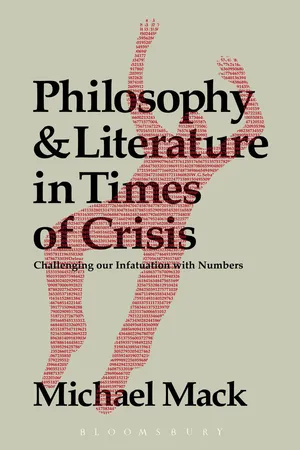
Highlighting literature and philosophy's potential impact on economics, health care, bioethics, public policy and theology, this book analyses the heuristic value of fiction.
It alerts us to how we risk succumbing to the deceptions of fiction in our everyday lives, because fictional representations constantly feign to be of the real and claim a reality of their own. Philosophy and literature disclose how the substantive sphere of social, economic and medical practice is sometimes driven and shaped by the affect-ridden and subjective. Analysing a wide range of literature-from Augustine, Shakespeare, Spinoza and Deleuze to Kafka, Sylvia Plath, Philip Roth, W. G. Sebald and Jonathan Littell-Michael Mack rethinks ethical attitudes towards the long or eternal life. In so doing he shows how philosophy and literature turn representation against itself to expose the hollowness of theologically grand concepts that govern our secular approach towards ethics, economics and medicine. Philosophy and literature help us resist our current infatuation with numbers and the numerical and contribute towards a future politics that is at once singular and diverse.
eBook - ePub
Philosophy and Literature in Times of Crisis
Challenging our Infatuation with Numbers
- 240 pages
- English
- ePUB (mobile friendly)
- Available on iOS & Android
eBook - ePub
About this book
Information
1
What Is It about Numbers?
INTO LIFE
closing words of Franz Rosenzweig’s The Star of Redemption
At a time of rising inequality, the marketization of everything means that people of affluence and people of modest means lead increasingly separate lives. We live and work and shop and play in different places. Our children go to different schools. You might call it the skyboxification of American life. It’s not good for democracy, nor is it a satisfying way to live.
Michael J. Sandel, What Money Can’t Buy
Our infatuation with numbers: Snow’s Two Cultures meets Lyotard’s The Postmodern Condition
Speaking of ‘the turn to affect’ we may describe the structure of feeling that we inhabit in the first decades of the twenty-first century. The term ‘turn to affect’ does not necessarily proclaim the overcoming of modernism or postmodernism. It merely signals a certain time-lapse or change in society at large. Strikingly, the divide between two cultures, between nature and society, between science and politics is constitutive of modernity’s consciousness. According to Bruno Latour, we have never been modern for the reason that the modern purification project – premised as it is on the radical separation between nature and society – has actually never been put to practice nor could it have ever been realized and because these nominally separated spheres are actually similarly constituted and in need of mediation. The project of modernity obfuscates or even denies the existence of subjectivity and the invisible. Deepening and developing Latour’s thesis, modernity could be defined as the unconscious of the invisible, as the unconscious of affect.
Postmodernism recognizes that there is something wrong with the modern insistence on objectivity and visibility, but it abstains from further commitments that would investigate modernity’s unconsciousness – which is the unconsciousness of affect and other forms of the non-measurable. As Latour put it, ‘Postmodernism is a symptom, not a fresh solution. It lives under the modern Constitution, but it no longer believes in the guarantees the Constitution offers.’1 Postmodernity’s non-commitment has also been called aloofness.
In this way Peter V. Zima has recently argued that indifference, or, in other words, a withdrawal of affect, characterizes postmodernism.2 Where postmodern art and culture remain aloof or cool, contemporary society seems to have fallen prey to various anxieties that grow out of an increasing sense of crisis, of instability and uncertainty. The recent financial crises and their implications for growing levels of anxiety in everyday life have led to a change in the structure of feeling.
Based on his reading of Spinoza’s Ethics, Lionel Trilling has distinguished between feeling and passion. The emotions form a substantial part of our mental life: ‘To us today, mind must inevitably seem to be a poor gray thing, for it always sought to detach itself from the passions (not from the emotions, Spinoza said and explained the difference) and from the conditions of time and place.’3 As will be discussed in the closing section of this chapter, literature engages with a realm beyond numbers. It is the sphere of feeling that cannot be measured. This immeasurable aspect of our life nevertheless constitutes a substantial part of the human mind and we cannot wish it away as C. P. Snow has famously done in his Rede lecture on the Two Cultures. This lecture and its postmodern variation will be the subject of critical engagement in the first section of this chapter. In the wake of the collapse of the supposedly ordered and predictable economic measurements, Trilling’s concern with our emotive and immeasurable sense of humanity has returned with new force in the form of affect studies.
As part of a contemporary change in the structure of feeling, we are becoming gradually more aware of the precarious foundations of life. Judith Butler has turned her attention to what it means to live precariously. Part of this recent preoccupation with the precarious is a re-discovery of care rather than postmodern indifference and aloofness. Lauren Berlant – a leading thinker of contemporary affect theory – has thus argued for a new aesthetics that does justice to what she calls crisis ordinariness, which characterizes life in the early twenty-first century.
Against this background, this chapter establishes the economic and cultural break of contemporary society with various optimistic beliefs in economic and scientific improvements, which has characterized not only modern but also postmodern theory. Previously, critics have argued that Lyotard’s famous The Postmodern Condition critiques a modern scientific and economic paradigm (this critique was seen to be part of Lyotard’s postmodernism). This chapter shows that the opposite is in fact the case: Lyotard radicalizes C. P. Snow’s plea for the public implementation of an economic paradigm while abandoning Snow’s modernist trust in the egalitarian benefit derived from science and economics. Lyotard embraces the computerization of society, which promises economic growth in developed societies. As Fredric Jameson has put it this pre-occupation with computers and economic processes led to ‘the eclipse of all of the affect (depth, anxiety, terror, the emotions of the monumental) that marked high modernism and its replacement by what Coleridge would have called fancy or Schiller aesthetic play, a commitment to surface and to the superficial in all the senses of the word’.4 Contemporary aesthetics departs from the superficial aloofness with which Lyotard celebrates the death of narratives. The public resurgence of anxiety in the face of current financial crises has shifted attention away from the superficial to the affective.
There are multiple causes for anxiety: economic crises, the growing divide between rich and poor, looming ecological catastrophes, rapid changes in techno-scientific products as well as paradigms, a shrinking of public funds for basic public requirements in education, research, medicine and security. These causes of anxiety have an economic ingredient in common. Consider the ecological crisis: it is at once a scientific issue (climate change) and an economic one (how to manage growth with limited natural resources?). Within this scientific-economic context, the humanities and arts have increasingly been pushed to the margins. They have almost disappeared from socio-political discussions and decisions that concern the public state of well being. Politicians seem to have downgraded the social role of creativity. Political discourse has relegated creativity to the status of a luxury we have to do without in a new world order where survival is premised on the economic application of already-created scientific goods and technological services – this is certainly true of the current UK government who has recently refused to fund the teaching of humanities and arts subjects at UK universities.
As has been discussed in the introduction, my notion of literature is broad, denoting creativity in a wide range of fields, which encompass the arts, humanities and sciences. Scientific inquiry certainly depends on creativity too. The arts and humanities have been charged as the main culprits of uselessness and being useless has almost become a synonym for being creative. The so-called ‘useless’ or creative aspect of both the sciences and the arts resides i...
Table of contents
- Cover
- Halftitle Page
- Title Page
- Dedication Page
- Contents
- Acknowledgements
- Introduction: Objects and Numbers – Our Current Infatuation
- 1. What Is It about Numbers?
- 2. Playing the Numbers: Ethics and Economics
- 3. Certainty and the Predictability of Numbers: The Question of Literary Ethics
- 4. A Disenchantment with Numbers: Philosophy and Literature
- 5. Medicine and the Limits of Numbers
- 6. Towards a Numerical Ambiguity
- 7. Conclusion: From Numbers to the Individual – A New Ethics of Subjectivity
- Index
- Imprint
Trusted by 375,005 students
Access to over 1.5 million titles for a fair monthly price.
Study more efficiently using our study tools.
Frequently asked questions
Yes, you can cancel anytime from the Subscription tab in your account settings on the Perlego website. Your subscription will stay active until the end of your current billing period. Learn how to cancel your subscription
No, books cannot be downloaded as external files, such as PDFs, for use outside of Perlego. However, you can download books within the Perlego app for offline reading on mobile or tablet. Learn how to download books offline
Perlego offers two plans: Essential and Complete
- Essential is ideal for learners and professionals who enjoy exploring a wide range of subjects. Access the Essential Library with 800,000+ trusted titles and best-sellers across business, personal growth, and the humanities. Includes unlimited reading time and Standard Read Aloud voice.
- Complete: Perfect for advanced learners and researchers needing full, unrestricted access. Unlock 1.5M+ books across hundreds of subjects, including academic and specialized titles. The Complete Plan also includes advanced features like Premium Read Aloud and Research Assistant.
We are an online textbook subscription service, where you can get access to an entire online library for less than the price of a single book per month. With over 1.5 million books across 990+ topics, we’ve got you covered! Learn about our mission
Look out for the read-aloud symbol on your next book to see if you can listen to it. The read-aloud tool reads text aloud for you, highlighting the text as it is being read. You can pause it, speed it up and slow it down. Learn more about Read Aloud
Yes! You can use the Perlego app on both iOS and Android devices to read anytime, anywhere — even offline. Perfect for commutes or when you’re on the go.
Please note we cannot support devices running on iOS 13 and Android 7 or earlier. Learn more about using the app
Please note we cannot support devices running on iOS 13 and Android 7 or earlier. Learn more about using the app
Yes, you can access Philosophy and Literature in Times of Crisis by Michael Mack in PDF and/or ePUB format, as well as other popular books in Letteratura & Critica letteraria. We have over 1.5 million books available in our catalogue for you to explore.