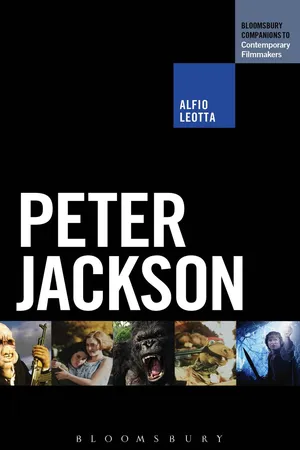
Peter Jackson is one of the most acclaimed and influential contemporary film-makers. This is the first book to combine the examination of Jackson's career with an in-depth critical analysis of his films, thus providing readers with the most comprehensive study of the New Zealand film-maker's body of work. The first section of the book concentrates on Jackson's biography, surveying the evolution of his career from the director of cult slapstick movies such as Meet the Feebles (1989) and Braindead (1992) to an entrepreneur responsible for the foundation of companies such as Wingnut Films and Weta Workshop, and finally to producer and director of mega blockbuster projects such as The Lord of the Rings (2001-2003) and The Hobbit (2012-2013).
The book further examines Jackson's work at the level of production, reception and textuality, along with key collaborative relationships and significant themes associated with Jackson's films. The examination of Peter Jackson's work and career ties into significant academic debates, including the relationship between national cinema and global Hollywood; the global dispersal of film production; the relationship between film authorship and industrial modes of production; the impact of the creative industries on the construction of national identity; and new developments in film technology.
- 288 pages
- English
- ePUB (mobile friendly)
- Available on iOS & Android
eBook - ePub
Peter Jackson
About this book
Information
1
The Cinema of Peter Jackson
Biography
The early years
Sir Peter Robert Jackson (ONZ KNZ) was born on 31 October 1961, Halloween night, in Wellington, New Zealand. Promotional material about Jackson’s films has often emphasized how his birthdate is particularly fitting, given his love of horror, blood and monsters. Jackson grew up in the small seaside community of Pukerua Bay, forty minutes north of Wellington. Like many other Britons, his parents, Bill and Joan Jackson, had migrated from England to New Zealand after the war. Bill had served in the British Army during the Siege of Malta, while Joan had worked at DeHavilland’s aircraft factory building Mosquito fast bombers. In his official biography Jackson recalled how his childhood was marked by his parents’ tales about the Second World War, which had represented a dominant part of their lives (Sibley 2006, 9). In 1954, shortly after marrying Joan, Bill found a job as a clerk for the Wellington City Council, where he would work until retirement. Following Peter’s birth, doctors advised Joan against having a second child due to her fragile health (Pryor 2003, 25). Later in life, Jackson claimed that his upbringing contributed to excite his imagination:
Being an only child does make you more imaginative, I think, because you have to create your own games by yourself with whatever props come to hand – Matchbox toys and building blocks and that sort of carry on. You don’t have anybody else to bounce off, so you’re creating it in your head. I think it certainly helps exercise the mind. It trains you to be imaginative. (Jackson cited in Pryor 2003, 25)
Another major influence on Jackson’s future film-making career was television. According to Jackson, movie-going was not a common activity in his family during his early childhood. By contrast, it was the television set, which entered Jackson’s life in 1965, that sparked his interest in moving images, storytelling and fantasy. Bill Jackson was a fan of old silent comedies, and through him, Peter was exposed to Buster Keaton, who in turn influenced his love for slapstick comedy (see A–Z: Splatstick). According to Jackson, however, the most influential TV programme he watched during his childhood was a British sci-fi puppet series: Thunderbirds. The show, which first aired in 1965, was created by pioneer puppet film maker Gerry Anderson, using a combination of marionette puppetry and scale model special effects. Thunderbirds followed the adventures of International Rescue, a team of action heroes operating from a secret base in the South Pacific Ocean. The protagonists were assisted in their missions by Thunderbirds machines, technologically advanced land, sea, air and space rescue vehicles. Thunderbirds played a crucial role in developing Jackson’s love for model making and storytelling:
I remember wanting to make models of the Thunderbirds crafts and buying plastic clip-together model kits that were around at the time and which I incorporated into my games. Like lots of kids, I had Matchbox toys of various vehicles and I created International-Rescue-style scenarios in the garden [. . .]. Setting up those little backyard dramas with my toys was when ‘special-effects’ really entered my awareness. (Jackson cited in Sibley 2006, 19)
Jackson was a devoted fan of Thunderbirds, and later in his career he would support Pukeko Pictures (a Weta offshoot) in their bid to remake the original TV series using both computer-generated imagery (CGI) and live action model sets (Wannan 2013).
Around 1969, a family friend, Jean Watson, who worked at the local Kodak processing lab, purchased a Super 8 movie camera for Peter’s parents who intended to record important events in their son’s childhood (Sibley 2006, 19). The young Peter, however, soon became the main user of this device. According to his mother, Joan, ‘as soon as it came into the house, that started Peter off’ (Joan Jackson cited in Pryor 2003, 26). Jackson’s early experiments with the Super 8 camera involved the disappearance of a cat in a puff of smoke and the making of a war movie featuring some of his friends in the family back garden. Around 1970, shortly after the beginning of his film experiments, Jackson watched the original version of King Kong (Cooper 1933) on television. The film made a profound impression on him (see A–Z: King Kong), and later in life, Jackson credited it as the main reason behind his decision to become a film maker: ‘I saw King Kong and the gorilla really sealed my destiny’ (Jackson cited in Sibley 2006, 21). Merian C. Cooper’s film also inspired Jackson to create his own special effects and develop more sophisticated film projects: after watching the film, Jackson decided to remake King Kong using his own stop motion puppets of the giant ape and various other monsters (see A–Z: Special Effects).
During his early life, Jackson was also exposed to other influential TV shows such as Monty Python’s Flying Circus, a 1969 British programme characterized by satire and subversive, surreal humour. Monty Python would inspire Jackson’s love for dark comedy that characterizes most of his oeuvre, including some of his early amateur projects. Television allowed Jackson to watch other film classics such as Planet of the Apes (Schaffner 1968), The 7th Voyage of Sinbad (Juran 1958) and Jason and the Argonauts (Chaffey 1963). In the early 1970s, Jackson, now in his teens, began broadening his knowledge of film with books and magazines about movies and moviemakers. During his high school years at Kapiti College, Jackson met other young students like Ken Hammon, who shared his passion for cinema. Both boys had projectors and regularly purchased 8 mm copies of various film classics such as King Kong and Nosferatu (Murnau 1922). Often, Jackson and his friends would hire 8 mm versions of British and American horror films such as Dr Terror’s House of Horrors (a 1965 movie directed by Freddie Francis featuring Peter Cushing and Christopher Lee) and Tobe Hooper’s The Texas Chain Saw Massacre (1974), which furthered Jackson’s fascination with gore and horror (Sibley 2006, 30). In his teenage years, Jackson also began travelling into Wellington to watch the latest movie releases. During the 1970s, Jackson saw several war movies, which influenced his fondness for spectacular battle sequences. Jackson was particularly impressed by Waterloo, a 1970 Russian film directed by Sergei Bondarchuk, which used 20,000 extras to recreate the battle of Waterloo between Napoleon Bonaparte and the Duke of Wellington. Referring to Jackson’s early cinematic passions, childhood friend Ken Hammon claimed that: ‘Pete adored the wide-screen, three hour historical epics that proliferated in the Fifties and early Sixties: Quo Vadis, Spartacus, El Cid, The Fall of the Roman Empire and the like’ (Hammon cited in Sibley 2006, 32). The style and content of these films informed Jackson’s future work, particularly the spectacular battle sequences in the LOTR and The Hobbit trilogies.
In 1978, Ken Hammon and other friends helped Jackson in making The Valley, a short fantasy film conceived for a film competition run by a New Zealand TV show. The film, which featured remarkable stop motion animation sequences, won some minor prizes and was broadcast on national television. The Valley also impressed the school’s principal, who offered Jackson and his friends the possibility of making an official promotional film about Kapiti College on the condition that they would return to school for a further year. Jackson, however, declined the offer as he had already passed his school certificate and was not interested in pursuing further studies (Sibley 2006, 41).
Jackson intended to find a job as a special effects developer in the local film industry; however, in 1970s’ New Zealand, opportunities in this sector were extremely scarce (see Chapter 3). Film production in the country was very limited, and although the New Zealand Film Commission, a government-funded institution responsible for supporting the making of local feature films, was established in 1978, it would take several years for the local film industry to fully develop. When Jackson graduated from high school, the only major production company in the country was the National Film Unit, a government body established in 1941 that produced mainly documentaries and promotional films. Shortly after leaving school, Jackson’s parents contacted the National Film Unit and arranged a job interview for Peter. Despite being impressed by his models, the managers of the Film Unit were unable to offer Jackson a position related to special effects (Pryor 2003, 35). After this rejection, Jackson decided to find a temporary job that would allow him to independently pursue his passion for film making. Only a few days after the interview at the National Film Unit, Jackson found a job as photoengraver at The Evening Post, a local newspaper. Jackson’s day-job salary financially supported his film experiments, and during this period, he began working on several projects inspired by genre movies such as the James Bond film franchise, and the Hammer Horror movies. The technological limitations of Jackson’s Super 8 camera, however, meant that none of these film projects was ever completed.
In 1982, Jackson and Ken Hammon took a three-week trip to Hollywood where they visited a sci-fi convention, local movie theatres and Disneyland. The Hollywood trip strengthened Jackson’s film-making ambitions and shortly after his return to Wellington he purchased a $2,500 16 mm camera with a loan from his parents. Referring to the crucial role played by his parents in supporting his passion for film making, Jackson said: ‘that kind of support from your parents is so important, and that loan was the most significant thing my mum and dad did to help me become a film-maker’ (Jackson cited in Sibley 2006, 69).
The new Bolex camera, which allowed Jackson to shoot up to thirty seconds of 16 mm footage at the time, represented a significant step up from his old Super 8. The new camera produced professional results; however, it also involved a more serious financial commitment: while three minutes of Super 8 film costed around $3, the equivalent amount of 16 mm film required around $100 (Sibley 2006, 70). Jackson decided to maximize the use of film by abandoning fruitless experiments and focusing on the production of a ten-minute film to enter in the festival circuit. In 1983, Jackson began working on Roast of the Day, a horror short film that would eventually become his first feature: Bad Taste (see A–Z: Bad Taste). The film, which had no script, was shot at weekends with the help of a small group of friends and was funded by Jackson’s job as a photoengraver. Jackson – who directed the film, built the equipment and created the make-up and special effects – applied several times for funding from the newly established Film Commission. Despite the Commission’s declining his grant applications and various drawbacks associated with the departure of some cast members, Jackson persevered, cumulating dozens of minutes of footage. In 1986, while creating props for a New Zealand TV show, Worzel Gummidge Downunder (1986–1989), Jackson met Costa Botes, a local critic and director who introduced him to several film makers, including a young screenwriter called Frances Walsh, who would later become Jackson’s life partner (Botes 2014). Encouraged by Botes, Jackson showed some Bad Taste footage to the CEO of the Film Commission, Jim Booth, who, impressed by the quality of the film, decided to grant some funding to complete principal photography and post-production. The making of the film was documented in Good Taste Made Bad Taste (1988), a film directed by Tony Hiles, who also acted as production supervisor for Jackson’s movie on behalf of the Film Commission. In 1987, after four years of filming, Bad Taste was screened in the market at the Cannes Film Festival where it was received positively and sold to several international markets, thereby making a significant profit (Shelton 2005, 90).
After the success of Bad Taste, Jackson was in a better position to secure financial backing to make his second feature film. After completing Bad Taste, the Wellington director started working with Fran Walsh and Stephen Sinclair on the development of a script for a zombie film variously titled House Bound or Braindead. In their original proposal to the Film Commission, the screenwriters described the film as ‘a tongue-in-cheek zombie genre movie’ that would achieve ‘that combination of gore and humour which was foreshadowed in Bad Taste, but this time with a script and the backup of a small professional crew’ (Sibley 2006, 155).
In 1988, the New Zealand Film Commission invited Hollywood screenwriting consultant Robert McKee to Wellington to deliver a three-day seminar on story structure. Jackson, Sinclair and Walsh, who all attended the seminar, were deeply influenced by the storytelling principles and techniques outlined by McKee. Later, Jackson admitted that McKee’s seminar played a crucial role in his career as he applied his principles of story structure to his future films, including LOTR (Sibley 2006, 158).
During this period, Jackson’s career was characterized by a number of other significant developments. Yearning to be involved in the more creative aspects of film making, Jim Booth, the CEO of the New Zealand Film Commission, resigned from his job to set up his own company and become Jackson’s producer. Booth’s insightful knowledge of the national film industry and of the international market represented a significant asset for Jackson: ‘I think Jim [Booth] gave Peter a huge amount of encouragement and confidence [. . .]. [Booth] enabled Peter to focus on what he wanted to achieve without having to worry about the mechanics involved’ (Shelton cited in Sibley 2006, 161). During the pre-production for Braindead, Jackson also began his professional relationship with two young special effects creators, Richard Taylor and Tania Rodger, who would later become the co-founders of Weta.
Despite the establishment of important professional collaborations, Jackson still had to face significant obstacles: just six weeks before principal photography for Braindead was scheduled to start, one of the main investors withdrew forcing Jackson to revive an older project. While seeking funding for Braindead, Jackson and his collaborators began working on Meet the Feebles, a dark comedy which followed behind the scenes of a troupe of puppets rehearsing for a TV show. The film, which was clearly inspired by the Muppet Show (1976–1981), featured graphic violence, sex, drug addiction and mass murder, and cemented Jackson’s cult reputation as Kiwi ‘splattermeister’.
Following the release of Bad Taste and Meet the Feebles, Jackson’s name reached Hollywood where he met Peter Nelson, an entertainment lawyer who in turn introduced him to several American studio executives. In the early 1990s, Jackson met Mark Ordeski, a representative of New Line Cinema, and showed him the script for a fantasy epic called Blubberhead. Co-written with Danny Mulheron, the film treatment brought together Jackson’s interest in stop motion animation, fantasy and Monty Pythonesque humour. Jackson, who hoped to make use of New Zealand landscapes, claimed that the film would appeal to both children and adults: ‘it has another edge to it that goes over children’s heads a bit. It’s action packed and a real rollercoaster ride’ (Jackson cited in Pryor 2003, 337). New Line refused to produce the film, but hired Jackson to write the script for one of the instalments of the Nightmare on Elm Street franchise. Although Jackson held numerous meetings with the producers who were impressed by his work, New Line Cinema eventually chose a different screenplay.
Meanwhile, Jim Booth had managed to secure funding to make Braindead, with filming scheduled to start in late 1991. Braindead benefitted from a much larger budget compared to Bad Taste and Meet the Feebles, and according to film critic Matthew Stephenson, it was ‘a much sturdier and more focused piece of film-making than anything attempted by Jackson before’ (Stephenson 2008). Braindead followed the protagonist’s attempt to stop a zombie epidemic and featured some of the goriest sequences in the history of cinema. It was reported that the film’s finale contained dozens of special effects and approximately 300 litres of fake blood (Sibley 2006, 85). The production of Braindead reinforced some of Jackson’s established collaborative relationships (with Fran Walsh, Richard Taylor, Tania Rodger and Jamie Selkirk, who had edited Bad Taste and Meet the Feebles) and represented the beginning of new ones (with story-boarder Christian Rivers and actor Jed Brophy).
Braindead proved to be an international success and the period that followed represented an important transition moment for Jackson’s career. Shortly after the release of the film, Jackson hired a Hollywood agent, Ken Kamins, who a few years later would play an important role in the negotiations for the production of LOTR. Jackson’s Hollywood connections, however, did not lure him away from Wellington. Unlike many other New Zealand film makers, who would leave their home country to pursue a better career in Australia, Britain or Hollywood, Jackson decided to stay in Wellington. Referring to his decision to work in New Zealand, Jackson claimed: ‘I figured I want to stay here, and make films now and again. So why not buy one of these old warehouses – and right now it’s a great buyers’ market for old warehouses – and just call it home’ (Jackson cited in Pryor 2003, 178). In 1993, Jackson laid the foundation of his empire by purchasing an old warehouse, now known as Camperdown Studios, in the industrial suburb of Miramar. Short...
Table of contents
- Cover
- Halftitle Page
- Title Page
- Contents
- Preface
- Acknowledgments
- 1. The Cinema of Peter Jackson
- 2. Collaborative Relationships
- 3. Peter Jackson, Wellywood and the Global Dispersal of Film Production
- 4. From Kaihoro to Middle Earth: The Imaginary Geography of Peter Jackson’s Film Landscapes
- A–Z Films/Themes/Key Concepts
- Appendix 1: Filmography
- Appendix 2: Selected Bibliography
- Works Cited
- Index
- Imprint
Trusted by 375,005 students
Access to over 1.5 million titles for a fair monthly price.
Study more efficiently using our study tools.
Frequently asked questions
Yes, you can cancel anytime from the Subscription tab in your account settings on the Perlego website. Your subscription will stay active until the end of your current billing period. Learn how to cancel your subscription
No, books cannot be downloaded as external files, such as PDFs, for use outside of Perlego. However, you can download books within the Perlego app for offline reading on mobile or tablet. Learn how to download books offline
Perlego offers two plans: Essential and Complete
- Essential is ideal for learners and professionals who enjoy exploring a wide range of subjects. Access the Essential Library with 800,000+ trusted titles and best-sellers across business, personal growth, and the humanities. Includes unlimited reading time and Standard Read Aloud voice.
- Complete: Perfect for advanced learners and researchers needing full, unrestricted access. Unlock 1.5M+ books across hundreds of subjects, including academic and specialized titles. The Complete Plan also includes advanced features like Premium Read Aloud and Research Assistant.
We are an online textbook subscription service, where you can get access to an entire online library for less than the price of a single book per month. With over 1.5 million books across 990+ topics, we’ve got you covered! Learn about our mission
Look out for the read-aloud symbol on your next book to see if you can listen to it. The read-aloud tool reads text aloud for you, highlighting the text as it is being read. You can pause it, speed it up and slow it down. Learn more about Read Aloud
Yes! You can use the Perlego app on both iOS and Android devices to read anytime, anywhere — even offline. Perfect for commutes or when you’re on the go.
Please note we cannot support devices running on iOS 13 and Android 7 or earlier. Learn more about using the app
Please note we cannot support devices running on iOS 13 and Android 7 or earlier. Learn more about using the app
Yes, you can access Peter Jackson by Alfio Leotta in PDF and/or ePUB format, as well as other popular books in Media & Performing Arts & Film Direction & Production. We have over 1.5 million books available in our catalogue for you to explore.