This is the first book to comprehensively examine the shifts that have informed republican tradition and transformation from the beginning of the "Troubles" in Northern Ireland until the final stages of the peace process. Using a combination of empirical research and literature, the book addresses Northern Irish republican identity through the influences of imagination, history and Catholicism before it charts the processes of decision-making and management that shaped the transition from militarism to politics. Drawing from interview material from a wide range of actors and key players the book considers the challenges that political republicanism has worked to overcome and concludes that ongoing political development will require a less acute, more ambiguous communication of values based on pragmatism and compromise, rather than the continued articulation of principles and convictions that sustained the armed struggle.
A unique work, From Armed Struggle to Political Struggle is essential for students and researchers in Irish politics, conflict resolution, and security studies
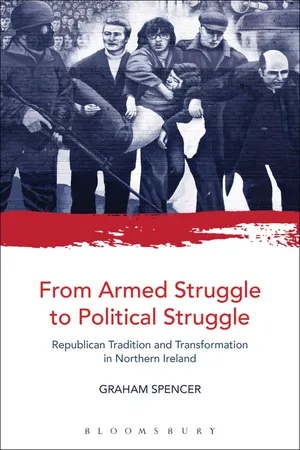
eBook - ePub
From Armed Struggle to Political Struggle
Republican Tradition and Transformation in Northern Ireland
- 288 pages
- English
- ePUB (mobile friendly)
- Available on iOS & Android
eBook - ePub
From Armed Struggle to Political Struggle
Republican Tradition and Transformation in Northern Ireland
About this book
Information
CHAPTER ONE
Imagination
Myth
In his examination of the Irish mind, Kearney points towards a kind of ‘double vision’ which emerges in response to definitions of what Ireland is. The history and culture of that Ireland, Kearney argues, is one of ‘dislocation and incongruity’ (2006: 21), and it is the tension between these two conditions which is seen to shape Irish identity. Kearney’s proposition finds some parallel with James Joyce who, in his observation of how nationalist political thinking worked in Ireland, noted a similar ‘double struggle’ at work between an emphasis on the external colonizer of Britain alongside varying strands of nationalism from constitutional to insurgent forces. (Gibbons 1992: 370). More widely, this double struggle is seen to derive from a heritage ‘mixture of poor realities and grand dreams’ (Toibin 1999) sustained by discourse and language which function as ‘weapon, dissemblance, seduction, apologia – anything, in fact, but representational’ in clarity of form (Eagleton quoted in Toibin 1999: ix). From this perspective, Irish identity is a fusion of contested ideals about what the nation means, framed by a consensus about the British presence and its coercive history.
Much of Irish history is shaped by an eschatological appeal and not just in relation to the external colonizer but in terms of the tension between individual freedom and institutional authority (exemplified by the connection between Church and state). In this relationship, as Toibin notes, the individual is seen as a ‘tragic hero’ who ‘is broken by the society he lives in’, where instead of social cohesion around grand themes and narratives, personal sacrifice becomes general sacrifice (1999: x), and where the Irish past is a product of ‘the idea of history as unfinished business, the idea of the disposed locals lying in wait, impelled by the wrongs done to their ancestors, the idea that the crimes committed by the settlers still hang in the air’ (1999: xvi). This identity is one of concern with the myths that shape the Irish condition, but one which ultimately finds shared meaning in that which is missing, denied or imposed (Toibin 1999: xvii). Rather than viewing this imagination as inherited (through an innate Irish worldview) or imposed (through the tensions of the Anglo-Irish relationship), Irish identity might be seen more as a work in progress (Kearney 2006: 21), a tension between what Ireland is and what it isn’t in response to the impact of historical and cultural change rather than some definitive account of Irish identity. What Toibin suggests is that the desire for release from the external colonizer is parallel to the desire to be released from institutional control, where denial has been absorbed into everyday lives and incompleteness has become integral to the Irish condition. The struggle to find meaning against this backdrop, as Seamus Deane reminds us, imbues nationalistic ethos with expectations of recovery. This recovery implies a narrative arc (a journey) which is both about what has been denied (invariably by external repression and coercion) and what must be regained (through the variations of Irish and national political emphasis), and it is in this landscape that the Irish mind emerges as a disputed process of political, social and religious meaning where identity is influenced as much by the conflicts within its borders (the self) as the conflicts with those outside of those borders (the other). The potential disconnect of the double vision can be seen as a dilemma with regard to what one believes alongside what one wants to be. Kearney’s dislocation and incongruity analogy has a wider purpose, however, in that the Irish mind appears to be searching for some degree of stability against a cultural and social ground of instability and against a landscape of divisions, contradictions and shifting tensions which frame what it meansto be Irish.
By using allegory and history to promote varying concepts of nationalist appeal and using constitutional politics or violence to justify differences about history and change, the Irish nationalist vision is a product of division which hinders any agreed articulation about national identity and progress (Gibbons 1992: 359). This internal conflict has also been historically affected by the institutional power of the Catholic Church which sought to undermine revolutionary nationalism from developing into a force that would challenge Catholic authority. This absence of an agreed, organizing centre beyond Catholicism acted as a barrier for the development of later socialist ideals which advocated overthrowing centralized power and the state (Gibbons 1992: 362). What did offer a galvanizing influence for nationalism however was the presence of the British, but it was more specifically the English which enabled the coalescence of nationalist sentiment to take shape (Gibbons 1992: 363). It was this external enemy which gave direction and energy to internal demands for nationalist expression, and it was the presence of colonial domination which underpinned arguments for Irish independence around which different nationalist ideals could congregate. The colonial presence then enabled differences within the Irish imagination to find some common point of reference which internally was lacking. Identity became increasingly preoccupied with that which was without rather than within and tended to use the external influence as a locus for national meaning and self-definition.
The narrative arc which depicts national identity as a transformative struggle takes early influence from the allegorical Ireland, where ‘visionary poetry and ballads’ were used to promise ‘apocalyptic deliverance’ from disaster such as the land confiscations conducted in the early period (Gibbons 1992: 366). Memories of the dead from holy wars promoted the trauma of loss and personified this experience through the defiled woman, seduced and then abandoned; a woman seen to exist as the peasant mother caught up with the undisclosed intentions of a seductive civilizing (colonizing) other (Gibbons 1992: 369). The personalization of invasion, repression and guilt through the metaphor of the female as the pillaged land, as Edna O’Brien argues, has augmented perceptions of defilement and impoverishment: ‘Ireland has always been a woman, a womb, a cave, a cow, a Rosaleen, a sow, a bride, a harlot’ (1976: 11). For O’Brien ‘The children inherit a trinity of guilts: the guilt for Christ’s Passion and Crucifixion, the guilt for the plundered land, and the furtive guilt for the mother frequently defiled by the insatiable father’ (O’Brien 1976: 19).
This emphasis on Ireland, where the land (rather than people) is idealized as the female archetype (Hill 1977), infused the rhetoric of republican leaders such as Patrick Pearse who, in his reflections on Irish identity, mused that in understanding Ireland the people had ‘to read the lineaments of her face, to understand the accents of her voice; to re-possess ourselves, disinherited as we were, of her spirit and mind’ (1922: 93). For Pearse, Irish independence meant defending ‘a man’s love for the place where his mother bore him, for the breast that gave him suck, for the voices of children that sounded in a house now silent’ (1922: 81), and his plea to Irish mothers was to bear the sacrifices that would need to be made in the fight for independence (Pearse 1922: 85), a fight where ‘Ireland must be herself; not merely a free self-governing state, but authentically the Irish nation bearing all the majestic marks of her nationhood’ (Pearse 1922: 304).
As an indication of the historical power and influence of myths, it is interesting to see how images and narratives of the female in Ireland drew from Celtic tradition (where storytelling fused myth, legend and history and where Ireland was a place of heroic battles, intense passion, warrior aspirations and where gods were part of everyday life (Gantz 1981)) where land was conceptualized in the form of a woman whose youthful femininity became ‘the sovereignty of Ireland’ (Mac Cana 1980: 521). The female was associated with natural forces, fertility and (re)birth and Celtic myths perpetuated the symbol of the ‘sovereignty goddess and the symbol of the land of Eire’ (Ni Bhrolchain 1980: 531). (The Poor Old Women is the traditional name for Ireland (Deane 1997: 19).) The image of fertility and growth and purification against evil spirits in the Celtic tradition imbued goddesses with supernatural and magical powers and provided metaphors which contributed to dreams and utopian visions. Significantly, fertility was seen as sacred, but it was the figure of Mary in the Catholic faith which also stood as the bridge between sacred and secular worlds, pointing towards the sinless image of womanhood whilst at the same time representing motherhood (Mac Curtain 1980: 541). The mother figure was a powerful symbol for republicans like Pearse who equated ‘the mother of an Irish nationalist with the Mother of Jesus at the foot of the Cross’ (Mac Curtain 1980: 542), linking the suffering of republicans through the symbols of motherhood and the dominant figure of Mary who mourned the death of Jesus and stood as a metaphor of loss, strength and pain.
Fellow republican James Connolly in 1908 also used the ‘Ireland as woman’ metaphor to incite rebellion against the repressive British whose ‘jaws are wet with the arm blood of the feast’ and where ‘For over a hundred years the majority of the Irish people begged for justice, and when ever and anon the hot blood of the best of her children would rise in rebellion at this mendicant posture Ireland turned her face from them and asked the enemy to forgive them. When her rebel sons and daughters were dead, hunted, imprisoned, hanged or exiled she would weep for them, pray for them, sigh for them, cry for them …’ (n.d: 74). The religious significance and resonance of sacrificial discourse can be seen in the modern period to make reference to women as pure, in contrast to the early period when a more liberal and less patronizing image of the female prevailed. Kearney relates this shift in tone to colonization where ‘women became as sexually intangible as the ideal of national sovereignty became politically intangible. Both became imaginary, aspirational, elusive’ (1997: 119). Myths of Ireland, according to Kearney, draw from images of sacrifice through a poetic overarching discourse. The role of the sacrifice and its relation to imagined renewal is seen to contribute to the poetical glorification of Ireland’s sacrificial sons and because of this intersects with notions of struggle and suffering in order for the Irish to ‘return to the security of their maternal origins: the mother church of Catholic revival; the motherland of national revival; and the mother tongue of Gaelic revival’ (Kearney 1997: 118). Kearney refers to the opening and closing statements of the Easter Proclamation of 1916 to demonstrate this myth further: ‘In the name of God and the dead generations from which she receives her old tradition of nationhood, Ireland, through us, summons her children to her flag and strikes for freedom’, and identifies how such rhetoric operates to connect ‘(i) the Catholic symbolism of mystical reunion with martyrs through the sacrifice of the Mass, and (ii) the mythological idea of Mother Ireland calling on her sons to shed their blood so that the nation can be restored after centuries of historical persecution’ (1997: 118).
The power of myths, as Armstrong points out, comes in particular from meaning that transcends everyday observable experience (2006: 2) and is preoccupied with the implications of death, with what lay beyond physical existence. As Armstrong puts it, ‘Many myths make no sense outside a liturgical drama that brings them to life, and are incomprehensible in a profane setting’ where ‘the most powerful myths are about extremity; they force us to go beyond our experience’ (2006: 3). But, the world which myth evokes, though concerned primarily with the unknown and though pointing to a world which remains beyond the everyday, also invites behaviour and moral conviction (as part of a utopian and ritualized vision) which is rooted in the divine, a world ‘which is richer, stronger and more enduring than our own’ (Armstrong 2006: 4–5). The appeal and power of myths connects with the hope and desire for a world that ‘points beyond human history to what is timeless in human existence, helping us to get beyond the chaotic flux of random events, and glimpse the core of reality’ (Armstrong 2006: 7) and so provides us with a glimpse of transcendent possibility. Myth then produces a conceptualization of worlds which expose the limits of the everyday and connects that everyday to a reality neither contained by time or the limits of rational understanding. Myth encourages one to see that death is the door to another higher realm, and that what one does in life is a preparation for reaching this realm; a world which is necessarily utopian and which cannot be proved (because it cannot be actual). It is a place where the individual is connected to meaning that is much bigger than aspirations in the lived world (which is self-evidently non-utopian) encouraging those who partake in myths to see themselves as part of a struggle for progress, as part of a process ‘which gives us hope, and compels us to live more fully’ (Armstrong 2006: 10) and which provides some way of addressing the fears and desires which permeate the human condition.
But the Celtic influence which gave foundation to the Irish imagination through myth also had a bigger purpose which was to function as a ‘cauldron’ that symbolised mystical energies and which presented a context and narrative about energy and motivation. For O’Driscoll, the Celtic consciousness derives from a recurring mythology where ‘the vessel is a symbol of the inexhaustible resources of the spirit, forever renewing itself, whether it be the hidden spirit that animates all matter, or, on modern psychological terms, an energy in the depths of the mind that, if developed, can free man from dependence on the body and the tyranny of historical fact’ (1981: xi). Through this consciousness one strives to reconcile the individual with the universal as part of a general tendency not to see opposites as contradictions, but as points of connection and where the soul moves towards transcendence. This state of consciousness is one which cannot be known through intellectual categorization (O’Driscoll 1981: xii) and is distinct from history and society, more a ‘spiritual rebirth’ where knowledge comes from the reconciliation of differences and where opposites are seen in terms of oneness. Here, the individual is not confined by the limitations and expectations of rational thought but invited to see the world as a sequence of variations shaped by metaphysical and mystical power. One can see the immediate Catholic implications of this worldview, where impressions are representative of other deeper impressions that are themselves representative of a spiritual order and where death is a higher realm than life, constrained as it is by biological determinants and finite possibilities. The afterlife, from the perspective of Celtic outlook, is part of a ‘communion between the living and the dead’ which is born from a tradition that presaged religious outlooks and is therefore part of a continuum which percolates and informs the Catholic impulse (O’Driscoll 1981: xvi).
The influences of the Celtic consciousness were especially influential on political thinking and can be observed in Pearse, who believed in striving for a state of perfection that honed ‘a more piercing vision’ which itself is ‘more humane, inspiration, above all a deeper spirituality’ (quoted in O’Driscoll 1981: xviii). The appeal of such a ‘piercing vision’ was a perception that also inspired the writing of those such as Yeats who similarly sought to draw from Celtic imagery to promulgate a deeper sense of historical belonging that positioned modern sensibility firmly in the imagined past: ‘the Irish nation’s insistence on developing its own culture by itself is not so much the demand of a young nation that wants to make good in the European concert as the demand of a very old nation to renew under new forms the glories of a past civilization’ (quoted in O’Driscoll 1981: xix).
Significantly, the influences of Celtic consciousness found expression through artistic reflection and Catholic experience, but it was the nationalist ambition which powerfully drew the artistic and the religious together by way of its emotive and dramatic emphasis on struggle and suffering. This is highlighted in Donoghue’s excellent essay on race, nation and state where the Celtic consciousness is strongly based on the notion of epic struggle (2011: 11). Notions of Celtic aspiration were crafted through narratives which were ‘quick to dream, and powerless to execute’, where ‘in external aspects and in moral history, the same tale is told – great things attempted, nothing done’ (quoted in Donoghue 2011: 14–15). The emergence of national consciousness in this context, as Donoghue reminds us, relied more on ‘a feeling of kinship’ and used the context of the family as a basis for categorizing who was accepted and acceptable and who was not (2011: 17). This idea of the nation as family (dysfunctional of otherwise), Donoghue contends, intensified the feelings of humiliation which derived from British power, and it was the intimacy provided by personalizing the nation which created a powerful focus for galvanising nationalistic belief and ambition (2011).
Donoghue particularly highlights how nationalist Ireland was shaped by literary and poetic expression, with Yeats an especially important figure in cultivating nationalistic awareness. Yeats was seen to cultivate an image of national awareness by drawing from historical myths and legendary stories about wandering, killing and fighting (Donoghue 2011: 18), using ‘sagas to appeal to unity of race as a force prior to historical divisions’ (Donoghue 2011: 19). Yeats thought of the Irish nation as a process, where people strove for self-expression and transformation, and he saw the poet as representative of that voice (Donoghue 2011). It was the poet who could give release to heroic and pagan impulses and who could encourage belief in magical forces that could be channelled into a unified sense of energy and purpose which evoked strong associations of memory through symbols (Donoghue 2011: 22). Yeats sought to collectivize the powerful influences of ‘ancestral memories, magic, the spiritus mundi, the summoning of a race to become a nation, the practice of an antinomian politics as cultural nationalism, the politics of difference, the tragic theatre, the sacred book of the arts’ in order to create an image and narrative of Ireland which stood apart from and superior to the scientific, restrictive and exploitative British presence (Donoghue 2011: 22–23) and used history of a powerful motivating imaginary to inspire nationalist goals. This was a nation (which Pearse notably used for inspiration) that was built less on actual events of history, and more on an idealised vision of Ireland (so more easily denigrated and exploited). But, such a nation was also a construction which invariably homogenised and failed to take account of divisions within Ireland itself. It was a representation, in other words, which was out of kilter with the political and social realities and complexities of what Ireland was.
Taking these mythological influences into consideration, Kearney reminds us that to discover the peculiarities of Irish identity and the divergences upon which identity is built, we would be well advised to look at Irish literature, since it is here, where dominant and peripheral narratives about what it means to be Irish, are most persuasively expressed and articulated. It is here, where the myths of hero, rebel and (dis)unity (Kearney 1985) inform the intellectual tradition (amongst other traits), and it is from these characterizations that modern social and political allegiances draw. It is also from the drama and emotion of the images produced that utopian ideas take form, making the journey and experience of suffering integral to identity and the path to a highly mythologized Ireland attractive. Such narratives, of course, illustrate a search for meaning, but in the process reveal a desire to address or question that which is lacking, and it is that which is lacking which highlights much about the search for identity and worth. As part of this search, the family becomes a particular interest for writers as well as how the impact of desire and love (invariably framed by expectations about marriage) exist alongside rigid social and religious convictions of what one should be (rather than what one is). On this, Enright asks, ‘Is choice a particularly Irish problem?’ and intimates that if it is, it probably relates to difficulties with shame and humiliation and ‘the problem of power’ (2010: xv). Enright appears to be on similar ground with Kearney here because what she observes in Irish literature is the dilemma of tensions between society and self, dilemmas which probably feed into political and social visions as much as individual worth and fear.
The search for Irishness has historically been preoccupied with martyrs (personal sacrifice for change) and metaphors (emotive devices by which to make sacrifice and the possibility of change seductive), both of which have been used as frameworks for dramatizing the struggle for national freedom and sovereignty (Toibin 1991: 45). The adaptation of these martyrs and metaphors points towards a struggle over belonging and place which is conceptualized through emotive association and the power of imagined futures that depend on constructing a past from which possible change offers comforting dislocation rather than feared abandonment. Because of fluidity between past and future, as Toibin notes, ‘there remains no fixed, formed place where one could stand and say: this is Ireland. There are so many versions of reality in this country, so many visions of where the centre of gravity lies’ (1991: 47). This is a society, he argues, ‘which is inexact, chaotic, defensive, nervous, only slowly beginning to form’ (1991: 48), and which historically has relied on mythic constructions to comprehend the realities (and possibilities) of social and political life.
The myth of martyrdom has been prominent in Irish identity and the importance of sacrifice is well explored by Kearney, who recognizes how the power of sacrificial myth derives from the expectation ‘that victory can only spring from defeat, and total rejuvenation of the community from the oblation of a chosen hero or heroic elite’ (2006: 36). With this emphasis, death is not seen as loss, but triumph, where for the dead ‘their deed is not buried with their bones but flows eternally from their graves and nourishes all those subsequent generations of martyrs who sacrifice themselves for an “enduring nation”’ (Kearney 1978b: 282). Martyrdom, then, constructs a collective memory of suffering where death is given more significance than life and where the utopia of what may be achieved in life can only come through death. And because of this, it is apparent that the myths which legitimate sacrifice can only be about what does not yet exist, and so, which can only reside in the imagination (since once this imagination becomes reality, the myths of utopia no longer have appeal). Kearney is surely right when he argues that the legitimacy of sacrifice relies on mythic constructions, not political reality, for such a reality exposes the illusion of utopianism and the impossibility of human perfection (1978b: 276). Moreover, political action can only give rise to temporary solutions t...
Table of contents
- Cover
- Halftitle Page
- Title Page
- Dedication Page
- Contents
- Acknowledgements
- Introduction
- 1. Imagination
- 2. History
- 3. Catholicism
- 4. Politics
- 5. Peace
- 6. Rebels and Reconciliation
- Conclusion
- Afterword
- List of Interviewees
- Bibliography
- Index
- Imprint
Trusted by 375,005 students
Access to over 1.5 million titles for a fair monthly price.
Study more efficiently using our study tools.
Frequently asked questions
Yes, you can cancel anytime from the Subscription tab in your account settings on the Perlego website. Your subscription will stay active until the end of your current billing period. Learn how to cancel your subscription
No, books cannot be downloaded as external files, such as PDFs, for use outside of Perlego. However, you can download books within the Perlego app for offline reading on mobile or tablet. Learn how to download books offline
Perlego offers two plans: Essential and Complete
- Essential is ideal for learners and professionals who enjoy exploring a wide range of subjects. Access the Essential Library with 800,000+ trusted titles and best-sellers across business, personal growth, and the humanities. Includes unlimited reading time and Standard Read Aloud voice.
- Complete: Perfect for advanced learners and researchers needing full, unrestricted access. Unlock 1.5M+ books across hundreds of subjects, including academic and specialized titles. The Complete Plan also includes advanced features like Premium Read Aloud and Research Assistant.
We are an online textbook subscription service, where you can get access to an entire online library for less than the price of a single book per month. With over 1.5 million books across 990+ topics, we’ve got you covered! Learn about our mission
Look out for the read-aloud symbol on your next book to see if you can listen to it. The read-aloud tool reads text aloud for you, highlighting the text as it is being read. You can pause it, speed it up and slow it down. Learn more about Read Aloud
Yes! You can use the Perlego app on both iOS and Android devices to read anytime, anywhere — even offline. Perfect for commutes or when you’re on the go.
Please note we cannot support devices running on iOS 13 and Android 7 or earlier. Learn more about using the app
Please note we cannot support devices running on iOS 13 and Android 7 or earlier. Learn more about using the app
Yes, you can access From Armed Struggle to Political Struggle by Graham Spencer in PDF and/or ePUB format, as well as other popular books in Politik & Internationale Beziehungen & Vergleichende Politikwissenschaften. We have over 1.5 million books available in our catalogue for you to explore.