- 280 pages
- English
- ePUB (mobile friendly)
- Available on iOS & Android
eBook - ePub
About this book
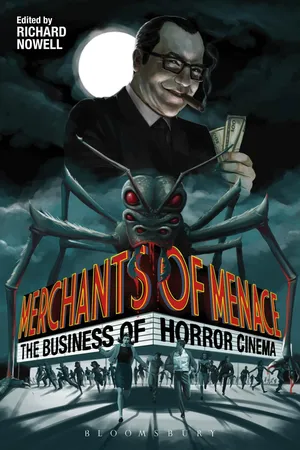
Even though horror has been a key component of media output for almost a century, the genre's industrial character remains under explored and poorly understood. Merchants of Menace: The Business of Horror Cinema responds to a major void in film history by shedding much-needed new light on the economic dimensions of one of the world's most enduring audiovisual forms. Given horror cuts across budgetary categories, industry sectors, national film cultures, and media, Merchants of Menace also promises to expand understandings of the economics of cinema generally. Covering 1930-present, this groundbreaking collection boasts fourteen original chapters from world-leading experts taking as their focus such diverse topics as early zombie pictures, post-WWII chillers, Civil Rights-Era marketing, Hollywood literary adaptations, Australian exploitation, "torture-porn" Auteurs, and twenty-first-century remakes.
Information
PART ONE
Production Lines, Trends, and Cycles
1
“House of Horrors”
Corporate Strategy at Universal Pictures in the 1930s
Kyle Edwards
In addition to the pursuit of profit—and control over their products and personnel, and the industrial conditions in which they operated—film companies operating during Hollywood’s classical era sought to develop a long-term presence in the industry, a recognizable public identity, and productive industrial relations, and to maximize efficiency. Their ability to achieve these goals depended on the formulation and execution of corporate strategy; that distinct pattern which provides “unity and coherence to the decision-making process” and “gives the firm its identity, its power to mobilize its strength, and its likelihood of success in the marketplace” (Andrews, 1980, p. 13). Strategy formalizes policy and operations, establishes consistency throughout an organization, and clarifies the relationship between day-to-day practices and the long-term goals of management (Besanko et al., 2004, p. 16). In so doing, it enables a company to adapt to “constantly changing business conditions” and, in select cases, to posit an identity that distinguishes the firm and its products from competitors and their output (ibid.).
During the classical period, film companies developed sophisticated corporate strategies that were built around their strengths and weaknesses, and their short- and long-term objectives (see e.g. Edwards, 2006, 2011; see also Christensen 2006, 2012). This chapter considers this phenomenon through an analysis of Universal Pictures’ early 1930s efforts to develop a corporate strategy around a series of modestly budgeted, sensationalistic horror films. For Universal, this production category represented a “core competence”—or, a “skill the corporation possesses that results in a sustainable competitive advantage” (Nordhielm, 2004, p. 15; see also Prahalad and Hamel, 1990)—that it would refine over the next few years, and through which it would build an identity as the paragon of horror, one that persists to the present day.
Accordingly, the first part of this chapter argues that Universal’s strategy provided a way to counteract the company’s deficiencies, to surmount financial obstacles, and to secure the attention of exhibitors and moviegoers. The second part focuses on the first of Universal’s horror films, Dracula (1931), showing that the company was drawn to the prestige and broad international appeal of this literary property, and that it pitched it to audiences on the allure of the evil Count. The third part argues that, with Frankenstein (1931), the first follow-up to Dracula, Universal developed discourses of quality around the property, thereby establishing transferable production and marketing models that it could apply to subsequent films. The final part examines Murders in the Rue Morgue (1932), The Black Cat (1934), and The Raven (1935), suggesting that these three films bear witness to the increased proficiency of Universal’s horror unit (i.e. evidence of its core competence), and the company’s desire to brand itself as the period’s premier “house of horrors” (see also Hirschhorn, 1983; Dick, 1997; Humphries, 2006; Spadoni, 2007).
This chapter therefore connects the production, content, and marketing of early sound-era horror to Universal Pictures’ commitment to its core competency and to branding exercises. In so doing, I hope to shed new light on the industrial forces that underpinned Universal’s contribution to the early development of this genre. In a more general sense, the chapter spotlights the extent to which a focus on the formulation and implementation of corporate strategy can help us to better understand the motives and actions of individual film companies, and therefore the underlying forces that help to shape film and media history.
Universal Pictures, Inc.
In 1912, the German émigré Carl Laemmle pioneered an early form of vertical integration when his firm, Universal Film Manufacturing Company, started to distribute and exhibit the short films it produced at its East Coast facilities. This company released its first feature-length film, Traffic in Souls, in 1913, the same year that it was renamed Universal Pictures, Inc., and two years before it relocated to a larger facility in North Hollywood (see e.g. Hirschhorn, 1983; Schatz, 2010). Despite the commercial success of Traffic in Souls, Laemmle opted to specialize in low-budget feature films and in one- and two-reel shorts, which, in addition to being shown at Universal’s own theaters, could be sold easily to independent exhibitors.
In 1920, Laemmle appointed the 21-year-old Irving Thalberg as general manager in charge of production. Thalberg hoped to raise the visibility of Universal by producing a greater number of big-budget pictures. Upscale fare like The Hunchback of Notre Dame (1923) soon began to appear on the company’s production schedule. Most of these lavish productions turned a profit, but Thalberg became frustrated with the restraints imposed by Laemmle’s low-budget programming. Needing a steady flow of capital to repay debts and to finance new films, Universal began offloading its theaters in the 1920s. Thus, where other film companies viewed the purchase of theaters as a means of corporate development—based on the regular cash flow, guaranteed sites of exhibition, and public advertising spaces that they provided—Universal focused on rural and foreign markets. As Thomas Schatz has pointed out, “Universal had all but written off the [US] first-run market by 1920” (2010, p. 21; see also Huettig, 1944).
Within a decade, Universal had shrunk in stature from a major to a major-minor. Under these conditions it perhaps comes as little surprise to discover that in 1923 Thalberg was headhunted by Louis B. Mayer Productions, which became MGM, following a merger. By the mid-1920s, Universal was left with few assets, a disparate production slate, and, after its top star Lon Chaney also joined MGM, no marquee names with which to excite exhibitors or moviegoers. Constant management shuffles ensured that Universal did not develop a long-term production policy. The company hemorrhaged money across the late 1920s as mismanagement threatened to undermine relationships with exhibitors, and resulted in a failure to establish production units that could be relied upon to deliver a steady supply of feature films.
Across the mid-to-late 1920s, Universal continued to be an important supplier of cinematic entertainment to rural markets, one of the last vestiges of silent film exhibition. Consequently, it was among the final major or major-minor film companies to move exclusively into the production of talkies (see Crafton, 1999). Although Laemmle preferred the low-risk policy of producing inexpensive features and shorts, and was in little doubt that talkies represented the future of the industry, in 1928, he ceded control of production to his 21-year-old son Carl ‘Junior’ Laemmle (hereafter Junior Laemmle). Like Thalberg before him, Junior Laemmle placed his confidence in big-budget films aimed at lavish movie palaces. A few of these early “Jewel” productions, as Junior Laemmle called prestige pictures, were financially successful, including the upscale musical Broadway (1929) and the epic war film All Quiet on the Western Front (1930); the former was Universal’s first foray into Technicolor, the latter a $1.4 million production that turned a significant profit and won an Academy Award for Best Picture.
In spite of the success it enjoyed with high-end product, Universal was neither sufficiently capitalized nor in possession of the upmarket first-run theaters needed to support such fare. “Pictures like Broadway and All Quiet on the Western Front,” Schatz has argued, “were acts of cinematic and institutional bad faith, hardly the basis for a consistent studio operation or a reliable market strategy” (2010, p. 87). Rather than risk his company’s solvency on new big-budget projects, Junior Laemmle took Universal in a different direction. He halved production, imposed a budget cap of $1 million per film, and developed a core competence in the production and promotion of modestly priced, technically proficient, sensational feature films that promised to distinguish the company from its competitors across all sectors of exhibition.1
The Great Depression hit the American film industry in 1931, when declining domestic ticket sales, coupled with a need to repay high-interest loans taken to finance the conversion to sound, resulted in the combined earnings of the top eight American film companies dropping by 90 percent from 1930 to 1931. Universal, however, eked out a $400,000 profit in 1931 (Schatz, 2010, p. 12; see also Wasko, 1982, ch. 3), thanks to a corporate strategy that was built, in part, on horror film production and distribution.
Dracula
Dracula introduced conventions and practices that would guide the development, production, and marketing of Universal’s subsequent horror films. The company had flirted with the idea of adapting this property in 1915, and gave it serious consideration in 1927, when Carl Laemmle instructed his staff to assess the possibilities of filming Bram Stoker’s bestselling 1897 novel (see Brunas et al., 1990, p. 9; see also Riley and Turner, 1990, pp. 26–7). Whereas some of Universal’s in-house assessments emphasized the viability of adapting the property based on its gruesome imagery, mysterious characters, and sensationalistic content, others dismissed Dracula as “revolting,” “horrible,” “unpleasant,” and “an insult to […] its audience.” Based on these mixed responses, Laemmle decided against developing a film that threatened to be too gruesome for the rural market (see Riley and Turner, 1990, pp. 19–72).
Two years later however, Junior Laemmle came to a rather different conclusion. Having reviewed an in-house report on the commercial potential of a cinematic version of Dracula, the executive authorized Universal to pay $40,000 for the rights to both the novel and a stage play credited to Deane and Balderston (Brunas et al., 1990, p. 9). Early in the adaptation process, Junior Laemmle requested that elements of the play be added to the script, that settings and situations be tailored to keep costs down, and that the final film be sufficiently short to feature on a double bill (see Taves, 1995; Riley and Turner, 1990, pp. 55–6).
This desire for efficient production practices influenced the selection of creative personnel. Bela Lugosi, who had played the Count on the stage, was hired to reprise this role in Universal’s film; he knew the part well and could be acquired at little expense (see Soister, 1999, pp. 81–9). Director Tod Browning was known for his collaborations with Chaney on a series of macabre MGM films, and set designer Charles D. Hall’s previous work for Universal demonstrated an ability to construct suitably sinister sets. Hall was also well acquainted with the company’s stock of props and sets, some of which could be repurposed for new films; recycling sets constituted a key cost-cutting measure. The initial treatment of the script reveals that scenes in a Hungarian village could be shot on Universal’s existing “Swiss Village Set”; in notes, Junior Laemmle sought clarification about the construction of new sets and the modification of existing ones. Ultimately, the film cost $355,050, still a generous budget given the average $237,000 cost of the company’s films at the time (Universal Pictures, n.d.a).2
Because it could not exert direct control over exhibitor ballyhoo on account of having sold off its theaters, Universal circulated a press book to theater owners in an effort to secure engagements and to advise them on how best to promote and publicize Dracula. The document encouraged exhibitors to play up the plausibility of the Dracula story, and of vampirism in general. For example, one newspaper advertisement read: “BEWARE! Be on guard for one who roams the night! Lock and Bolt the doors and windows! Investigate all strange noises! […] Get set for Dracula, the vampire mystery thriller!” (Universal Pictures, 1990 [1931], p. 3; capitalization in original). The press book also suggested publicity stunts that involved inviting audiences to think about whether the vampire myth might actually be rooted in fact (ibid., p. 5). These included an essay-writing contest in which newspaper readers would consider whether the creatures really existed, and a campaign encouraging them to send letters on...
Table of contents
- FC
- Halftitle
- Title
- Contents
- Illustrations
- Acknowledgments
- Contributors
- Introduction: There’s Gold in Them There Chills
- PART ONE Production Lines, Trends, and Cycles
- PART TWO Film Content, Style, and Themes
- PART THREE Movie Marketing, Branding, and Distribution
- Index
- Copyright
Trusted by 375,005 students
Access to over 1.5 million titles for a fair monthly price.
Study more efficiently using our study tools.
Frequently asked questions
Yes, you can cancel anytime from the Subscription tab in your account settings on the Perlego website. Your subscription will stay active until the end of your current billing period. Learn how to cancel your subscription
No, books cannot be downloaded as external files, such as PDFs, for use outside of Perlego. However, you can download books within the Perlego app for offline reading on mobile or tablet. Learn how to download books offline
Perlego offers two plans: Essential and Complete
- Essential is ideal for learners and professionals who enjoy exploring a wide range of subjects. Access the Essential Library with 800,000+ trusted titles and best-sellers across business, personal growth, and the humanities. Includes unlimited reading time and Standard Read Aloud voice.
- Complete: Perfect for advanced learners and researchers needing full, unrestricted access. Unlock 1.5M+ books across hundreds of subjects, including academic and specialized titles. The Complete Plan also includes advanced features like Premium Read Aloud and Research Assistant.
We are an online textbook subscription service, where you can get access to an entire online library for less than the price of a single book per month. With over 1.5 million books across 990+ topics, we’ve got you covered! Learn about our mission
Look out for the read-aloud symbol on your next book to see if you can listen to it. The read-aloud tool reads text aloud for you, highlighting the text as it is being read. You can pause it, speed it up and slow it down. Learn more about Read Aloud
Yes! You can use the Perlego app on both iOS and Android devices to read anytime, anywhere — even offline. Perfect for commutes or when you’re on the go.
Please note we cannot support devices running on iOS 13 and Android 7 or earlier. Learn more about using the app
Please note we cannot support devices running on iOS 13 and Android 7 or earlier. Learn more about using the app
Yes, you can access Merchants of Menace by Richard Nowell in PDF and/or ePUB format, as well as other popular books in Medios de comunicación y artes escénicas & Negocios en general. We have over 1.5 million books available in our catalogue for you to explore.