The Organic Globalizer is a collection of critical essays which takes the position that hip-hop holds political significance through an understanding of its ability to at once raise cultural awareness, expand civil society's focus on social and economic justice through institution building, and engage in political activism and participation. Collectively, the essays assert hip hop's importance as an "organic globalizer:" no matter its pervasiveness or reach around the world, hip-hop ultimately remains a grassroots phenomenon that is born of the community from which it permeates. Hip hop, then, holds promise through three separate but related avenues: (1) through cultural awareness and identification/recognition of voices of marginalized communities through music and art; (2) through social creation and the institutionalization of independent alternative institutions and non-profit organizations in civil society geared toward social and economic justice; and (3) through political activism and participation in which demands are articulated and made on the state.
With editorial bridges between chapters and an emphasis on interdisciplinary and diverse perspectives, The Organic Globalizer is the natural scholarly evolution in the conversation about hip-hop and politics.
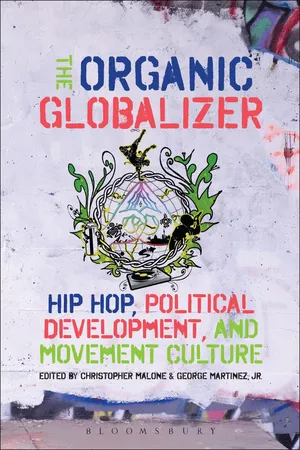
eBook - ePub
The Organic Globalizer
Hip Hop, Political Development, and Movement Culture
- 304 pages
- English
- ePUB (mobile friendly)
- Available on iOS & Android
eBook - ePub
The Organic Globalizer
Hip Hop, Political Development, and Movement Culture
About this book
Information
CHAPTER ONE
The organic globalizer1
Christopher Malone and George Martinez, Jr.
Introduction
Music is a potent form of communication that crosses cultural and linguistic barriers through various information networks. At certain times, it also has the ability to inextricably link itself to protest movements, power, and politics. From the sorrow songs sung by slaves on the plantation, to the subversive character of American jazz, blues, and R&B in the heyday of the Civil Rights Movement, to the “revolution in four-part harmony” that helped to end apartheid in South Africa,2 music has played a fundamental role in many social and political transformations. Today that power has undoubtedly been magnified with the rise of globalized communications. More than ever, faster than ever, music connects and influences people of all nations.
Hip hop is no less a potent form of communication that has perhaps benefited more from globalized modes of communication than any other recent musical genre. From its emergence during the urban struggles of New York in the 1970s, its reach today spans all seven continents and is arguably the most important artistic global force since its emergence. Like all music, hip hop is first and foremost movement: rhythmic movement, bodily movement, movement of time and space and awareness (emotional, spiritual, cultural) within it. Unlike all other genres, however, we contend that hip hop in both its core and its elements contains a unique movement culture, which carries with it certain cultural, social, and political possibilities other musical genres rooted in specific traditions do not. These possibilities, ingrained in hip hop’s movement culture, are why we call it the “organic globalizer”: no matter its pervasiveness or its reach around the world, hip hop ultimately remains—and, we argue, should remain—a grassroots phenomenon that is born of the community from which it permeates. On the other hand, hip hop’s global appeal (in both form and content) also presents interesting possibilities that transcend geographical and cultural boundaries.
Recognizing hip hop as an organic globalizer means that we must acknowledge hip hop itself as more than the transmission of symbolic expression of a particular culture or tradition. Though the historical development of hip hop in the United States has been distinct from the ways in which it is instantiated in local communities elsewhere, we nonetheless contend that the movement culture of hip hop positions it institutionally as a potential vehicle to usher in new forms of understanding about social cleavages (e.g. racial and class based) and new means of mobilizing that may lead to more democratic participation, civic engagement, and civic literacy of historically marginalized groups. We say “may” because hip hop does not necessarily lead to new forms of understanding or means of mobilizing. Neither does it have to. It has been, and can be, simply a particular musical genre—like others, done well or not so well depending on the artist. But this other side of hip hop, the side that trains the eye on the margin between actuality and possibility in the realm of social and political transformation, the “organic globalizer” side if you will: this is what interests us and broadly speaking animates the pages in this volume.
While we will have more to say about the essays collected in this volune at the end of this chapter and the beginning of each to follow, our particular claims about hip hop as an organic globalizer unfold in what immediately follows. In the first section, we position our concept of hip hop within other analyses. While many scholars and commentators recognize the political impact of hip hop, much of the debate has focused primarily on the American context, and whether or not hip hop should be construed as a continuation of the long hard social and political struggles of African Americans. Much like several excellent recent works on hip hop,3 our goal is to broaden the inquiry out beyond the analysis of hip hop as a symbolic embodiment of black culture to argue that the “elements” of hip hop give it an organic quality that has been adopted, co-opted, and utilized by indigenous communities around the world for their own ends.
The second section sketches out what we identify as the three stages in the political development of hip hop: (1) the cultural awareness and emergence stage (roughly the early 1970s to the late 1980s), marked by the identification and recognition of voices of marginalized communities through music and art; (2) the social creation and institutionalization stage (roughly late 1980s–2000), marked by the development of independent alternative institutions and non-profit organizations in civil society geared toward social and economic justice; and (3) the political activism and participation stage (2000–present), which hip hop has entered in the United States. It is marked by demands made on the state by group actors, and the recognition of hip hop’s ability to affect electoral outcomes through political participation. For the most part, organizers in the hip hop community tended to reject electoral politics during the first and second stages. In the last decade, this has changed to the point where hip hop has become an important feature in electoral politics in the United States—through issue advocacy and/or the emergence of hip hop candidates.
In the United States, then, the movement culture of hip hop followed a fairly straightforward, linear developmental path to the point where, today, all three of these developmental phases can operate in co-terminus fashion. Though it does not necessarily have to be all of these, there is a side of hip hop in the United States that lays a unique claim to a cultural, social, and political nexus. Can this movement culture and institutional developmental model be “exported”? Have we seen other countries or regions of the world follow similar patterns whereby hip hop has moved from cultural expression to social and political force? Herein rests the real possibility for hip hop as organic globalizer.
In the final section, we provide a brief overview on the rest of the volume and what it seeks to achieve.
Hip hop as the organic globalizer
While hip hop as a cultural and aesthetic form of expression is over 40 years old, the scholarly literature on its social, economic, and political impact is roughly half that. It was only two decades ago that Tricia Rose released her groundbreaking work Black Noise: Rap Music and Black Culture in Contemporary America, which provided the first extensive historical analysis of the development of hip hop (Rose 1994). That same year, historian and cultural studies scholar Robin D. G. Kelley tied the emergence of hip hop to black working-class culture in his excellent book Race Rebels: Culture, Politics, and the Black Working Class (Kelley 1994). Since then scholarship has indeed grown steadily as many authors have begun analyzing hip hop for its global reach.4 But as with Rose and Kelley’s pioneering work, a good deal of what followed continued to “African Americanize” hip hop through a focus on its ties to the African American community in the United States.5 Todd Boyd’s The New H.N.I.C.: The Death of Civil Rights and the Reign of Hip Hop (2003) was a representative case in point. It argued that a fundamental shift in power and leadership from the civil rights generation to the hip hop generation was all but completed—and with it new priorities, issues, and methods of political and cultural communication. Boyd’s work prompted other African American historians and cultural critics such as Derrick Alridge (2003) to counter that the civil rights and hip hop movements had much more in common than Boyd acknowledged, and that hip hop should be seen more as a continuation in the long history of the black American struggle rather than some fundamental break within it.6
We do not dispute these and other authors’ historical accounts, or the fact that hip hop is intrinsically connected to black culture and history in the United States. We take that as a given and, as hopefully will be seen below, we build upon their work to make our case. However, restricting an analysis of the history and development of hip hop to the American context without connecting it to a systematic analysis of hip hop’s reach and potential for social transformation through localized cultural norms and traditions misses an important element in the emergence of hip hop across the world. Recent scholarship has made that eminently clear: Halifu Osamare’s The Hiplife in Ghana: West African Indigenization of Hip-Hop (2012), for instance, analyzes how American hip hop has at once been globalized and indigenized in West Africa, transforming culture, society, and politics. Similarly, we offer a critical reinterpretation and reassessment of its evolution and expansion. While acknowledging the (multi)cultural roots of hip hop, our emphasis here shall instead be on its peculiar development from (1) a cultural expression; to (2) a network of grassroots social institutions built around issues of social justice; and, finally, to (3) a potentially enduring political force.7 We postulate that this trajectory has implications for marginalized communities using hip hop as a transformational force across the globe.
The fundamental premise: hip hop is situated at once as a cultural phenomenon and institutionalized social reality on the global scale the likes of which we have not seen before with similar musical genres. In this sense, we agree with Arlene Tickner (2008: 121), who argues:
what makes hip hop unique among popular musical genres is the way it relates to everyday life. In reflecting on poverty, inequality, exclusion, and discrimination; claiming a positive identity based on these conditions; and offering musical, linguistic and corporal tools for commenting on them, it transcends the bounded sites where it is practiced and participates in a symbolic network that circulates globally.
While other cultural movements grounded in music have served as vehicles for social transformation, few if any have had the unique success in building a network of grassroots institutions geared toward social justice and political participation both locally and globally to the extent that hip hop has in its relatively short lifespan. Essentially this is what we mean by the term “organic globalizer.” It consists of a unique process in which the elements of a subculture that began in New York City spread across the United States, then the world through simple exposure, and the forces it set in motion. Tickner explains that hip hop was initially experienced in urban communities in the United States viscerally or “authentically,” and then was commoditized in the United States for a largely white audience through the rap music industry. Rap music was in turn exported across the globe in this “homogenized” or commoditized version (Tickner 2008: 121–3). A similar analysis led Rose (2008) to conclude that hip hop was in crisis. However, something peculiar has also happened—an organic reversal of sorts (see, for instance, Chapter 9, Barbara Franz’s work on hip hop in Central Europe). Many of those same communities that may have initially consumed a cultural caricature of hip hop promoted by the rap industry have since sought to make hip hop “their own” by using it to lodge that same visceral connection to local communities’ hip hop first experienced in the United States. To be sure, such an organic process is not necessarily automatic or positive—as the work of many contributors to this volume makes eminently clear. But when an attempt to organize communities around a local hip hop culture has taken place, it has done so through a budding but burgeoning set of social and political networks.
What comes of the institutionalization of hip hop as the organic globalizer remains to be seen. As we stated at the outset, an eye should gravitate toward the space between potentiality and actuality, and between the descriptive as well as the normative. On one side, we simply seek to explain how hip hop emerged as a specific form of cultural expression but was transformed into a robust set of social institutions that eventually—and perhaps inevitably—led to political activism and a call for hip hop communities to become politically involved. On the other side, we suggest that this history provides a prescription—a road map of sorts—for how the vehicle of hip hop might serve to develop the necessary institutions both in the United States and elsewhere to transform political realities at the local level.
The questions that the development and evolution of hip hop thus raises are compelling and require responses if we are to understand hip hop’s impact and the prospects it holds for social and political transformation in communities around the globe. How exactly did a cultural artifact—born in the ramshackle but vibrant urban settings of New York City in the early 1970s—come to facilitate an awareness of a plethora of social problems (global as well as local) through the creation of community organizations some 20 years later? How did the creation and development of those institutions in turn precipitate and advance the growth of hip hop into the electoral arena by engaging in activities like voter registration and voter turnout drives, and the encouragement of “hip hop” candidates to run for political office on platforms of social justice? Can this model of growth and institutional development be replicated in other parts of the world? And finally, what are the prospects for new and lasting forms of democratic participation for marginalized groups?
From cultural expression to political activism: Three stages in the development of hip hop
We shall take up the first of these questions in this section by tracing the development of hip hop over the last 40 years in the United States. We identify three distinct phases in its history. One caveat here before proceeding: while these three phases occurred more or less sequentially over time in the United States, they should be seen today as operating contemporaneously with each other. Today, hip hop as cultural expression exists right alongside various social institutions and the political participation of the hip hop community.
Stage I: Cultural awareness and emergence (early 1970s to the mid-1980s)
The power of hip hop rests in the ability to combine every day experiences, limite...
Table of contents
- Cover
- Half Title
- Title Page
- Contents
- About the cover art
- Contributors
- 1 The organic globalizer
- 2 No church in the wild: Politics, morality, and hip hop in the Political Science classroom
- 3 (Re)building the cypher: Fulfilling the promise of hip hop for liberation
- 4 Men or monsters? The applied uses of the commercial rap artist
- 5 Copyright outlaws and hip hop moguls: Intellectual property law and the development of hip hop music
- 6 Whirl trade: The peculiar image of hip hop in the global economies
- 7 Liberation hip hop: Palestinian hip hop and peaceful resistance
- 8 Asserting identity through music: Indigenous hip hop and self-empowerment
- 9 Hip hop and the dialects of political awareness: Between branding banality and authenticity in Central European rap
- 10 Representations of Chinese-ness in Afro-Cuban hip hop during post-Soviet era Cuba
- 11 The politics of violence, hustling, and contempt in the Oakland, CA rap music scene
- 12 The belly of the beast
- 13 All day, all week, occupy all streets! Race, class, and hip hop in the Occupy Movement
- Index
- eCopyright
Trusted by 375,005 students
Access to over 1.5 million titles for a fair monthly price.
Study more efficiently using our study tools.
Frequently asked questions
Yes, you can cancel anytime from the Subscription tab in your account settings on the Perlego website. Your subscription will stay active until the end of your current billing period. Learn how to cancel your subscription
No, books cannot be downloaded as external files, such as PDFs, for use outside of Perlego. However, you can download books within the Perlego app for offline reading on mobile or tablet. Learn how to download books offline
We are an online textbook subscription service, where you can get access to an entire online library for less than the price of a single book per month. With over 1.5 million books across 990+ topics, we’ve got you covered! Learn about our mission
Look out for the read-aloud symbol on your next book to see if you can listen to it. The read-aloud tool reads text aloud for you, highlighting the text as it is being read. You can pause it, speed it up and slow it down. Learn more about Read Aloud
Yes! You can use the Perlego app on both iOS and Android devices to read anytime, anywhere — even offline. Perfect for commutes or when you’re on the go.
Please note we cannot support devices running on iOS 13 and Android 7 or earlier. Learn more about using the app
Please note we cannot support devices running on iOS 13 and Android 7 or earlier. Learn more about using the app
Yes, you can access The Organic Globalizer by Christopher Malone, George Martinez Jr., Christopher Malone,George Martinez Jr. in PDF and/or ePUB format, as well as other popular books in Media & Performing Arts & Music. We have over 1.5 million books available in our catalogue for you to explore.