eBook - ePub
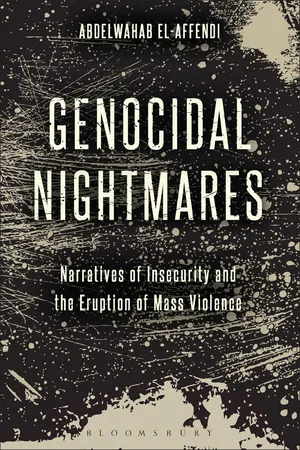
Genocidal Nightmares
Narratives of Insecurity and the Logic of Mass Atrocities
- 288 pages
- English
- ePUB (mobile friendly)
- Available on iOS & Android
eBook - ePub
About this book
This book offers a novel and productive explanation of why 'ordinary' people can be moved to engage in destructive mass violence (or terrorism and the abuse of rights), often in large numbers and in unexpected ways. Its argument is that narratives of insecurity (powerful horror stories people tell and believe about their world and others) can easily make extreme acts appear acceptable, even necessary and heroic. As in action or horror movies, the script dictates how the 'hero' acts. The book provides theoretical justifications for this analysis, building on earlier studies but going beyond them in what amount to a breakthrough in mapping the context of mass violence. It backs its argument with a large number of case studies covering four continents, written by prominent scholars from the relevant countries or with deep knowledge of them. A substantial introduction by the UN's Special Advisor on the Prevention of Genocide demonstrates the policy relevance of this path-breaking work.
Information
1
Introduction: Narrating the Precariousness of Human Decency
[Man] is … essentially a story-telling animal … I can only answer the question ‘What am I to do?’ if I can answer the prior question ‘Of what story or stories do I find myself a part?’
Alasdair MacIntyre, 19811
The killing starts with the use of words disqualifying [the victim’s] humanity … simple words, a few short phrases, pronounced in the context of threat and fear, open the country’s future to apocalypse of mass murder.
Jacques Semelin, 20072
The right narrative in politics can win an election, gather a mob, destroy an enemy, start a war.
L. Timmel Duchamp, 20103
Nabokov … helps us get inside cruelty, and thereby helps articulate the dimly felt connection between art and torture.
Richard Rorty, 19894
In August 2012, just as Norwegian mass murderer Anders Behring Breivik was being sentenced to twenty-one years in jail for killing seventy-seven people a year earlier in a shooting spree preceded by a car bomb, a French intellectual published an essay that appeared to praise the mass killer. Richard Millet, an editor at Gallimard, provoked outrage when he described Breivik as an artist whose atrocities had attained ‘formal perfection … in their literary dimension’.5 While insisting that he did not approve of the terror, Millet said Breivik was ‘what Norway deserves’. His acts were ‘what awaits our societies’ that remained in denial to the impact of multiculturalism on European nations, which were ‘dissolving socially’ and ‘losing their Christian essence’.6
Breivik, it is to be recalled, detonated a two-ton car bomb in the heart of Oslo on 22 July 2011, killing seven people before starting a shooting spree at a youth camp on a nearby idyllic island. By the time he surrendered to the police, sixty-nine more people were killed and nearly 200 injured. Prior to embarking on his massacre, Breivik, (described by the police as a ‘right-wing fundamentalist Christian’, and styling himself as a ‘Marxist Hunter’) emailed a 1,518-page ‘compendium’ to over a thousand people. In this work, he explained how and why he planned his acts, detailing his motives and reproducing literature which influenced his beliefs and actions. He even included an ‘interview’ he conducted with himself, as an aide for those wanting to decipher his motives and sources of inspiration. He was so keen to get his ‘story’ to the world, since without it this ‘work of art’ would not make sense.
Precisely because of this ‘due diligence’, the Oslo massacre provides explanatory clues about the motives and drives behind the type of mass atrocities that are the focus of our present study. In the light of all this, we can see a clear linear link between the nightmare scenarios (which Millet also reproduced in his own ‘literary’ compendium) of a Europe teetering over the abyss of cultural oblivion and the atrocity perpetrated. The act makes no sense outside the narrative in which it is embedded and ‘is meaningful not only because a story can be told about it after the fact’ but equally because ‘we are called to action by beckoning scripts’.7
In this chapter, we outline and explore the thesis that atrocities are embedded in narratives of insecurity and make sense mainly within nightmare scenarios of the type expounded by Breivik and Millet. We begin by offering conceptual clarifications and definitions of key terms, tracing their interconnections before proceeding to explore difficulties that usually hamper the search for adequate explanations for such atrocities. Finally, we indicate how we seek to provide novel explanations to overcome these difficulties. Summaries of the chapters will then follow.
Conceptual clarifications
The key terms used in this study (‘mass violence’, ‘terrorism’, ‘genocide’, etc.) are heavily contested and notoriously difficult to pin down. However, on closer scrutiny, the contests surrounding concepts like terrorism appear to be more about justification than meaning. A report by the United Nations’ High-level Panel on Threats, Challenges and Change (2004) underlined this point by trying to overcome two sets of objections to an agreed definition: demands to exempt either acts perpetrated by states or by peoples under foreign occupation. To resolve the issue, the Panel first sought consensus on the principle that attacks on innocent civilians could not be justified under any circumstances, including when resisting foreign occupation. Then it reaffirmed the principle that atrocities perpetrated by states are already covered in international law as war crimes and crimes against humanity, and need not be designated ‘terrorism’.8 That attacks on innocent civilians represented the core defining feature of terrorism was made explicit in the Panel’s proposed definition of it as encompassing ‘any action … intended to cause death or serious bodily harm to civilians or non-combatants, when the purpose of such act, by its nature or context, is to intimidate a population, or to compel a Government or an international organization to do or to abstain from doing any act’.9
For Alex Schmid, a leading expert in the field, the difficulty to agree a definition is due, among other things, to the wide variety of terrorist acts, the deeply emotive character of the term, and the tendency to use it for purposes of condemnation and de-legitimation.10 Schmid offers a list of ten elements for an act to qualify as terrorism, including attacks on non-combatants, a political motive, being directed to larger audience (for purposes of intimidation and propaganda) and the illegal/criminal nature of the act.11 We believe the High Panel’s indicative definition (together with Schmid’s list of ‘ingredients’) will be sufficient for our purposes. Terrorism is mainly politically motivated attacks on non-combatants for the purposes of political intimidation and coercion.
Arriving at an internationally agreed legal definition of a term is no guarantee that it will stop being contested, as the case with the term ‘genocide’ proves. The 1948 UN Convention on the Prevention and Punishment of the Crime of Genocide (UNGC) states in Article II that an act qualifies as genocide if it targets any national, ethnic, racial or religious group, with the intent of destroying it ‘in whole or in part’, either through killing its members, causing them serious bodily or mental harm, deliberately inflicting on the group conditions calculated to cause physical destruction, imposing measures intended to prevent births or forcibly transferring children of the group to another. However, that did not protect the term against ‘inflationary’ use (and abuse, such as describing inter-racial marriage or birth control as genocide).12 As is the case with terrorism, this ambiguity has to do with the tendency to use the term in an evaluative sense, to denote a category of the most abominable, and the least morally defensible, crimes imaginable. However, it is safe to say that, as with terrorism, the difficulty is usually not about the definition but again about numbers and ‘mitigating circumstances’. For in spite of difficulties with intent, and the ambiguity surrounding acts short of murder, it is not that difficult to recognize acts that qualify as genocidal, in the sense of being ‘extensive, group-selective violence whose purpose is the destruction of that group in a territory under the control of a perpetrator’.13
Benjamin A. Valentino chose the term ‘mass killing’ (defined ‘simply as the intentional killing of massive numbers of noncombatants’) as a generic term that encompasses genocide and ethnic cleansing, ‘in order to avoid … difficulties with the term “genocide” ’. Additionally, ‘massive’ is defined as ‘at least fifty thousand intentional deaths over the course of five years or fewer’.14 In a later work, Valentino modifies the definition to denote ‘any event in which the actions of state agents result in the intentional death of at least 1,000 non-combatants from a discrete group in a period of sustained violence’. The period in question is also deemed to start when the number of killings surpasses 100 and ends if the numbers dip below this figure for three consecutive years.15
For Christian Gerlach, mass violence is ‘widespread physical violence against noncombatants’, which goes beyond direct killings to incorporate ‘forced removal or expulsion, enforced hunger or undersupply, forced labor, collective rape, strategic bombing, and excessive imprisonment’.16 Jacques Semelin proposes ‘massacre’ (defined as ‘a form of action that is most often collective and aimed at destroying non-combatants’, italics in original) as the basic unit (‘lowest common denominator’) of mass violence. Genocide and acts of mass violence are then defined in terms of a series of massacres.17
There may be a case for using such a limited and carefully delineated concept as a starting point and building up from there. But even here several problems crop up. Massacres could be committed against combatants, if they are captured (the 1943 Katyn massacre of captured Polish officers by Stalin’s troops) or when they are practically unarmed because of unevenness in fire-power (Kitchener’s massacre of the Mahdists in the Battle of Omdurman in 1898 or the ‘Turkey shoot’ of fleeing Iraqi soldiers in Kuwait in 1991). It is also not always ‘collective’, since a lone gunman or a couple could indulge in massacres, as in Breivik’s case.
From our perspective, what matters is not just the numbers but the message being sent and the limits the perpetrators observe. In this regard, Valentino’s own alternative rendering of the problem in terms of the ‘systematic murder of noncombatants’18 is a good starting point. When acts of murder are ‘systematic’, the perpetrators do not foresee a limit or upper ceiling for potential victims. That could be used as the defining characteristic of incidents of mass violence: it is where at least one side in a conflict either deliberately seeks to maximize casualties as a conscious objective, or does not care how many victims, including non-combatants, were targeted in order to achieve a given political objective. This definition covers genocide and mass terrorism, where the maximization of casualties is a direct aim, but also cases of ‘ethnic cleansing’ (defined in one UN report as ‘a purposeful policy designed by one ethnic or religious group to remove by violent and terror-inspiring means the civilian population of another ethnic or religious group from certain geographical areas’).19 It also covers the phenomenon Semelin calls ‘genocide of subjugation’, aiming to subdue, rather than to exterminate, a group, including ‘collateral damage’ during carpet bombing, mass shelling or the use of weapons of mass destruction. This definition avoids objections that subsuming genocide under mass murder is ‘simplistic’ and does not capture core aspects of the crime.20 For it captures Arendt’s important insight about totalitarian and genocidal regimes being ‘the fullest expression of a distinctly modern pathological ambition for power that rejected any sense of limits’.21
It is indeed this manifest preparedness to accept no limits or restraint which characterizes the phenomena grouped by Scott Straus under the rubric ‘mass atrocities’. This concept covers a range of acts of violence that include crimes against humanity, genocide, ethnic cleansing and war crimes. It also implies ‘a vague degree of scale consistent with genocide’ but without being restricted to ‘group-selective or group-destructive violence.’ Straus recommends that the concept should evolve towards incorporating ‘a high threshold of deliberate lethal violence against civilians’.22 We believe our definition of mass violence fulfils this requirement by highlighting the preparedness to inflict, or tolerate, a limitless number of casualties and totally unrestrained brutality. It also bypasses the problematic question of intention, since preparedness can be inferred from actual conduct. We did not need Breivik’s trial confession to discover that he was not going to stop killing voluntarily. We can also see clearly from the conduct of the Syrian regime since the March 2011 uprising that it was prepared to inflict as much brutality as it took to suppress the popular uprising. Not all mass killers have extermination as an objective, as most hope intimidation would do the trick.
The term ‘mass atrocity’ is also employed by Gareth Evans to refer to ‘what is now embraced by the description “genocide, war crimes, ethnic cleansing, and crimes against humanity” ’.23 The term is used to refer to discreet instances of mass violence as defined above, an equivale...
Table of contents
- Cover
- Halftitle Page
- Title Page
- Dedication Page
- Contents
- Preface
- Foreword
- 1. Introduction: Narrating the Precariousness of Human Decency
- 2. Killer Narratives: Collective Nightmares and the Construction of Narrative Communities of Insecurity
- 3. Imagining Nationhood, Framing Postcoloniality: Narrativizing Nigeria through the Kinesis of (Hi)Story
- 4. Sudanese Stories: Narratives of Grievance, Distrust and Fatalism in Recurrent Violence
- 5. General Elections and Narratives of Violent Conflict: The Land Question and Civic Competence in Kenya
- 6. The Violence of Security, Lethal Representations and Hindu Nationalism in India
- 7. Memories of Victimhood in Serbia and Croatia from the 1980s to the Disintegration of Yugoslavia
- 8. Insecurity, Victimhood, Self and Other: The Case of Israel and Palestine
- 9. Resistance Narratives: Palestinian Women, Islam and Insecurity
- 10. The State and Intergroup Violence: The Case of Modern Iraq
- 11. Islamophobia as a Securitization Narrative: The Exclusionary Logic of Imperial Geopolitics
- 12. Killer Narratives in Western Popular Culture: Telling it as it is Not
- Concluding Remarks
- Authors’ Biographies
- Index
- Imprint
Trusted by 375,005 students
Access to over 1.5 million titles for a fair monthly price.
Study more efficiently using our study tools.
Frequently asked questions
Yes, you can cancel anytime from the Subscription tab in your account settings on the Perlego website. Your subscription will stay active until the end of your current billing period. Learn how to cancel your subscription
No, books cannot be downloaded as external files, such as PDFs, for use outside of Perlego. However, you can download books within the Perlego app for offline reading on mobile or tablet. Learn how to download books offline
Perlego offers two plans: Essential and Complete
- Essential is ideal for learners and professionals who enjoy exploring a wide range of subjects. Access the Essential Library with 800,000+ trusted titles and best-sellers across business, personal growth, and the humanities. Includes unlimited reading time and Standard Read Aloud voice.
- Complete: Perfect for advanced learners and researchers needing full, unrestricted access. Unlock 1.5M+ books across hundreds of subjects, including academic and specialized titles. The Complete Plan also includes advanced features like Premium Read Aloud and Research Assistant.
We are an online textbook subscription service, where you can get access to an entire online library for less than the price of a single book per month. With over 1.5 million books across 990+ topics, we’ve got you covered! Learn about our mission
Look out for the read-aloud symbol on your next book to see if you can listen to it. The read-aloud tool reads text aloud for you, highlighting the text as it is being read. You can pause it, speed it up and slow it down. Learn more about Read Aloud
Yes! You can use the Perlego app on both iOS and Android devices to read anytime, anywhere — even offline. Perfect for commutes or when you’re on the go.
Please note we cannot support devices running on iOS 13 and Android 7 or earlier. Learn more about using the app
Please note we cannot support devices running on iOS 13 and Android 7 or earlier. Learn more about using the app
Yes, you can access Genocidal Nightmares by Abdelwahab El-Affendi in PDF and/or ePUB format, as well as other popular books in Politics & International Relations & World History. We have over 1.5 million books available in our catalogue for you to explore.