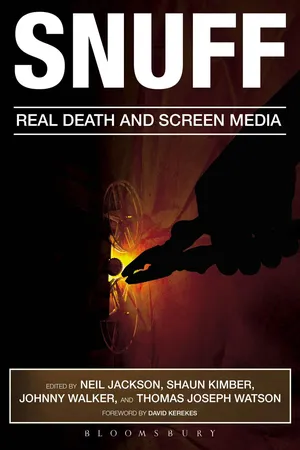
eBook - ePub
Snuff
Real Death and Screen Media
- 304 pages
- English
- ePUB (mobile friendly)
- Available on iOS & Android
eBook - ePub
Snuff
Real Death and Screen Media
About this book
The phenomenon of so-called 'snuff movies' (films that allegedly document real acts of murder, specifically designed to 'entertain' and sexually arouse the spectator) represents a fascinating socio-cultural paradox. At once unproven, yet accepted by many, as emblematic of the very worst extremes of pornography and horror, moral detractors have argued that the mere idea of snuff constitutes the logical (and terminal) extension of generic forms that are dependent primarily upon the excitement, stimulation and, ultimately, corruption of the senses. Snuff: Real Death and Screen Media brings together scholars from film and media studies to assess the longevity of one of screen media's most enduring cultural myths. Thorough, provocative, and well argued, the contributions to this volume address areas ranging from exploitation movies, the video industry, trends in contemporary horror cinema, pornography and Web 2.0.
Information
PART ONE
THE CHANGING MEANINGS OF “SNUFF”
1 THE WAY TO DIGITAL DEATH
Julian Petley
Prologue: Flat Earth news
Thanks largely to the press, the myth of the “snuff movie” still refuses to lie down and die. Take, for example, this headline from the British newspaper the Telegraph, July 16, 2014: “Discovery Fined for Showing Torture and Dismemberment before Watershed.”1 One had to read a full six paragraphs of the article before discovering, via a brief quote from Ofcom (the Office of Communications) that the programs in question contained “prolonged and disturbing reconstructions of torture, mutilation and murder.”2 The story appeared in other national papers too, although the Star, July 17, was the only one to cover the story and to fail to mention at all that the controversial scenes were in fact reconstructions. The story certainly had legs: Googling “Investigation Discovery,” “Ofcom,” and “female killers” produced 2,320 results, from national and local UK papers, as well as from the international press.
The original source of the story turned out to be an alert on July 16 from the Press Association which noted that the Investigation Discovery channel had been fined £100,000 for screening the series Deadly Women (2008–2014), which examined a number of real-life murder cases and contained “graphic depictions of extreme violence including torture, a child murder, and dismemberment of a corpse,”3 hours before the watershed. The alert also included, albeit not prominently, the quote from Ofcom about the series consisting of reconstructions.
Indeed, when Ofcom first reported on the series, in issue 246 of its Broadcast Bulletin,4 on the very first page of the fourteen devoted to the series, the words “dramatic reconstructions” are used twice and the word “re-enacted” is used once, and the nature of the series remains abundantly clear throughout the following pages. The story was not picked up by the press. What gave rise to the Media Lawyer alert was Ofcom’s announcement, on July 16, 2014, that it was imposing a sanction on Discovery for broadcasting the series at an inappropriate time.5 But again, from the start of the seventeen-page Ofcom document, it is clear that the offending programs are reconstructions: the word itself is first used eight lines in from the early section explaining which particular rules of the Ofcom Code had been breached. By contrast, in the alert6 it occurs only once, about halfway through, and since—in a classic instance of what Nick Davies aptly calls “churnalism”7—most newspapers published the alert more or less verbatim, it would have been all too easy for the casual reader to have formed the impression that Investigation Discovery had been repeatedly broadcasting images of “real live death.” Thus are myths and misconceptions propagated and sustained.
“A terrible fascination”
When the word “snuff” is used today, particularly in a condemnatory context, it is usually to denote precisely those images of “real live death” which now circulate in such profusion courtesy of the Internet, and which, unsurprisingly, given when they were published, feature in neither David Kerekes and David Slater’s Killing for Culture,8 nor my chapter on “snuff” in Graeme Harper and Xavier Mendik’s collection Unruly Pleasures: The Cult Film and its Critics.9 But there is nothing essentially new about such images themselves, whether captured deliberately or by chance; although the coming of digital technology, along with changes to the broadcasting environment in many countries, has undoubtedly altered in significant respects the situation in which they are produced and circulated. What follows is in no sense a definitive list, merely a brief and selective indication of the long genealogy of photographic images of “real live death.”
If we date the beginnings of camera photography to the 1820s, with the work of Nicéphore Niépce, then we can say that it was not long, by the standards of the time, before the camera was used to photograph dead people, since by the end of the 1830s, the first examples of photographic, as opposed to painted, postmortem portraiture had begun to appear.10 But these peaceful memorabilia of loved ones were a far cry from the first really memorable photographic images of the dead, which were far from serene. These were depictions of the aftermaths of battles in the American Civil War (1860–1865), and are generally credited to Matthew Brady.11 However, many of these were actually taken by his employees, particularly Alexander Gardner, in the early days of the war and before he left Brady’s employ in 1862. It should be noted, however, that newspapers could not use these (or any other) photographs, for at this time they lacked the technique and equipment for making half-tone blocks. Brady and his teams would surely have filmed the battles themselves had the camera technology of the day enabled them to capture moving action, but, nonetheless, the images of the dead carry a powerful charge, and no more so than those showing the bloody aftermath of the Battle of Antietan in September 1862. As one historian has noted, the battle in question—which saw the death, wounding, or disappearance of over 22,000 people—“took a human toll never exceeded on any other single day in [America’s] history”, and so “intense and sustained was the violence, a man recalled, that for a moment in his mind’s eye the very landscape around him turned red.”12 In October, the photographs of the battle that were taken by Gardner and his assistant were exhibited at Brady’s New York gallery. An observation in the review of the exhibition, in The New York Times, October 20, 1862, is remarkably pertinent in the context of this chapter:
Mr. Brady has done something to bring home to us the terrible reality and earnestness of war. If he has not brought bodies and laid them in our dooryards and along the streets, he has done something very like it. At the door of his gallery hangs a little placard, “The Dead of Antietam.” Crowds are constantly going up the stairs; follow them, and you find them bending over photographic views of that fearful battle-field, taken immediately after the action. Of all objects of horror, one would think that the battlefield should stand preeminent, and that it should bear away the palm of repulsiveness. But, on the contrary, there is a terrible fascination about it that draws one near these pictures, and makes him loth to leave them. You will see hushed, reverend groups standing around these weird copies of carnage, bending down to look in the pale faces of the dead, chained by the strange spell that dwells in dead men’s eyes.13
But equally pertinent is the fact that, on July 7, 1865, Gardner photographed the execution by hanging of four of the conspirators in the plot to kill Abraham Lincoln.14
Censorship and self-censorship
With the moving image came the possibility of capturing the actual instant of death on film in documentaries and newsreels. For example, on June 14, 1913, British Pathé newsreel cameras caught the moment when Emily Davison—a prominent women’s activist (and key figure in the suffragette movement)—was fatally trampled at Epsom Derby when she stepped in front of King George V’s horse (although the image is indistinct, and—contra the film’s title card—she actually died four days later).15 Much more dramatic and explicit (though not of course by present-day standards) was the Pathé footage of the fatal end of Frank Lockhart’s attempt on the world land speed record at Daytona Beach, Florida, on April 25, 1928, in which Lockhart’s body being thrown from his crashing car is clearly visible.16 He died instantly.
Of course, what could actually be shown on public screens, particularly in the newsreels, was heavily mediated by the exercise of both official censorship and self-censorship. This was most certainly the case in the First World War, where both forms of censorship began on the battlefield and continued on the home front. In Britain, newsreels were not actually subject to inspection by the British Board of Film Censors (BBFC), but their contents were most certainly prone to self-censorship by those who produced them. The predominant attitude of the newsreel companies to representing reality in general, and not simply warfare, was later neatly summed up by G.T. Cummins, the editor of Paramount, who in 1934 stated that: “The daily life of the whole civilized world is to be told in pictures, nothing must be omitted. But nothing must be included which the average man will not like.”17 Not upsetting the patrons clearly had a primarily economic motive, but it was also extremely important not to bring down the wrath of the local authorities on the cinemas within their jurisdiction, as they had the power to cut and ban films of all kinds. And certain local councils clearly had the newsreels within their sights. Thus, in 1938, after Hereford County Council had complained about newsreels containing footage of Japanese air attacks on Chinese cities during the Sino-Japanese War that had commenced the previous year, the Executive of the County Councils Association “formally requested the Home Secretary to make it an offence to display films depicting suffering or loss of life and to make all films showing events more than a week old subject to censorship.”18 The request was turned down, but within a year, Britain itself would be at war; as in all combatant countries, maintaining morale on the home front was paramount, and a huge amount of effort, both on the battlefield itself and back home, went into ensuring that graphic scenes of carnage were kept safely off the screen. Indeed, in the UK, newsreel footage shot during the liberation of the concentration camps in 1944 and 1945 was heavily sanitized before it was shown in cinemas—even though it served the useful purpose of reminding audiences of the horrors against which the country was still fighting. And over ten years after the end of the war, a documentary such as Alain Resnais’ Nuit et brouillard/Night and Fog (France, 1955) found its horrific images of mass murder on an industrial scale toned down by censors in the UK, and a number of other countries too.19
Murders, suicides, and executions
Today, the images of “real live death” that cause the greatest concern are those of onscreen murders, suicides, and executions which circulate via the Internet and which are frequently denounced as a form of modern-day “snuff,” but, again, there is nothing essentially new in such imagery.
Perhaps the best-known example of an onscreen execution is that of Nguyễn Văn Lém, a member of the National Liberation Front who, on February 1, 1968, during the Vietnam War (1955–1975), was summarily executed in a Saigon street by General Nguyễn Ngọc Loan, South Vietnam’s Chief of National Police. The event was recorded as both still and moving images by Eddie Adams, an Associated Press photographer, and Vo Suu, an NBC cameraman.20 Significantly, it is the still image that captures the moment of death most strikingly, only partly because in the moving image, the shot body of the prisoner is a blur, although the moving version d...
Table of contents
- Cover
- Halftitle Page
- Title Page
- Contents
- List of Figures
- Foreword: A Culture of Change
- Acknowledgments
- Introduction: Shot, Cut, and Slaughtered
- Part One: The Changing Meanings of “Snuff”
- Part Two: “Snuff” Across Film and Television
- List of Contributors
- Select Bibliography
- Index
- Imprint
Trusted by 375,005 students
Access to over 1.5 million titles for a fair monthly price.
Study more efficiently using our study tools.
Frequently asked questions
Yes, you can cancel anytime from the Subscription tab in your account settings on the Perlego website. Your subscription will stay active until the end of your current billing period. Learn how to cancel your subscription
No, books cannot be downloaded as external files, such as PDFs, for use outside of Perlego. However, you can download books within the Perlego app for offline reading on mobile or tablet. Learn how to download books offline
Perlego offers two plans: Essential and Complete
- Essential is ideal for learners and professionals who enjoy exploring a wide range of subjects. Access the Essential Library with 800,000+ trusted titles and best-sellers across business, personal growth, and the humanities. Includes unlimited reading time and Standard Read Aloud voice.
- Complete: Perfect for advanced learners and researchers needing full, unrestricted access. Unlock 1.5M+ books across hundreds of subjects, including academic and specialized titles. The Complete Plan also includes advanced features like Premium Read Aloud and Research Assistant.
We are an online textbook subscription service, where you can get access to an entire online library for less than the price of a single book per month. With over 1.5 million books across 990+ topics, we’ve got you covered! Learn about our mission
Look out for the read-aloud symbol on your next book to see if you can listen to it. The read-aloud tool reads text aloud for you, highlighting the text as it is being read. You can pause it, speed it up and slow it down. Learn more about Read Aloud
Yes! You can use the Perlego app on both iOS and Android devices to read anytime, anywhere — even offline. Perfect for commutes or when you’re on the go.
Please note we cannot support devices running on iOS 13 and Android 7 or earlier. Learn more about using the app
Please note we cannot support devices running on iOS 13 and Android 7 or earlier. Learn more about using the app
Yes, you can access Snuff by Neil Jackson, Shaun Kimber, Johnny Walker, Thomas Joseph Watson, Neil Jackson,Shaun Kimber,Johnny Walker,Thomas Joseph Watson in PDF and/or ePUB format, as well as other popular books in Media & Performing Arts & Film History & Criticism. We have over 1.5 million books available in our catalogue for you to explore.