Scholarly responses to Henry Miller's works have never been numerous and for many years Miller was not a fashionable writer for literary studies. In fact, there exist only three collections of essays concerning Henry Miller's oeuvre. Since these books appeared, a new generation of international Miller scholars has emerged, one that is re-energizing critical readings of this important American Modernist.
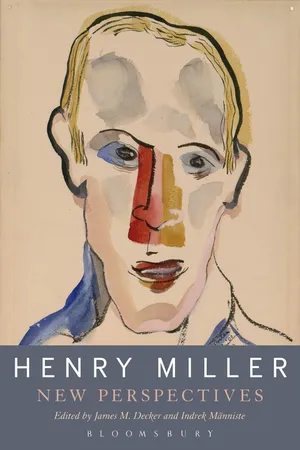
Henry Miller: New Perspectives presents new essays on carefully chosen themes within Miller and his intellectual heritage to form the most authoritative collection ever published on this author.
eBook - ePub
Henry Miller
New Perspectives
- 256 pages
- English
- ePUB (mobile friendly)
- Available on iOS & Android
eBook - ePub
About this book
Information
1
Henry Miller’s Inhuman Philosophy
If we believe D.H. Lawrence, then every novelist “who amounts to anything has a philosophy.”1 Indeed, philosophy is something that writers have rather than something that they do as opposed to professional philosophers. Philosophy, in this largely hidden and often unexplainable sense, is ultimately to do with one’s life as lived day to day. It is existential by nature. It guides and permeates one’s life and thinking and manifests itself in the writer’s works mostly indistinctly, not explicitly. We could call this literary lebensphilosophie, a metaphysical sense of life. Metaphysics, however, can be experienced and voiced both as a professional doctrine and as an “intuitive relation to reality.”2 It is precisely in this latter sense, and the frame of thinking, that, I think, we should approach to reflect on Henry Miller’s relationship with philosophy.
Miller’s association with philosophy is an ambivalent one, to say the very least. While he found academic philosophy, as a seemingly endless study of doctrines and never-ending quarrels, to be dull and lifeless, he, at the same time, was greatly fascinated and influenced by philosophers like Friedrich Nietzsche, Oswald Spengler, Henri Bergson, Lao-Tzu, and several others, in whose ideas he saw a creative and vigorous response to his time and its human condition, including very much his own. If it were to have any practical use at all, philosophy would have to serve as a catalyst for both artistic and everyday rejuvenation for Miller. Ideas, always, have to be “wedded to action,” he said (CAN, 246).
Concerning the issue of Miller’s own philosophy, or the question whether he does in fact have one, the commentators have so far remained fairly skeptical, if not outright dismissive. It has been argued, for example, that “no explicit or systematic philosophical approach” could possibly be drawn from Miller’s works3 and that he has feelings rather than “a philosophy” (LP, 194). However, since states of feeling are in essence “inseparable from the states of being,”4 the latter observation alone does not at all exclude Miller from philosophical discussions. On the contrary, being is one of the fundamental questions of metaphysics; the one that is asked both “in moments of rejoicing” and “boredom”5 and Miller, in his own way, lived this question throughout his peculiar auto-novel genre. It’s not, then, a question of whether but how Miller’s ideas and concepts relate to a wider realm of philosophical ideas. Indeed, regardless of the supposed ambiguities, thinkers like Paul Weiss and Count von Keyserling have claimed to see “a philosophical position” in Miller’s work.6 Also, prominent French thinkers like Gilles Deleuze, Félix Guattari, and Maurice Blanchot have found value and originality in Miller’s thinking.7
While the prevailing skepticism is often warranted in the face of Miller’s tendency to convolute different or even opposing philosophical ideas into his texts and regularly contradict himself, the critics, perhaps, have expected too much from a novelist. Indeed, taking once again D.H. Lawrence’s advice, I take his thought that metaphysics must always “subserve the artistic purpose beyond the artist’s conscious aim. Otherwise the novel becomes a treatise,”8 to be a sound suggestion in tracing down the role of philosophy in any writer’s works. It would seem that a writer’s unique metaphysics, in the sense I we qualified above, can be approached successfully only from the inside of his text and lebenswelt, from his own conceptual array, and not by evaluating the philosophical worth of a literary work by its clear-cut compatibility and consistency (or lack thereof) to well-known philosophical systems.
Here, I argue against skeptics that Miller does indeed have a kind of philosophy, which underpins most of his texts. Furthermore, I demonstrate that this philosophy, as a metaphysical sense of life, can be seen as forming a pervading theoretical structure the understanding of which is necessary to explain even some of the most basics of Miller’s ideas. I argue that by repudiating some of the most potent elements of late modernity such as the linear sense of time and history, Miller paves the way for overcoming the decidedly positivist stance of Western thinking. By drawing attention to his distinction between the traditional and full present, I unveil an important philosophical demarcation line for Miller’s thinking. In addition, building upon his notion of the inhuman artist, as a kind of redeemer of the “destitute times” of the traditional present, I view Miller’s literary-artistic journey as that of transcendental passing over from human to inhuman, from traditional to full present. Finally, I show that the inhuman’s aspirations are finalized in Miller’s transcendental China-concept, which is to be read as the climax of the full present whereupon one has overcome the metaphysics of the traditional present in its overpowering entirety.
Nightmare of history
Much like with several other modernist writers, Miller’s philosophical sympathies grow out from his reactionary sensitivity to the modern age. Modernists’ dialectical visions of concurrent destruction and renovation, the decreation and creation of modern man and society express an essentially crises-centered view of their reality9 and Miller is no exception to it. Wallace Fowlie quite rightly suggests that Miller, as a visionary, “daily lives the metaphysical problems of his age.”10 The main concern of Miller’s “daily metaphysics” always remains the same: the question of the possibility of the life of the modern artist in the “destitute times” [dürftiger Zeit] of the “early winter of Western Civilization,” to borrow Hölderlin’s and Spengler’s well-known descriptions.11 Indeed, it seems that the ever-present confrontation between the horror of the present day, the times of need in the deepest sense for many, and the envisioned freedom of the artist’s life becomes an underlying yet conflicting tension for Miller, which he sets out to resolve throughout his oeuvre. More particularly, it is precisely his rejection of the most dominant ideas of modernity—a linear notion of time and history, progress, modern technology, and an aesthetic view of art—that form the center of Miller’s philosophical avenues.
We find Miller intently voicing discontent regarding the modern era in his Tropic of Cancer. “The cancer of time is eating us away. Our heroes have killed themselves, or are killing themselves. The hero, then, is not Time, but Timelessness,” wrote Miller in the very first page of the book (CAN, 1). While “time” can be read here both historically and as a temporal category in a metaphysical sense, in either case the failure is evident for Miller. Historically, modern times have failed to produce the better man and world that “our heroes” of the Enlightenment era dreamt about. Miller is fighting against a notion of time that is embedded in the very metaphysics of the age, a metaphysics that is commonly taken to support the linear concept of history. Time’s role, commonly construed as rigid, it seemed to Miller, served to a great extent merely for the purpose of justifying historical developments as necessary and inevitable. Since this very notion of history has produced only madness, Miller reasons, the exact opposite of time and history is needed: namely timelessness and ahistoricity.
With this view Miller did not position himself against any particular individual or view but rather against a general trend of the modern Western world, which saw its main purpose in human progress. The idea of progress, in turn, is often based on an interpretation of history “which regards men as slowly advancing in a definite and desirable direction, and infers that this progress will continue indefinitely.”12 Accordingly, it was believed that a condition of “general happiness will ultimately be enjoyed.”13 For Miller, however, this type of “happiness” is merely a “statistical happiness” (CAP, 4) for it omits the artists’ kind.
While Miller was not directly exposed to the views of the defenders of this “progressive view,” he learned them via the works of later critical commentators of modernity (Max Stirner, Friedrich Nietzsche, Oswald Spengler, and others) and of the actual results the ideas described above had on the modern society of his day. We see throughout Miller’s works that, for example, Auguste Comte’s (the founding father of positivism) vigorous insistence on scientific descriptions of the human condition is one of the fundamental errors of the modern day for Miller since it completely disregards the artist’s perspective and well-being. In like manner, Miller considers Friedrich Hegel’s linear account and the universal notion of freedom not as a victory, but indeed as the defeat of humanity.
How, then, does Miller come to reject the linear notion of history and why? Miller declares in Tropic of Capricorn that “the world I knew is no more, it is dead, finished, cleaned up. And everything that I was is cleaned up with it. I am a carcass getting an injection of new life…” (CAP, 220). In this decidedly apocalyptical description, he seems to fix the past, construed historically, as dead. He also marks the end of his past self understood within the limits of the wardship of history. Yet, this Miller sees as a thoroughly positive event. He welcomes the discontinuation of his life from the indifferent flow of time, which seems not to bother most of the people around him. Miller distances himself, as it were, from the general human history altogether. It is, it seems, precisely with the help of Spengler’s distinctions between “two possibilities of world formation” that Miller saw the potential for rejecting the historical and time-bound view of himself. In asking “for whom is there History?” Spengler concedes that while “history is obviously for everyone” it makes a great difference
… whether anyone lives under the constant impression that his life is an element in a far wider life-course that goes on for hundreds and thousands of years, or conceives of himself as something rounded off and self-contained. For the latter type of consciousness there is certainly no world-history, no world-as-history.14
We notice that Spengler directly opposes himself to the “progressive view” of the history of Enlightenment. In his quest for “timelessness,” both in its metaphysical and ahistorical meaning, Miller exhibits similar anxieties to Spengler. Miller, being an individualist, and greatly sympathizing with Spengler’s view of ahistorical nature of certain cultures (Classical, Indian, etc.) clearly saw himself as being “self-contained” and, as noted above, rejected the idea of “world-history.” Miller seems to echo Spengler’s distinction even more distinctly when he separates the “objective” time that people (“historical men” in Spengler’s terms) measure with clocks and calendars from the time of one’s own “inside chronometer.” In a letter to Michael Fraenkel he elaborates this view
Are times out of joint? Then look to the clock! Not the clock on the mantelpiece, but the chronometer inside which tells when you are living and when you are not … . Now we are swamped with time—Western Union time, sidereal time, Einsteinian time, reading time, bedtime, all kinds of time which tell us nothing about what is passing inside us, or even outside us. We are moving on the escalator of time … (HAM, 19–20)
Consequently, Miller moves toward the establishment of his own notion of time, based on his individual experiences, not on natural laws and science. He steps off, as it were, from the “escalator of time” because it has nothing to do with his personal life and feelings. Since time is now measured, or rather directed, by his own “inside chronometer,” Miller can, it seems, uphold certain moments and sustain their aura as long as he pleases. The moment is over when one no longer wishes to dwell in it, not when the clock or calendar says it’s another minute or day. Time for Miller becomes something essentially psychological or phenomenological, it seems. Capitalizing on David Hoy’s insight, it could be even argued that Miller makes a salient distinction between time and temporality. Time, according to Hoy, refers to “universal time, clock time, or objective time,” whereas temporality is “time insofar as it manifests itself in human experience.”15 Temporality is “lived time” and thus, Hoy suggests, quite literally, “time of our lives.” It is t...
Table of contents
- Cover
- Halftitle Page
- Title Page
- Dedication Page
- Contents
- Notes on Contributors
- Foreword
- Acknowledgments
- Chronology
- Abbreviations
- Introduction
- 1. Henry Miller’s Inhuman Philosophy
- 2. “The agonizing gutter of my past”: Henry Miller, Conversion, and the Trauma of the Modern
- 3. When Henry Miller Left for Tibet
- 4. The Religiosity of Henry Miller
- 5. Henry Miller and Morality
- 6. Tropic of Cancer: Word Becoming Flesh
- 7. “A dirty book worth reading”: Henry Miller’s Tropic of Cancer and the Feminist Backlash
- 8. Henry Miller: Obscene Other of the Law
- 9. The Ecstatic Psychotic: Henry Miller via Jacques Lacan
- 10. Big Sur and Walden: Henry Miller’s Practical Transcendentalism
- 11. A Surrealist Duet: Word and Image in Into the Night Life with Henry Miller and Bezalel Schatz Sarah Garland
- 12. Cartography of the Obscene
- 13. Dispossessed Sexual Politics: Henry Miller’s Anarchism Qua Kate Millett and Ursula K. Le Guin
- 14. Miller’s Paris
- 15. Henry Miller’s Titillating Words
- Bibliography
- Index
- Imprint
Trusted by 375,005 students
Access to over 1.5 million titles for a fair monthly price.
Study more efficiently using our study tools.
Frequently asked questions
Yes, you can cancel anytime from the Subscription tab in your account settings on the Perlego website. Your subscription will stay active until the end of your current billing period. Learn how to cancel your subscription
No, books cannot be downloaded as external files, such as PDFs, for use outside of Perlego. However, you can download books within the Perlego app for offline reading on mobile or tablet. Learn how to download books offline
Perlego offers two plans: Essential and Complete
- Essential is ideal for learners and professionals who enjoy exploring a wide range of subjects. Access the Essential Library with 800,000+ trusted titles and best-sellers across business, personal growth, and the humanities. Includes unlimited reading time and Standard Read Aloud voice.
- Complete: Perfect for advanced learners and researchers needing full, unrestricted access. Unlock 1.5M+ books across hundreds of subjects, including academic and specialized titles. The Complete Plan also includes advanced features like Premium Read Aloud and Research Assistant.
We are an online textbook subscription service, where you can get access to an entire online library for less than the price of a single book per month. With over 1.5 million books across 990+ topics, we’ve got you covered! Learn about our mission
Look out for the read-aloud symbol on your next book to see if you can listen to it. The read-aloud tool reads text aloud for you, highlighting the text as it is being read. You can pause it, speed it up and slow it down. Learn more about Read Aloud
Yes! You can use the Perlego app on both iOS and Android devices to read anytime, anywhere — even offline. Perfect for commutes or when you’re on the go.
Please note we cannot support devices running on iOS 13 and Android 7 or earlier. Learn more about using the app
Please note we cannot support devices running on iOS 13 and Android 7 or earlier. Learn more about using the app
Yes, you can access Henry Miller by James M. Decker, Indrek Männiste, James M. Decker,Indrek Männiste in PDF and/or ePUB format, as well as other popular books in Literature & Literary Criticism. We have over 1.5 million books available in our catalogue for you to explore.