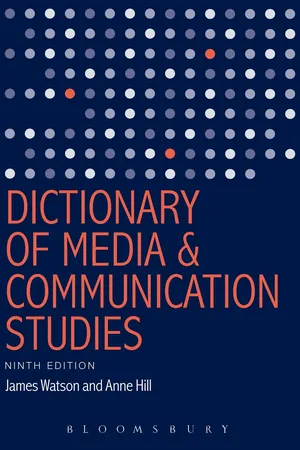
The Dictionary of Media and Communication Studies has provided students and the general public alike with a gateway into the study of intercultural communication, public relations and marketing communications since 1984. In this 9th edition, James Watson and Anne Hill provide a detailed compendium of the different facets of personal, group, mass-media and internet communication that continues to be a vital source of information for all those interested in how communication affects our lives. They cover new applications and developments, such as the incorporation of Neuroscience techniques in advertising and marketing. Other updates include Cyber-bullying, Twitter scandals, conduct in media organizations, on-line lobbying, global protesting/petitioning, and gender issues relating to social media in general.
While new entries explore the profound shifts that have taken place in the world of communication in recent years, the purpose of this new edition is not necessarily to keep abreast of every new media event but to reflect the trends that influence and prompt such events, such as the Leveson Inquiry and Report and phone hacking via mobile phones. Politics seems to be playing out more on Twitter than in The Times. This volume seeks to make its twenty-first century readers more media literate, as well as more critical consumers of modern news.
- 448 pages
- English
- ePUB (mobile friendly)
- Available on iOS & Android
eBook - ePub
Dictionary of Media and Communication Studies
About this book
Information
A
AA-certificate, A-certificate See CERTIFICATION OF FILMS.
Aberrant decoding See DECODE.
Abstraction, ladder of See NARRATIVE: LADDER OF ABSTRACTION.
ABX model of communication See NEWCOMB’S ABX MODEL.
Accent According to David Crystal in Ben Crystal and David Crystal, You Say Potato: A Book About Accents (Macmillan, 2014), ‘An accent is a person’s distinctive pronunciation,’ one that is influenced by an individual’s geographical and social background. However, ‘no two people have exactly the same accent and voice quality’. Accent is an important means by which we express our sense of identity. Accent is a feature of DIALECT and can be classed as an aspect of NON-VERBAL COMMUNICATION. The use of most languages is marked by differing dialects and their accompanying accents. David Crystal notes that ‘travelling around the populated parts of England, I hear a noticeable accent shift every twenty-five miles or so – sometimes much less’. Increased mobility, cultural diversity and growth of the mass media have also resulted in a considerable mixing of accents and Crystal argues: ‘Mixed accents are the norm these days.’
English is a global language, spoken, David Crystal estimates, ‘by over two thousand million people around the world’, generating ever more variation in the accents in which it is spoken. Consequently, ‘the number of English accents in the world is growing’ and across the globe there are both similarities and differences in these accents. An example noted by Crystal is that while the prestige accents of Britain and the United States – ‘received pronunciation’ (RP) and ‘general American’ (GA) respectively – have similarities, one difference is that ‘in RP, words ending in -ary or -ory (such as secretary and laboratory) don’t have a stress on the ending. They do in GA.’
In Britain a range of regional accents still survive and are important signs of regional identity and affiliation. Simon Elmes commenting on contemporary uses of accent found in the BBC Voices survey in his book entitled Talking for Britain: A Journey through the Nation’s Dialects (Penguin Books, 2005) notes that ‘a striking feature of many of the … interviews has been the way in which specific accents and words are identified as belonging very narrowly to a particular village or town’.
Regional accents can trigger social evaluations of both the sender and content of the message. David Crystal notes some examples. Within Britain, accents such as ‘Edinburgh, Scots or Yorkshire’ tend to score highly for ‘pleasantness’. RP, long considered the prestige accent, can now often be perceived as ‘too posh’ and unfriendly – Ben Crystal points to the move to use regional accents in advertisements. Consequently, RP speakers may seek to modify their pronunciation. A Brummie (Birmingham) accent continues to evoke negative associations – though a Brummie speaker may not share this general view. A number of studies have also shown also that those living in other countries often do not share the reactions to accents of those living in Britain. Peter Trudgill in Sociolinguistics: An Introduction to Language and Society (Penguin, 2000) argues that evaluations of accents and dialects tend to be social rather than linguistic, for ‘there is nothing at all inherent in non-standard varieties which makes them inferior’. Reactions to regional accents are also subject to change.
Differences in accents will often reflect differences in the social structure of a society, and in particular its patterns of social stratification. Trudgill notes this relationship in Britain: typically those from the higher social classes are more likely to use standard dialect and an accent close to RP, the prestige accent, while those from the lower classes are more likely to use non-standard dialect and a localized, regional accent. However, as several researchers have noted, individuals can and do accommodate, that is adjust, their use of accent and dialect to fit in with the social context.
Trudgill also points out that among certain groups within society a ‘covert prestige’ can be attached to accents generally viewed as not prestigious, especially when they are part of ‘non-standard’ speech. Such accents and ‘non-standard’ speech may also be used to convey an image of toughness and masculinity in certain situations, irrespective of the actual social status of the speaker.
Accessed voices Within any society, these are the people who have a ready and privileged access to the channels of mass communication: politicians, civil servants, industrialists, experts of various kinds, pundits, royals and celebrities; and it is their views and styles that are given voice in preference to the views of others in society. Roger Fowler in his Language of News: Discourses and Ideology of the Press (Routledge, 1991) writes of this selectivity: ‘The political effect of this division between the accessed and unaccessed hardly needs stating: an imbalance between the representation of the already privileged, on the one hand, and the already unprivileged, on the other, with the views of the official, the powerful and the rich being constantly invoked to legitimate the status quo.’
With the advances in communicative exchange brought about by the INTERNET, the public has more choice in terms of who and what they access. TWITTER provides a forum anyone can use to express opinions and agree with or counter those they disagree with. The exclusiveness of the past has given ground to the popular and the public (see EMPOWERMENT). However, though there is far less reliance on traditional channels of mass communication, the ‘usual suspects’ as listed by Fowler still dominate the press and national broadcasting.
Accommodation, politics of See POLITICS OF ACCOMMODATION (IN THE MEDIA).
Accountability of media See MCQUAIL’S ACCOUNTABILITY OF MEDIA MODEL, 1997.
Acculturation, deculturation The process by which a society or an individual adapts to the need for cultural change. The conditions for such change occur, for example, when encounters with other cultures continue on a prolonged basis, such as in colonization, emigration and immigration. In analysing the process by which individuals adapt to life in a new country, Young Yun Kim in ‘Adapting to a new culture’ in Larry Samovar and Richard Porter, Intercultural Communication: a reader (Wadsworth, 1997) commented: ‘They are challenged to learn at least some new ways of thinking, feeling, and acting – an activity commonly called acculturation. … At the same time, they go through the process of deculturation … of unlearning some of their previously acquired cultural habits at least to the extent that new responses are adopted in situations that previously would have evoked old ones.’
Such a process produces stress and anxiety and necessarily affects the communicative performance of those undergoing it. However, communication with those in the new culture is essential to adaptation. Interestingly Kim argues that the mass media can be a useful source of information for those trying to acclimatize to a new culture, as the messages they carry ‘explicitly or implicitly convey the world views, myths, beliefs, values, mores and norms of the culture’. See COMMUNICATION: INTERCULTURAL COMMUNICATION.
▶ Young Yun Kim, Becoming Intercultural: An Integrative Theory of Communication and Cross-cultural Adaptation (Sage, 2001).
Action code See CODES OF NARRATIVE.
Active-audience thesis See AUDIENCE: ACTIVE AUDIENCE.
Active participation Occurs in situations where media interest in a news story becomes involvement, and the story takes on a media-induced direction. An appetite for stories of scandal and sensation, and the cut-throat competition for circulation, can lead newspapers into playing the role of agent provocateur, as handy with the chequebook as the reporter’s notebook.
Activism See MEDIA ACTIVISM.
Actuality Material from real life – the presentation in a broadcast programme of real events and people to illustrate some current theme or practice.
Actualization See MASLOW’S HIERARCHY OF NEEDS.
Adaptors See NON-VERBAL BEHAVIOUR: REPERTOIRE.
Advertising If advertising merely sold products, it would cause less critical concern than it does. But it also sells images, dreams, ideal ways of life, ideal images of self; it sells, then reinforces time and again, values – those of consumerism; and it trades in stereotypes. As long ago as 1965, E. S. Turner, in The Shocking History of Advertising (Penguin), declared that ‘advertising is the whip which hustles humanity up the road to the Better Mousetrap’. A generation later Raymond Williams in Problems in Materialism and Culture (Verso, 1980) argued that advertising has the ability to ‘associate consumption with human desires to which it has no real reference. The magic obscures the real sources of general satisfaction because their discovery would involve radical change in the whole common way of life.’ Judith Williamson in Decoding Advertisements (Marion Boyars, 1978, 1998) shared a similar concern, arguing that fundamental concerns about economic issues, ‘are sublimated into “meanings”, “images”, “lifestyles”, to be bought with products not money’. Robert Heath in Seducing the Subconscious: The Psychology of Emotional Influence in Advertising (Wiley-Blackwell, 2012) argues that ‘the most successful advertising campaigns … are able to effortlessly slip things under our radar and influence our behaviour without us ever really knowing that they have done so’. This is achieved ‘by “seducing” our subconscious’. Heath’s research suggests that ‘we are extraordinarily vulnerable to emotive communication’.
A number of critics point to the danger that advertising messages and the consumption they partly fuel may undermine and distort self-development. Anthony Giddens in Modernity and Self-Identity (Polity Press, 1991) believed that ‘the consumption of ever-novel goods becomes a substitute for the genuine development of self: appearance replaces essence’. Self-actualization is ‘packaged and distributed according to market criteria. Mediated experience is centrally involved here. The mass media routinely present modes of life to which, it is implied, everyone should aspire.’ For Don Slater in Consumer Culture and Modernity (Polity Press, 1997), ‘Consumer culture “technicizes” the project of self by treating all problems as solvable through various commodities.’
Not all would agree with such criticisms. Those subscribing to the doctrines of nineteenth-century liberalism, for example, would argue that consumer culture, of which advertising is an integral element, liberates rather than oppresses, in providing the individual with many opportunities to rationally pursue his/her self-interest. Tony Yeshin in Advertising (Thomson Learning, 2006) also reminds us of the important economic role played by advertising in that it ‘provides the means for encouraging competition. By making information about competing products and services widely available, it ensures that no single product can, ordinarily, dominate a market.’ Arguably, advertising helps drive innovation, spread markets, reduce the price of goods, accelerate turnover and keep people in employment. It also funds a diverse range of media.
The many modes of advertising may be categorized as follows: (1) Commercial consumer advertising, with its target the mass audience and its channel the mass media. Latterly, of course, the INTERNET has become the new frontier for commercial advertising. (2) Trade and technical advertising, such as ads in specialist magazines. (3) Prestige advertising, particularly that of big business and large institutions, generall...
Table of contents
- Cover
- Half-Title
- Title
- Preface to the 9th edition
- A checklist for use
- Acknowledgments
- Abbreviations: A selection
- Topic guide
- A
- A chronology of media events
- Copyright
Trusted by 375,005 students
Access to over 1.5 million titles for a fair monthly price.
Study more efficiently using our study tools.
Frequently asked questions
Yes, you can cancel anytime from the Subscription tab in your account settings on the Perlego website. Your subscription will stay active until the end of your current billing period. Learn how to cancel your subscription
No, books cannot be downloaded as external files, such as PDFs, for use outside of Perlego. However, you can download books within the Perlego app for offline reading on mobile or tablet. Learn how to download books offline
Perlego offers two plans: Essential and Complete
- Essential is ideal for learners and professionals who enjoy exploring a wide range of subjects. Access the Essential Library with 800,000+ trusted titles and best-sellers across business, personal growth, and the humanities. Includes unlimited reading time and Standard Read Aloud voice.
- Complete: Perfect for advanced learners and researchers needing full, unrestricted access. Unlock 1.5M+ books across hundreds of subjects, including academic and specialized titles. The Complete Plan also includes advanced features like Premium Read Aloud and Research Assistant.
We are an online textbook subscription service, where you can get access to an entire online library for less than the price of a single book per month. With over 1.5 million books across 990+ topics, we’ve got you covered! Learn about our mission
Look out for the read-aloud symbol on your next book to see if you can listen to it. The read-aloud tool reads text aloud for you, highlighting the text as it is being read. You can pause it, speed it up and slow it down. Learn more about Read Aloud
Yes! You can use the Perlego app on both iOS and Android devices to read anytime, anywhere — even offline. Perfect for commutes or when you’re on the go.
Please note we cannot support devices running on iOS 13 and Android 7 or earlier. Learn more about using the app
Please note we cannot support devices running on iOS 13 and Android 7 or earlier. Learn more about using the app
Yes, you can access Dictionary of Media and Communication Studies by James Watson,Anne Hill in PDF and/or ePUB format, as well as other popular books in Languages & Linguistics & Communication Studies. We have over 1.5 million books available in our catalogue for you to explore.