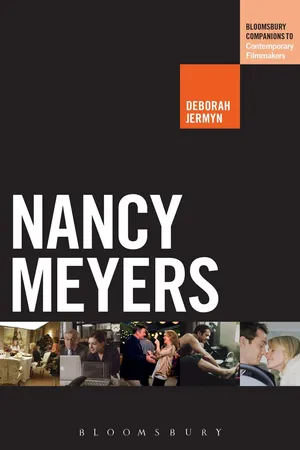
Nancy Meyers is acknowledged as the most commercially successful woman filmmaker of all time, described by Daphne Merkin in The New York Times on the release of It's Complicated as "a singular figure in Hollywood – [she] may, in fact, be the most powerful female writer-director-producer currently working". Yet Meyers remains a director who, alongside being widely dismissed by critics, has been largely absent in scholarly accounts both of contemporary Hollywood cinema, and of feminism and film. Despite Meyers' impressive track record for turning a profit (including the biggest box-office return ever achieved by a woman filmmaker at that timefor What Women Want in 2000), and a multifaceted career as a writer/producer/director dating back to her co-writing Private Benjamin in 1980, Meyers has been oddly neglected by Film Studies to date.
Including Nancy Meyers in the Bloomsbury Companions to Contemporary Filmmakers rectifies this omission, giving her the kind of detailed consideration and recognition she warrants and exploring how, notwithstanding the challenges authorship holds for feminist film studies, Meyers can be situated as a skilled 'auteur'. This book proposes that Meyers' box-office success, the consistency of style and theme across her films, and the breadth of her body of work as a writer/producer/director across more than three decades at the forefront of Hollywood, (thus importantly bridging the second/third waves of feminism) make her a key contemporary US filmmaker. Structured to meet the needs of both the student and scholar, Jermyn's volume situates Meyers within this historical and critical context, exploring the distinctive qualities of her body of work, the reasons behind the pervasive resistance to it and new ways of understanding her films.
- 272 pages
- English
- ePUB (mobile friendly)
- Available on iOS & Android
eBook - ePub
Nancy Meyers
About this book
Information
1
Key Collaborative Relationships
Meet the Shmeyers: Meyers as Writer-Producer and the ‘Writing Couple’ Leitmotif
As we saw in the Introduction, throughout the 1980s and 1990s Nancy Meyers was part of a hugely successful filmmaking team with her long-term collaborator, and romantic partner, Charles Shyer. Despite their prominence as filmmakers in this era, till now, no scholarship has explored their partnership. Yet the kind of labour I undertake here, tracing and unravelling how this foremost woman practitioner was ‘packaged’ and constructed in particular, digestible ways for/by the industry within this partnership, is crucial to the feminist project of understanding and addressing the manifold processes that work to keep women filmmakers pigeonholed and marginalized. In seeking to interrogate this background to Meyers’s career as a director, this chapter makes another significant and original contribution to placing Meyers within a feminist film history. To undertake this work, in what follows, I draw predominantly on the archival press and publicity cuttings held at the Margaret Herrick Library of the Academy of Motion Picture Arts and Sciences in LA, which extend to a variety of (pre-internet) local LA newspapers, press releases and the trade and industry press, as well as women’s magazines, drawn from the 1980s to the 1990s.1 To understand what ‘Nancy Meyers’ means, and to understand how gendered discourses inform how men and women directors are disseminated differently, it is clearly not sufficient to only analyse her oeuvre. Instead, in keeping with previous work I have undertaken on Kathryn Bigelow (Jermyn, 2003), and notwithstanding the extent to which Meyers is still not generally popularly recognized, one must ask how she has been fashioned, conveyed and sold as a particular kind of (female filmmaker) figure in the public domain. These sources thus provide an invaluable opportunity and form rich intertextual evidence with which to reconstruct how Meyers’s and Shyer’s partnership was shaped and circulated in this period, extending and informing our understanding of how her career and status in Hollywood evolved.
This chapter will underline how an exploration of the pair’s work and relationship (or rather representations of their relationship) is evidently crucial to understanding and contextualizing Meyers’s career trajectory, and not solely because of the length, breadth and entwinedness of their shared professional lives over two decades. Beyond this, as a woman breaking into the business at the start of her career, the fact that Meyers initially constituted one-half of a male-female duo would have helped open doors to her in the late 1970s, and indeed beyond, that would likely have otherwise proven infinitely harder to wedge ajar alone. Meyers has indicated her own sense that working with a male partner made her a more palatable prospect for the industry, having remarked, ‘I know the fact that there was a man in the room with me all those years made the medicine go down’ (Merkin, 2009; see also Topel, 2006: 272). Furthermore, Shyer importantly came with industry contacts and a pedigree that Meyers did not have. In addition to his own writing and directing experience (a production background which, as he put it, ‘was one of the main reasons they let us produce Private Benjamin’ (cited in Blair, 1995: 63)), his father, director Melville Shyer, was one of the founders of the Directors Guild of America (Martinez, 1987: 6), who had worked as the First AD on renowned films including Fritz Lang’s Scarlet Street (1945) and Robert Siodmak’s The Killers (1946). But it is important to clarify here that recognizing how Shyer may have helped Meyers’s early career get started in this manner is in no way at all to suggest that he somehow discovered or mentored a talent that was only nascent before they met, or that her entry into the industry was thus not entirely deserved because it was aided by some kind of nepotism. Rather, it is to acknowledge the extent of the endemic sexism rampant in the industry at this time (which endures to this day) – and by extension, to reflect on how much equally promising female talent was (and continues to be) shut down by a relentlessly male-dominated business. On the one hand, Meyers has said, ‘In terms of writing, I didn’t feel any prejudice’ (Topel, 2006: 272). Yet in a shocking recollection she has also described the outrageous conditions that were attached to her contract as a writer-producer on Private Benjamin, recounting, ‘This is how backwards the movie business was then. It was in my contract that I could never be on the set alone as the only producer. My male partner had to be there’ (Bayou, 2013).
Rochlin describes the Meyers-Shyer partnership in a piece for the New York Times publicizing the release of What Women Want; ‘For years they were sold as the film industry’s united front, the happy couple who made well-cast, wholesome movies that featured a lot of laughs, some poignant interludes and their daughters [in] cameo roles’ (2000). Such was their early success that by the time of Baby Boom in 1987, the second of their co-written enterprises as a duo directed by Shyer, they had it stipulated in their contracts that no rewrites by anyone but themselves were permitted on their scripts (Rosenfeld, 1987; Galbraith, 1988). To more fully grasp Meyers’s history and oeuvre, then, it is crucial to trace her partnership with Shyer and how this shaped her entry into the business. Arguably, it would be unfeasible to attempt to identify if and where one might distinguish and extract Meyers’s particular authorial voice in this earliest (team)work, as a co-producer and co-writer working alongside the man who was also her domestic partner (later father to their two daughters, and husband). At the same time, unquestionably, themes and motifs emerge in these collaborations that remain cornerstones of Meyers’s later directorial work, including her interest and active participation in design from the start. She has told how, for example, she used some of her own furnishings and clothes on Irreconcilable Differences, in part because of the low budget (Bayou, 2013); elsewhere in a 1987 interview in which the pair discuss how they share labour and responsibilities, Shyer observes, ‘Nancy spends a lot of time with the designers,’ and Meyers chips in, ‘I am very concerned with that aspect of the film’ (Martinez, 1987: 6). Yet it is ultimately impossible, of course, to unravel the intricacies at work in a long-term collaborative relationship of the kind shared by Meyers and Shyer – a relationship so close in this instance that they were collectively known in the industry as ‘the Shmeyers’ (or ‘the Shymers’ in some accounts) (see for example, Bernard, 1995; Fink, 1998; Rochlin, 2000; Meyers, 2010).
Meyers and film as collaboration
Indeed, this last point underlines one of the key criticisms long levied against the authorship approach in Film Studies, as already alluded to in the Introduction: how does one disentangle the multiple influences at work in a collaborative art? How does one relegate or elevate the roles of writer, director and producer – or other creative roles – in this process? Indeed, as noted, we have seen that Meyers’s particular eye for a kind of seemingly (and misleadingly) effortlessly tasteful and elegant interior design has been identified as key to the existence of a ‘Meyers style’; that she has spoken about how her interior decorator mother influenced her formative interests in this respect (Merkin, 2009); and she has observed how as a writer and producer long before becoming a director, she sought from the outset of her career to play an active part in design. For example, she recalls having ‘a bit of a war’ with the set decorators on Private Benjamin about whether Judy’s childhood bedroom would have contained high school photos of her in the hockey team (Meyers maintained Judy would not have played hockey and thus this detail was erroneous to her character. They were removed) (Bayou, 2013). But even here, in the realm of interior design and mise-en-scène, the arena in which Meyers is most readily credited with a filmic ‘signature’, it is worth noting, for example, that she has consulted with interior designer James Radin in three of her films – Something’s Gotta Give, The Holiday and It’s Complicated – so that even this distinctive feature of her work is one in which one can chart the importance of collaboration. Indeed, Radin’s website portfolio at www.jamesradin.com very much speaks to the ‘Meyers aesthetic’, and interestingly, off-screen, Radin also ‘did’ Meyers’s own home (Lennon, 2009; Abramovitch, 2012). Further, Meyers happily admits to the importance of her regular, long-term collaborators to her oeuvre and her working practices, telling The Hollywood Reporter that while the quality she wishes she had as a director is ‘a looseness, sort of an ease’, what helps her in the absence of this is that ‘I have worked in collaboration. It is so great to have somebody to turn to that you trust. To just know there is another person that is as involved as you are’ (Galloway, 2007).
Outside of Shyer, then, this list of recurrent collaborators (working with her across at least three or more films) extends among others to Suzanne Farwell, who has moved over the years from being Meyers’s assistant on The Parent Trap to a producer on The Intern, by way of being president of Waverly Films (Meyers’s production company at Columbia Pictures) from 2001 to 2004 and co- or executive-producer of Something’s Gotta Give, The Holiday and It’s Complicated; Bruce A. Block (who worked as an associate or co-producer on numerous of the Shmeyers’s films and the Baby Boom TV series, then subsequently as co-producer on The Parent Trap and What Women Want, and producer on Something’s Gotta Give and The Holiday, as well as a second unit director on numerous of these); Dean Cundey (director of photography for The Parent Trap, What Women Want and The Holiday), who Meyers especially credits for helping her through the challenging split-screen process on The Parent Trap (‘[He’d] done a lot of effects films, like Who Framed Roger Rabbit and Jurassic Park. He was the absolutely right guy for me and really helped me’ (Dawes, 2009)); Jon Hutman (production designer for What Women Want, Something’s Gotta Give, The Holiday, It’s Complicated); K. C. Colwell (First AD on What Women Want, Something’s Gotta Give, The Holiday and It’s Complicated, as well as earlier Shmeyers’s movies); Hans Zimmer (music for Something’s Gotta Give, The Holiday and It’s Complicated) and Joe Hutshing (editor The Holiday; Something’s Gotta Give; It’s Complicated) (all credits from imdb).2 Her relationship with four-time Best Film Editing Academy Award nominee and double-Oscar winning Hutshing is evidently hugely valued by Meyers, for example. She has said of him, ‘I love working with Joe. We have a really safe relationship in the cutting room. We’re allowed to try things and really have fun’ (Dawes, 2009). Explaining their practices in more detail at the Writers Guild Foundation, she describes their close and trusting collaborative partnership in the edit suite and throughout production, saying,
He is a fabulous film editor that I love and I love being locked in a room with him all day, I really do ... He’s a great collaborator and he lets me be me. If I want to see every inch of everything I shot and it takes us two days to look at all the footage, he never says, ‘Do we really have to watch all the takes of every ... ?’ ... And I look at everything, I really do ... which is why when I’m doing a lot of takes and the actors are rolling their eyes at me I say, ‘You know, I look at all this stuff ... ’ And I make an insane amount of notes, every night I email him after shooting, which is a process he and I have come to that really works ... he doesn’t see dailies with me ... we don’t talk that much in the day ... so I send him notes every night ... and it’s always great to hear what he thinks because he’s not there in the moment, he’s separate from it like the audience. If he says ‘It didn’t really work for me’, that’s a great thing for me to hear. (Writers Guild Foundation, 2010)
Meyers’s account here also points to the professed fastidiousness of her working practices – how she writes ‘an insane amount of notes’ every night after shooting, how she re-watches every take in the edit suite with Hutshing. Still, her history with Shyer remains foremost among her collaborative relationships. Early interviews with Meyers and Shyer recurrently point to how closely enmeshed the couple’s practices as co-writers were, and how the lines of their work blurred, both on set and at home. A 1985 interview with the L.A. Herald-Examiner, for example, notes their ‘huge office in back ... with special screenwriting desks that face each other’ (Cherubin, 1985: B1). A couple of years later, in an interview with Drama-Logue (the former West coast weekly theatre trade newspaper) following the release of Baby Boom, Meyers explained how they work in the following fashion:
There are definite things we do divide up but, generally, everything is worked on by both of us. I’ll write something and give it to him. He’ll re-write it and give it back to me. Then I’ll re-write that. We’ll then just throw out ideas to one another. It is never a matter of one person sitting down and writing while the other does something else. We are usually always together during the process. (Martinez, 1987: 6)
Shyer goes on to describe how on set Meyers is always watching a monitor hooked up to the camera while he directs, following every scene as it is shot and ‘as the camera sees it. After we do a scene, Nancy and I will talk about it. It’s a great way of working’ (ibid.). In this vein, a 1994 art...
Table of contents
- Cover
- Half Title
- Dedication
- Series Information
- Title Page
- Contents
- List of Illustrations
- Acknowledgements
- Preface
- Introduction: Women, Hollywood and the Politics of the Popular
- 1 Key Collaborative RelationshipsMeet the Shmeyers: Meyers as Writer-Producer and the ‘Writing Couple’ Leitmotif
- 2 Ways of Watching‘The Romcom Queen’: Gender, Genre and Cultural Value
- 3 Rethinking AuthorshipThe Wrong Kind of Woman Filmmaker? Meyers and the Quandaries of the Female Auteur
- 4 Key Concepts‘Your Age Is One of My Favourite Things About You’: Meyers’s Older Women and the Gendered Experience of Ageing
- Conclusion
- Bibliography
- Index
- Copyright Page
Trusted by 375,005 students
Access to over 1.5 million titles for a fair monthly price.
Study more efficiently using our study tools.
Frequently asked questions
Yes, you can cancel anytime from the Subscription tab in your account settings on the Perlego website. Your subscription will stay active until the end of your current billing period. Learn how to cancel your subscription
No, books cannot be downloaded as external files, such as PDFs, for use outside of Perlego. However, you can download books within the Perlego app for offline reading on mobile or tablet. Learn how to download books offline
We are an online textbook subscription service, where you can get access to an entire online library for less than the price of a single book per month. With over 1.5 million books across 990+ topics, we’ve got you covered! Learn about our mission
Look out for the read-aloud symbol on your next book to see if you can listen to it. The read-aloud tool reads text aloud for you, highlighting the text as it is being read. You can pause it, speed it up and slow it down. Learn more about Read Aloud
Yes! You can use the Perlego app on both iOS and Android devices to read anytime, anywhere — even offline. Perfect for commutes or when you’re on the go.
Please note we cannot support devices running on iOS 13 and Android 7 or earlier. Learn more about using the app
Please note we cannot support devices running on iOS 13 and Android 7 or earlier. Learn more about using the app
Yes, you can access Nancy Meyers by Deborah Jermyn in PDF and/or ePUB format, as well as other popular books in Médias et arts de la scène & Direction et production de films. We have over 1.5 million books available in our catalogue for you to explore.