In 1896, Maxim Gorky declared cinema "the Kingdom of Shadows." In its silent, ashen-grey world, he saw a land of spectral, and ever since then cinema has had a special relationship with the haunted and the ghostly. Cinematic Ghosts is the first collection devoted to this subject, including fourteen new essays, dedicated to exploring the many permutations of the movies' phantoms.
Cinematic Ghosts contains essays revisiting some classic ghost films within the genres of horror (The Haunting, 1963), romance (Portrait of Jennie, 1948), comedy (Beetlejuice, 1988) and the art film (Uncle Boonmee Who Can Recall His Past Lives, 2010), as well as essays dealing with a number of films from around the world, from Sweden to China. Cinematic Ghosts traces the archetype of the cinematic ghost from the silent era until today, offering analyses from a range of historical, aesthetic and theoretical dimensions.
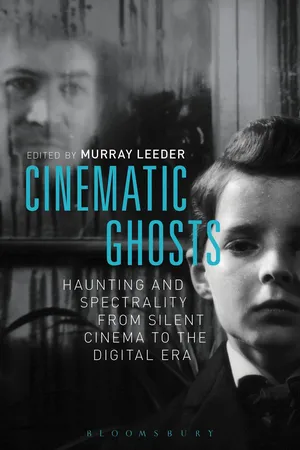
eBook - ePub
Cinematic Ghosts
Haunting and Spectrality from Silent Cinema to the Digital Era
- 320 pages
- English
- ePUB (mobile friendly)
- Available on iOS & Android
eBook - ePub
About this book
Information
PART ONE
Ghosts of Pre-Cinema and Silent Cinema
1
Phantom Images and Modern Manifestations: Spirit Photography, Magic Theater, Trick Films, and Photography’s Uncanny
Ghosts. Cine recordings of the vivacious doings of persons long dead.
KEN JACOBS ON HIS FILM TOM, TOM THE PIPER’S SON
The rest of the company, with myself, seemed not to know whether or not there is any truth in these modern manifestations.
SUSAN B. ANTHONY, DIARY NOTATION IN 1854, ON A DISCUSSION OF SPIRITUALISM
While western culture’s valorization of the visual may be rooted in a tradition which identifies the conceivable with the visible (the idea with what one sees),1 there is no question that in the nineteenth century we enter into a new realm of visuality, and that it is the photograph that stands as its emblem.2 The key role of the photograph as a guarantor of a new realm of visual certainty comes from a network of interrelated aspects. First, to use (as others have)3 the vocabulary of Charles Sanders Peirce, there is the photograph’s dual identity as an icon, a bearer of resemblance, and as an index, a trace left by a past event. The idea that people, places, and objects could somehow leave behind—cause, in fact—their own images gave photography a key role as evidence, in some sense apodictic. Essential to the belief system which photography engendered was the fact that the image was created by a physical process over which human craft exerted no decisive role. Photography was therefore a scientific process, free from the unreliability of human discourse. Photography could serve as both tool of discovery and means of verification in a new worldview constructed on an investigation of actual entities explored through their visible aspects.
However, if photography emerged as the material support for a new positivism, it was also experienced as an uncanny phenomenon, one which seemed to undermine the unique identity of objects and people, endlessly reproducing the appearances of objects, creating a parallel world of phantasmatic doubles alongside the concrete world of the senses verified by positivism. While the process of photography could be thoroughly explained by chemical and physical operations, the cultural reception of the process frequently associated it with the occult and supernatural. Balzac gives a good example of this in a digression in his novel Cousin Pons which states that Daguerre’s invention has proved “that a man or a building is incessantly and continuously represented by a picture in the atmosphere, that all existing objects project into it a kind of spectre which can be captured and perceived.”4
Balzac’s description shows his ability to defamiliarize the surfaces of reality through poetic re-description. But more than that, it testifies to a widespread understanding of photography that paralleled (without necessarily contradicting) its official role as scientific record of visual reality. At the same time that the daguerreotype recorded the visual nature of material reality it also seemed to dematerialize it, to transform it into a ghostly double. However, before one sees in Balzac’s conception a simple return to a Platonic idealism in which the eidos of every object seems to hover around it and photography becomes the proof of idealism, one must note the decentering implications of this description. Every object, place, and person is continuously radiating these images (a process that Balzac’s friend the photographer Nadar remembered the writer describing to him as a constant shedding of an immaterial skin5). Rather than representing an ur-form of these objects, the only true reality as in Plato’s idealism, these images are constantly cast off, like a sort of detritus. Photography simply retains some of them. This process of individual entities constantly broadcasting normally imperceptible signals, which can be received as images, exemplifies an extraordinary new mythology of modernity as it confronted technological change. Unlike official allegories which vaunted the forces of commerce and technology with desiccated images from classical mythology, this modern mythology welcomed the dissolving effects of modernity into the core of its metaphysics.
When I call this early reception of photography uncanny, I hope to summon all the resonances of this term. Thanks to Freud’s English translator’s decision to render his complex German term unheimlich by “uncanny,” the specter of Freud’s famous essay arises irrepressibly. Since my principal topic in this essay will be the use of photographs to document the presence of spirits, this visitation is not at all unwelcome. Among the themes that Freud relates to the experience of the uncanny is that of the double. And it is my thesis that was the uncanny ability of photography to produce a double of its subject that gave it its unique ontology as much as its existential link with its original source. This extraordinary reproductive quality now seems so familiar that it takes the defamiliarization of initial reception such as Balzac’s to restore to us an original sense of amazement.
The theme from “The Uncanny” that most inflected Freud’s future writing was that of repetition, which followed from his discussion of the double. It was the fascination with repetition, first broached in this essay, that led Freud to discover the compulsion to repeat and ultimately led him beyond the pleasure principle to a confrontation with the death drive and his late posing of the conflict between Eros and Thanatos.6 Freud admits that the connection between repetition and the uncanny may not seem obvious at first sight. However, he adds, under certain circumstances and conditions repetition does arouse an uncanny sensation, one which recalls “the sense of helplessness experienced in some dream states.” As an example he narrates an experience of his own:
As I was walking one hot summer afternoon, through the deserted streets of a provincial town in Italy which was unknown to me, I found myself in a quarter of whose character I could not remain long in doubt. Nothing but painted women were to be seen at the windows of the small houses, and I hastened to leave the narrow street at the next turning. But after having wandered about for a time without enquiring my way, I suddenly found myself back in the same street, where my presence was now beginning to excite attention. I hurried away once more only to arrive by another detour at the same place yet a third time. Now, however, a feeling overcame me which I can only describe as uncanny, and I was glad enough to find myself back at the piazza I had left a short while before, with-out any further voyages of discovery.7
We could compare it to an extraordinary literary work from 1875, which chronicles a similarly obsessive and uncanny urban labyrinth. In Villiers de L’Isle-Adam’s short story “The Very Image,” a businessman on his way to an appointment wanders somewhat accidentally into an imposing building which rises before him “like a stone apparition” but has a curiously hospitable air about it. As Villiers describes it:
I promptly found myself before a room with a glass roof through which a ghastly light was falling.
There were pillars on which clothes, mufflers, and hats had been hung.
Marble tables were installed on all sides.
Some people were there with legs outstretched, heads raised, staring eyes and matter of fact expressions, who appeared to be meditating.
And their gaze was devoid of thought and their faces the color of the weather.
There were portfolios lying open and papers spread out beside each one of them.
And then I realized that the mistress of the house, on whose courteous welcome I had been counting, was none other than Death.8
The narrator had wandered into the Paris morgue, a site open to the public in the nineteenth century, where gawkers could gaze on unclaimed corpses laid out on stone tables beneath dripping water taps.
The narrator rushes to get a cab to keep his appointment. However, arriving at the arranged rendezvous, he:
promptly found myself in a room into which a ghastly light was filtered through the windows.
There were pillars on which clothes, mufflers, and hats had been hung … .9
And the text repeats with minuscule variations its previous description. The narrator returns home, resolving never again to do business, and shudders as he stresses that “the second glimpse is more sinister than the first.”10
Several things are striking about this convergence of texts. First, Villiers had understood several decades before Freud the uncanny effect of repetition. Second, the confrontation with the repressed, here death and in Freud commercial illicit sex, comes through a sort of helpless surrender of the dream logic of urban topography. However timeless the effects of the unconscious may be, we see again how often in Freud they illuminate the new experiences of modernity. And finally and most importantly for my thesis, the effect of repetition, particularly in Villiers, inevitably recalls the possibilities of photography. Although Villiers evokes his capture in a closed circuit of time through repetition of a verbal text, this description summons up memories of film loops, of the uncanny possibilities of a photographic repetition of situations and actions.11 And it is this effect of exact duplication, I believe, that makes the second glimpse, the double of the first, so sinister.
Although Freud does not cite the way photography evokes to the “constant recurrence of the same thing”12 explicitly, it does haunt the margins (or at least the footnotes) of the essay. His discussion of the double proceeds from Otto Rank’s classic essay on the theme, which—as Freud notes—began with a consideration of a film: the Hanns Heinz Ewers-Stellan Rye-Paul Wegener 1913 production of The Student of Prague. This early classic of the German uncanny cinema portrayed its unearthly double through the old photographic trick of multiple exposures (which was likewise essential to both the spirit photographers I shall discuss and the filmmaking of Georges Méliès).13 While both Freud and Rank demonstrate that the double has a long lineage (from archaic beliefs in detachable souls to the romantic Doppelganger) that predates photography, nonetheless photography furnished a technology which could summon up an uncanny visual experience of doubling, as much as it was capable of presenting facts in all their positivity and uniqueness.
Balzac wrote his description of photography about a decade after Daguerre’s first successful experiments. While Cousin Pons was being published in 1846, the United States was seized by a different sort of manifestation which led to a new worldwide metaphysical system, spiritualism. First in the small village of Hydesville, New York, and later in the city of Rochester (coincidentally to become the industrial home of both Eastman Kodak company and Xerox), a pair of young girls, the Fox sisters, were subject to a consistent rapping noise, which was eventually interpreted as a coded message from a spirit of a murdered peddler. Taken under the management of an older sister, the Fox girls soon became the center of a new movement based on communicating with the dead through séances at which rapped-out messages were received and inspired communications obtained during trances.14 Although ideas of necromancy and other forms of intercourse with the dead are universal, the modernity of the Fox sisters and related phenomena was generally recognized and hailed by many as a new revelation. Spiritualism soon had an international following, but the sense of America as the land of the future and the home of the latest technology gave the Fox sisters’ revelations an added connotation of apocalyptic modernity, and later American mediums an added authority.
The spiritualist movement related its revelations to modern changes in technology and science, such as electricity, telegraphy, and new discoveries in chemistry and biology,15 showing the sort of merging of pseudoscience and spirituality that Robert Darnton found surrounding mesmerism in prerevolutionary France.16 Although this was primarily a means of endowing their new revelations with the growing authority of recent inventions,17 there are also indications that the mentalit...
Table of contents
- Cover
- Halftitle Page
- Title Page
- Contents
- Acknowledgments
- Introduction
- Part One: Ghosts of Pre-Cinema and Silent Cinema
- Part Two: Cinematic Ghosts from the 1940s through the 1980s
- Part Three: Millennial Ghosts
- Afterword: Haunted Viewers
- List of Contributors
- Index
- Imprint
Trusted by 375,005 students
Access to over 1.5 million titles for a fair monthly price.
Study more efficiently using our study tools.
Frequently asked questions
Yes, you can cancel anytime from the Subscription tab in your account settings on the Perlego website. Your subscription will stay active until the end of your current billing period. Learn how to cancel your subscription
No, books cannot be downloaded as external files, such as PDFs, for use outside of Perlego. However, you can download books within the Perlego app for offline reading on mobile or tablet. Learn how to download books offline
Perlego offers two plans: Essential and Complete
- Essential is ideal for learners and professionals who enjoy exploring a wide range of subjects. Access the Essential Library with 800,000+ trusted titles and best-sellers across business, personal growth, and the humanities. Includes unlimited reading time and Standard Read Aloud voice.
- Complete: Perfect for advanced learners and researchers needing full, unrestricted access. Unlock 1.5M+ books across hundreds of subjects, including academic and specialized titles. The Complete Plan also includes advanced features like Premium Read Aloud and Research Assistant.
We are an online textbook subscription service, where you can get access to an entire online library for less than the price of a single book per month. With over 1.5 million books across 990+ topics, we’ve got you covered! Learn about our mission
Look out for the read-aloud symbol on your next book to see if you can listen to it. The read-aloud tool reads text aloud for you, highlighting the text as it is being read. You can pause it, speed it up and slow it down. Learn more about Read Aloud
Yes! You can use the Perlego app on both iOS and Android devices to read anytime, anywhere — even offline. Perfect for commutes or when you’re on the go.
Please note we cannot support devices running on iOS 13 and Android 7 or earlier. Learn more about using the app
Please note we cannot support devices running on iOS 13 and Android 7 or earlier. Learn more about using the app
Yes, you can access Cinematic Ghosts by Murray Leeder in PDF and/or ePUB format, as well as other popular books in Media & Performing Arts & Film & Video. We have over 1.5 million books available in our catalogue for you to explore.