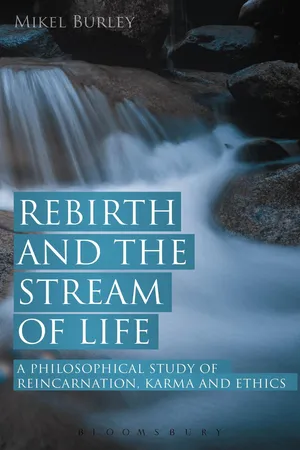
eBook - ePub
Rebirth and the Stream of Life
A Philosophical Study of Reincarnation, Karma and Ethics
- 208 pages
- English
- ePUB (mobile friendly)
- Available on iOS & Android
eBook - ePub
About this book
Rebirth and the Stream of Life explores the diversity as well as the ethical and religious significance of rebirth beliefs, focusing especially on Hindu and Buddhist traditions but also discussing indigenous religions and ancient Greek thought. Utilizing resources from religious studies, anthropology and theology, an expanded conception of philosophy of religion is exemplified, which takes seriously lived experience rather than treating religious beliefs in isolation from their place in believers' lives. Drawing upon his expertise in interdisciplinary working and Wittgenstein-influenced approaches, Mikel Burley examines several interrelated phenomena, including purported past-life memories, the relationship between metaphysics and ethics, efforts to 'demythologize' rebirth, and moral critiques of the doctrine of karma. This range of topics, with rebirth as a unifying theme, makes the book of value to anyone interested in philosophy, the study of religions, and what it means to believe that we undergo multiple lives.
Information
Chapter 1
VARIETIES OF REBIRTH
Belief in rebirth, in one form or another, has been around for millennia. Some scholars have speculated that it may have arisen ‘contemporaneously with the origins of human culture per se’ (Long 1987: 265).1 So, too, is it geographically diffuse, some version of it being present among myriad peoples, in numerous religions and philosophical schools of thought. Besides the major traditions deriving from South Asia, those who have professed a belief in rebirth (or at least to whom such a belief has commonly been attributed) include the following: Orphics, Pythagoreans and Platonists in ancient Greece;2 Manichaeans, who flourished from Europe to southern China between the third and seventh centuries ce;3 Chinese Daoists influenced by Buddhism during the fifth century ce and thereafter;4 certain Jewish sects, especially Kabbalists from the twelfth century onwards;5 several religious traditions largely rooted in Islam, notably the Alevis, Druze, Ismā‘īlīs and Nuṣayrīyah (or ‘Alawites);6 adherents of the syncretic Ahl-e Haqq religion based in Iranian Kurdistan;7 Gnostic-influenced forms of Christianity, including the so-called Cathars of the eleventh to fourteenth centuries;8 many Native American and Inuit communities;9 a number of peoples from Africa, such as the Yorùbá, Igbo and Beng of West Africa, the Nandi of East Africa and the Betsileo of Madagascar;10 the Jívaro people of eastern Ecuador;11 Brazilian Spiritist and Umbanda movements from the second half of the nineteenth century onwards;12 Melanesian peoples such as the Trobriand Islanders;13 various followers of Pagan or Neo-Pagan paths;14 a large number of New Age groups and practitioners;15 and a plethora of New Religious Movements.16 Furthermore, it has been claimed that belief in rebirth is growing in popularity among people who would not typically associate themselves with any of the foregoing cultural or religious groups, and is becoming a ‘mainstream option’ in the United Kingdom and other western countries.17
A single book, let alone a single chapter, can hardly do justice to even a small proportion of these multifarious traditions, groups, movements and individuals; hence I do not propose to attempt a comprehensive or systematic survey. Rather, in order to provide a basis from which to venture into more specific philosophical inquiries, the present chapter sets out to offer an overview of salient themes in rebirth traditions and to introduce some useful conceptual distinctions. Without presuming to have devised an exhaustive typology, I cite selected examples to illustrate a range of similarities and differences that obtain across the traditions concerned, thereby building up a nuanced picture of the multiplex phenomenon that constitutes the subject of this book. Types of rebirth belief can be distinguished from one another along several dimensions. In this chapter I distinguish between them first in terms of their soteriological orientations, and then, over two further sections, in terms of the kind of connection or correlation that they suppose to exist between lifetimes in any particular succession of rebirths. Of the many modes of connection that could be mentioned, I have opted to highlight those which I term retributive, affinitive and consanguineous respectively. Each of these forms a broad category which could be subdivided beyond the degree of conceptual refinement that I have brought into play. But rather than try to capture every quirk and peculiarity of the traditions discussed, my aim is simply to point towards the diversity that exists, thereby guarding against any premature suppositions concerning what rebirth beliefs ‘must’ be like.
Soteriological Orientations
Rebirth beliefs are typically closely aligned with specific conceptions of the value and purpose of life, and these latter conceptions often envisage all of life, or human life in particular, as having a direction or goal. When the goal is conceived as a kind of salvation, or as a spiritual liberation or fulfilment, then we may meaningfully speak of a vision of life as having a soteriological orientation.18 A rebirth belief need not necessarily be accompanied by such an orientation; it might simply comprise the idea that people, or other living beings, are in some sense reborn after they die, without this entailing that the process of ongoing death and rebirth is directed towards a salvific end. In this section I shall consider two main types of soteriological orientation, which I call cessative and affirmatory respectively; these will then be compared and contrasted with a third type of orientation, which is in effect non-soteriological. I readily admit that talk of ‘types’ carries with it dangers of over-simplification. However, while the glossing over of some details and idiosyncrasies is unavoidable, this can be mitigated by grounding the discussion in particular examples rather than letting it float off into ‘ideal typical’ abstractions.
I am borrowing the term ‘cessative’ from Stuart Sarbacker, who distinguishes between the ‘numinous and cessative dimensions of yoga and meditative practice in the Hindu and Buddhist context’ (2005: 1). For my purposes the ‘numinous’ can be set aside, and although Hinduism and Buddhism are of central importance, it need not be with these traditions alone that the term ‘cessative’ is associated. Sarbacker is concerned specifically with meditative discipline, but the idea of a cessative dimension – one that ‘emphasizes the attainment of freedom through separation from phenomenal existence’ (ibid.) – can be applied to a soteriological orientation to life more generally. In the context of conceptions of rebirth, it becomes the view that the flow or cycle of existence from life to death to rebirth – known as saṃsāra in the South Asian traditions – is not an end in itself but something ultimately to be brought to cessation.
It is sometimes assumed that a belief in rebirth is motivated by ‘the instinctive love of life and desire for continued existence after death’ (Dasgupta 1965: 212). Although in some cases this may be true, cessative soteriologies portray the succession of our lives as an arduous and meandering trudge that must be ended sooner or later; and if one is a spiritual adept who has dedicated one’s existence to the soteriological quest, then in principle the sooner it is ended the better. This ostensibly pessimistic apprehension of worldly life is vividly depicted in a passage from the Indian Mārkaṇḍeya Purāṇa (c. third to ninth centuries ce), wherein an embryo in the womb is imagined as becoming dispirited by the recollection of its numerous previous lives. ‘I won’t ever do that again’, it thinks, vowing to take precautions in its imminent lifetime to avoid having to return on any future occasion. Each of us, the text adds, ‘wanders on the wheel of rebirth [saṃsāra-cakra] like the bucket on the wheel of a well’ (11.13–15, 21, trans. O’Flaherty 1988: 98).19 From this point of view, the goal is not to remain on the wheel, feeling thankful for yet another opportunity to experience the wonders of life, but rather to strive for ‘release’ (mokṣa, mukti).20
How this release or liberation is conceptualized varies between different South Asian traditions, as do understandings of how it is most effectively to be secured. One tendency is found in certain devotional movements, in which what is aimed at is an ecstatic encounter with the divine, or ‘total absorption’ therein, achieved by means of an intensification of amorous emotionality and the grace of one’s beloved deity (McDaniel 1989; Talib 1979). An alternative tendency is towards detachment from and the progressive diminution of affective impulses. In Buddhism the culmination of this process is conceived as the ‘blowing out’ (nirvāṇa in Sanskrit, nibbāna in Pāli) of the three fires, namely passion, hatred and delusion.21 In ‘non-dualist’ Vedānta liberation is held to be precipitated by an ‘immediate knowledge’ of brahman and ātman – that is, by knowledge of the depth of universal being and the depth of the self, and of the identity or ‘non-difference’ between them – which is gained ‘through proper understanding of sacred texts, not by devotion or works’ (Fort 1998: 5).22 In classical Sāṃkhya and Yoga it consists in the ‘aloneness’ (kaivalya) of the conscious subject (puruṣa), having realized through sustained meditation its non-identity with everything that constitutes the world of its experience (prakṛti) (Burley 2004, 2012b). In Jainism it is said to take the form of ‘perfect knowledge’ or ‘unlimited, absolute, direct omniscience’ (kevala-jñāna);23 achieved by adhering to a stringent regime of ethical conduct and contemplation, this knowledge remains latent in the living soul until various contaminating factors, known as karmas, have been eradicated.24
When reflecting upon these conceptions of a final ‘release’ from the stream of life we should not overlook differences between the normative soteriological injunctions of a given religious tradition on the one hand and the daily lived activity of most followers of that tradition on the other. Some theorists make a distinction along these lines when they distinguish highly dedicated practitioners or ‘religious virtuosos’, who are often monastics or wandering mendicants, from the great majority of religious adherents, comprising various types of lay followers.25 We should be wary, however, of assuming that the ‘virtuosic’ practitioners consistently do what their sacred scriptures say they ought to be doing. In particular, it would be unwise to assume that textual descriptions of recondite ‘states of consciousness’ necessarily correspond to the achievements of most monks and nuns or even to those of the authors of the texts themselves; these authors might simply have been basing their accounts on accepted formulations in the absence of any first-hand experience.26
Pertinent to these considerations is a distinction, introduced by Melford Spiro in his study of Buddhism in Burma, between what he designates nibbanic and kammatic Buddhism.27 The first of these is so called because it is ‘an ideology of radical salvation’ that vigorously advocates striving for the final goal of nibbāna (Spiro 1982: 66). Whether the members of the monastic order who do the advocating are themselves follow...
Table of contents
- Title
- Contents
- Acknowledgements
- Abbreviations
- Introduction Thinking about Rebirth
- Chapter 1 Varieties of Rebirth
- Chapter 2 Remembering Having Lived Before?
- Chapter 3 Finding Meaning in Multiple Lives
- Chapter 4 Integrating Rebirth and Ethics
- Chapter 5 Demythologizing Rebirth?
- Chapter 6 Karma and Evil
- Chapter 7 Conclusions
- Bibliography
- Index
- Copyright
Trusted by 375,005 students
Access to over 1.5 million titles for a fair monthly price.
Study more efficiently using our study tools.
Frequently asked questions
Yes, you can cancel anytime from the Subscription tab in your account settings on the Perlego website. Your subscription will stay active until the end of your current billing period. Learn how to cancel your subscription
No, books cannot be downloaded as external files, such as PDFs, for use outside of Perlego. However, you can download books within the Perlego app for offline reading on mobile or tablet. Learn how to download books offline
Perlego offers two plans: Essential and Complete
- Essential is ideal for learners and professionals who enjoy exploring a wide range of subjects. Access the Essential Library with 800,000+ trusted titles and best-sellers across business, personal growth, and the humanities. Includes unlimited reading time and Standard Read Aloud voice.
- Complete: Perfect for advanced learners and researchers needing full, unrestricted access. Unlock 1.5M+ books across hundreds of subjects, including academic and specialized titles. The Complete Plan also includes advanced features like Premium Read Aloud and Research Assistant.
We are an online textbook subscription service, where you can get access to an entire online library for less than the price of a single book per month. With over 1.5 million books across 990+ topics, we’ve got you covered! Learn about our mission
Look out for the read-aloud symbol on your next book to see if you can listen to it. The read-aloud tool reads text aloud for you, highlighting the text as it is being read. You can pause it, speed it up and slow it down. Learn more about Read Aloud
Yes! You can use the Perlego app on both iOS and Android devices to read anytime, anywhere — even offline. Perfect for commutes or when you’re on the go.
Please note we cannot support devices running on iOS 13 and Android 7 or earlier. Learn more about using the app
Please note we cannot support devices running on iOS 13 and Android 7 or earlier. Learn more about using the app
Yes, you can access Rebirth and the Stream of Life by Mikel Burley in PDF and/or ePUB format, as well as other popular books in Philosophy & Ethics & Moral Philosophy. We have over 1.5 million books available in our catalogue for you to explore.