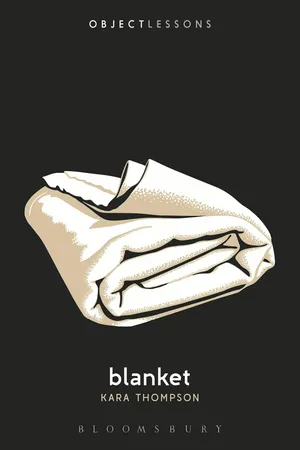
Object Lessons is a series of short, beautifully designed books about the hidden lives of ordinary things.
We are born into blankets. They keep us alive and they cover us in death. We pull and tug on blankets to see us through the night or an illness. They shield us in mourning and witness our most intimate pleasures.
Curious, fearless, vulnerable, and critical, Blanket interweaves cultural critique with memoir to cast new light on a ubiquitous object. Kara Thompson reveals blankets everywhere--film, art, geology, disasters, battlefields, resistance, home--and transforms an ordinary thing into a vibrant and vital carrier of stories and secrets, an object of inheritance and belonging, a companion to uncover.
Object Lessons is published in partnership with an essay series in The Atlantic.
eBook - ePub
Blanket
About this book
Information
Unfold 1
When I try to write about blankets, I tell a story about death.
1 WITNESS
The full metal jacket bullet is a kind of blanket object: an outer layer made of a copper alloy covers or blankets a softer core, usually made of lead. Because these bullets exit the bodies they penetrate, they create massive internal trauma and then go on to inflict even more damage. Police departments in the United States have increasingly switched to hollow-point bullets because they reduce “collateral damage”: These bullets fragment, fracture, and linger inside the first body they hit.1 But in international armed combat, in keeping with the 1899 Hague Declaration Concerning Expanding Bullets, the US military only activates full metal jackets.
The title of Stanley Kubrick’s 1987 film about the Tet Offensive refers to the ammunition soldiers used in the Vietnam War. But Full Metal Jacket also contends with the traumas of combat, which are repressed and later expressed in the anxious and tenuous seams between violence and homoeroticism. The first section of the film dramatizes the grueling itineraries of Marines basic training. The scenes focus on the failures of one private against the resilience of another as each endures the inflammatory insults of their drill instructor, Gunnery Sergeant Hartman. Hartman demands that Private James T. Davis, nicknamed “Joker” for his use of irony and sarcasm, must mentor, guide, and even cajole Private Leonard Lawrence, or “Pyle,” to complete the physical and mental tasks and tests of basic training. Hartman targets Pyle because of his size, his lack of athleticism, his desire for food, and (what gets portrayed as) his intellectual disability. Joker seems to take up the directive admirably. He exercises a teacher’s patience with an air of paternal, even coach-like, intimacy. In one scene, he encourages Pyle to climb a tall structure that resembles an oversized ladder; when Pyle reveals his fear by quietly crying and hesitating to throw his leg over the top bar in order to climb down the other side, Joker waits with him and repeats “Atta boy” and “That’s it.”
The scene shifts to the two in close proximity, nearly touching: Joker kneels at the head of a bed, and Pyle sits and watches intently as Joker shows him how to create a neat, taut, four-inch fold with blanket and sheet. The next montage confirms that Pyle has learned a great deal—he knows how to position his weapon, he can run and jump onto a rope, he jogs in formation. But after Hartman discovers at bed check that Pyle has hidden a jelly donut inside his footlocker, we sense a distinct shift, a kind of regression, which is made most obvious by infantilizing gestures against Pyle: Hartman commands him to suck his thumb while the others exercise in precise synchrony, and Joker dresses him (buttons his shirt, straightens his collar) while Pyle reveals his anxiety that everyone, including Joker, now “hates” him.
While most of these scenes are brightly lit by sun or overhead fluorescent light, a subsequent shot plunges into low light, a blue cast against a close shot of a white towel. Two hands appear to place a bar of soap on the towel. The hands wrap, twist, and tighten the towel around the soap; the moment concludes with a few strikes of the bed with this newly fashioned weapon. The next shot hovers on Joker in the same blue low light, awake and in bed. He stands up and looks at Pyle, sound asleep in the bunk above his. As all the men climb out of their beds swiftly and stealthily, dressed in identical stark-white boxers and white T-shirts, they amass and multiply like a horde of ghosts. Private Cowboy forces a gag into Pyle’s mouth while others cover him with a blanket—an aggressive swaddle. While Pyle is immobilized and unable to scream, the privates beat him with the bars of soap wrapped in towels, striking the blanket and thus his body, one after the other. As the men stream up to the bed to pummel Pyle, their faces morph into grimaces of exertion and exhilaration. Finally Cowboy, working to keep Pyle restrained, yells at Joker to “do it.” Joker stands back and strikes Pyle several times in a row with great force, and then slinks into the lower bunk while others remove the blanket and disperse. As Cowboy removes the gag he tells Pyle, “Remember, it’s just a bad dream, fat boy,” and the scene ends with Pyle’s cries of pain, shame, and shock while Joker lies below and covers his ears.
This scene dramatizes a hazing ritual military and fraternity cultures call a “blanket party.” While many scenes of trauma follow in Full Metal Jacket, the blanket party turns acutely disturbing because it stages the pain and violence in the quiet darkness of bedtime. The weapons and ammunition are domestic, intimate objects: soap, towels, and a blanket. And the one whom Private Lawrence trusts the most, the one who has provided the most care and tenderness, is the one who inflicts the harshest pain. The blanket, towels, and soap—the very objects they could use together in bed or in a shower—come to sanctify their intimacy as violent rather than pleasurable, thus betraying the often indeterminate distinction between the two. Remember, it’s just a bad dream, fat boy reminds Pyle, and us, that he occupies a different bodily and affective place among them: He’s the “fat boy” whose loud cries turn trauma outward, while the others cathect their pain into a bad dream. Remember transforms the sentence from a command into a lesson for Pyle’s conscious self to repress and cathect, to direct the pain not simply inward but to the unconscious, so that it becomes undetectable as such.
In 1980, five years after the Vietnam War, Post-Traumatic Stress Disorder (PTSD) appeared in the DSM-III (Diagnostic and Statistical Manual of Mental Disorders). The official recognition of PTSD as a mental-health condition codified a discourse and diagnosis for the presence and endurance of somatic and psychological forms of trauma that have always accompanied military service and combat.2 Trauma derives from the Greek τραῦμα, meaning wound, and initially referred to an external wound or bodily injury. But by the late nineteenth century, psychologists and psychoanalysts used the discourse of trauma to refer to psychic injury, turning attention to the brain itself as the primary organ from which biological and emotional functions originate.3 Though it is now an outmoded term (and yet still understood to be distinct from PTSD), World War I soldiers and veterans were diagnosed with “shell shock”—the first medicalized description of the imbricated physiological and emotional traumas caused by the technologies of war.4 The term is at once inescapably literal—the shock associated with the experience of exploding shells or artillery projectile bombs and shrapnel from mortars and grenades, which caused well over half of the 9.7 million military fatalities—and metaphorically rich, particularly if we take into account Freud’s speculative text on trauma published in the shadows of World War I.
Beyond the Pleasure Principle (1920) understands trauma as psychic and social, biological and cultural, external and internal. It asks readers to confront what may be counterintuitive: Trauma is a sensation (and even a form of pleasure) we are compelled to repeat precisely because we won’t remember the sensation as a site of trauma. And in this compulsion to repeat lies the tension between the conscious and unconscious ego. We seek to avoid the “unpleasure” that would be released if we were to liberate the repressed from the unconscious, but our instincts are compelled by the death drive. The pleasure principle aims, but ultimately fails, to guard against the stimulations from within, the “instincts” that drive us toward death. Beyond the Pleasure Principleforwards a theory, which Freud concedes may be difficult to abandon: Humans strive not forward, but instead toward an instinct or urge to revert backward, to an “earlier state of things.” There is, he argues, an “expression of the inertia inherent in organic life” (43). To illustrate this point, Freud turns to biology and metaphor. He invites readers to “picture a living organism in its most simplified possible form,” like a gastropod whose receptive layer, or shell, is turned outward (28). The shell absorbs the pleasures and stimulations of the external world to the point that it ceases to live. That simple organism would not survive the stimulations of the external world without the shell, which it acquires by death: “its outermost surface ceases to have the structure proper to living matter” and to some degree becomes “inorganic and thenceforward functions as a special envelope or membrane resistant to stimuli” (30). Protection against stimuli is almost more important, he maintains, than the reception of stimuli.
The full metal jacket, exploding artillery, and Joker’s blanket at once induce trauma and shock by their own material shells—the layers and forms of cover that penetrate a body, a soft target—and yet the shock that causes the psychic and somatic trauma is a result of a compromised shell. Shock is the breach of the shell (36). Joker’s blanket party exposes the blanket as a site and screen for trauma: the object through which their traumas pass, and the object that turns Pyle’s pain and sensation outward. The blanket functions as a shell that both protects from and produces shock. Pain and pleasure commingle in the blanket’s fibers. All “forms of sensation carry with them the trace of trauma. Every organism or body is by definition ‘sensitive,’ requiring some form of protection from the incursions of the outside world,” Ann Cvetkovich explains (53). Stimulation threatens, even if we seek and repeat it. To take the pleasure principle seriously is to understand that pleasure and its analogs (stimulation, penetration) marshal their apparent counterparts, pain and death, so that the body measures and modulates pleasure and unpleasure in order to survive.
Freud’s account of trauma and the death drive constructs a discourse of animacy: The shell or protective layer—once alive—hardens and eventually dies as it absorbs stimulations, so that even organic bodies live on the threshold between life and nonlife. The scaly-foot snail could be the wish fulfillment of Freud’s early twentieth-century speculations. These gastropods survive repeated crab attacks with their ingenious triple-layer blanket: under the outer shell, which they fabricate into iron with the help of bacteria and extreme heat produced from hydrothermal vents in the Indian Ocean, lies a thick but compliant middle layer followed by a strong, calcified interior. A recent study of scaly-foot snails, funded partially by the Department of Defense and led by Christine Ortiz, an associate professor of materials science and engineering at MIT, may help improve armor and other forms of cover for soldiers, police, and first responders—their shells, a medium on the verge of life and death, may serve as a prototype to protect humans from the penetration of bullets like the full metal jacket.5 The shell, the cover, and the blanket linger in elastic animacy.
When people die in their attempts to summit Mt. Everest, their bodies must be left where they lay. To climb Mt. Everest is to witness a terrain as an archive of death. Survivors cover the bodies with rocks, packs, or national flags in an attempt to mark their passing and hide them from view—blankets as witness marks and memorial covers. When blankets cover dead bodies, the viewer understands this is a body not embalmed for public display, but which nevertheless lies in public view—the result of an unexpected disaster or act of violence, a flash flood, a shooting, the detonation of a bomb. Since we know what’s underneath, what does the blanket conceal? Sometimes traces of life soak through. The blanket might relent to the body’s shape. What does it feel like to cover a body, one frozen in gestures of surprise or surrender? What does it feel like to be a blanket?6
Jane Bennett argues that something constructive “happens to the concept of agency once nonhuman beings are figured less as social constructions and more as actors, and once humans themselves are assessed not as autonomous but as vital materialities” (21). One never acts alone, but always in collaboration with other bodies and forces, what Bennett calls an agentic assemblage. A collaboration between blanket and human likely activated the agency of the variola virus, or smallpox, in the eighteenth and nineteenth centuries in order to kill or subdue Native peoples and nations who attempted to protect their homelands through both armed conflict and diplomacy. Variola infects most productively by way of the respiratory tract, by prolonged face-to-face contact. But it can live longer in scabs than in respiratory fluids, and the earliest attempts to inoculate a person infected with the virus used dried smallpox scabs stored and transported on scraps of paper, on threads, or in vases (Mayor 73, no. 7–8). While the veracity and verifiability of the “small-pox blanket” as a weapon of biological warfare have been repeatedly called into question, there is no doubt that blankets and other textiles can host the virus for a prolonged period. And British troops and settlers certainly understood the function of the blanket as trade currency and an agent of survival for Native peoples.
The Seven Years’ War ended officially in February 1763, after nine years of conflict for North American territory between Great Britain and France and their respective Native ally nations. But peace was elusive: Britain had seized a vast land space over which it had little to no control, and it was deeply in debt from nearly a decade of war. Its attempts to contend with both its financial crisis and its reach of power eventually led to the American Revolution. But alongside Great Britain’s conflicts with American settlers, British troops and colonial militias now fought Native nations who tried to protect their homelands and lifeways. From 1763 to 1766, Chief Pontiac (Ottawa) led a united delegation of Native nations, including Ottawa, Ojibwe, Potawatomi, Huron, Miami (Weas and Piankashaws), Kickapoo, Mascouten, Lenape, Shawnee, Wyandot, Seneca, and Seneca-Cayuga, against British attacks and incursions. By 1764, Henry Bouquet assumed the role of British commander at Fort Pitt (in present-day Pittsburgh). His correspondence with Lord Jeffery Amherst about Fort Pitt and what Francis Parkman called in 1851 “the formidable nature of the Indian outbreak” reveals a concerted plot to enact biological warfare on Pontiac’s delegation. Amherst wrote to Bouquet: “Could it not be contrived to send the small pox among those disaffected tribes of Indians? We must on this occasion use every stratagem in our power to reduce them” (39).7 In his response, Bouquet lamented that they could not simply “hunt them [Native peoples] with English dogs, supported by rangers and some light horse, who would, I think, effectually extirpate or remove that vermin.” Amherst responded, “You will do well to try to inoculate the Indians by means of blankets, as well as to try every other method that can serve to extirpate this execrable race” (40).8
Trader and land speculator William Trent recorded in his journal that as two Delaware Indians left Fort Pitt after meeting with British soldiers, they were given blankets infested with smallpox. “Out of regard for them,” the soldiers gifted “two Blankets and an Handkerchief out of the Small Pox Hospital.” Trent added, “I hope it will have the desired effect.”9 Out of regard for them presents the British as benevolent protectors—when in fact they had just gambled on the blankets infecting recipients with smallpox. A smallpox epidemic spread among the southeastern Ohio peoples from 1763 to 1764. The contagion also affected the Ohio Iroquois and Shawnees and further south, the Choctaws, Chickasaws, and Muscogees. During the first four centuries of European colonization, up to 90 percent of Indigenous peoples in the Americas died from viruses such as smallpox, measles, and influenza (Ostler).10
Parkman notes that no hard evidence indicates that Bouquet carried out this plan, but a smallpox outbreak indeed devastated Native peoples in the Great Lakes region and Ohio Valley a few months after this correspondence.11 When those who accepted blankets opened them to wrap the warm fabric around their bodies, they would have inhaled traces of skin and pustule remnants from the blanket’s fibers. Once a body was infected with smallpox, the illness could last over five weeks, if the victim survived that long.
In the agential assemblage of British commanders, land speculators and settlers, viruses and disease, blankets, and smallpox, millions of Native people died after European invasion. What should constitute “evidence” and archive when we already know this devastating fact to be true? When does the scenario of the “smallpox blanket”—as a trope, a carrier, a weapon—turn implausible? That the virus lives on a blanket? That the blanket could transfer its agencies from security and warmth to illness and death? That colonial troops sought to defeat Native peoples at any cost in order to steal and settle land? Amherst and Bouquet equated Native people to pests and vermin that needed to be exterminated. Their correspondence does not betr...
Table of contents
- Cover
- Series
- Dedication
- Title
- Contents
- A Note to the Reader
- Preface: Convolute
- Unfold 1
- Unfold 2
- Unfold 3
- Unfold 4
- Unfold 5
- Unfold 6
- Unfold 7
- Notes
- Acknowledgements
- Bibliography
- List of Figures
- Index
- Copyright
Trusted by 375,005 students
Access to over 1.5 million titles for a fair monthly price.
Study more efficiently using our study tools.
Frequently asked questions
Yes, you can cancel anytime from the Subscription tab in your account settings on the Perlego website. Your subscription will stay active until the end of your current billing period. Learn how to cancel your subscription
No, books cannot be downloaded as external files, such as PDFs, for use outside of Perlego. However, you can download books within the Perlego app for offline reading on mobile or tablet. Learn how to download books offline
Perlego offers two plans: Essential and Complete
- Essential is ideal for learners and professionals who enjoy exploring a wide range of subjects. Access the Essential Library with 800,000+ trusted titles and best-sellers across business, personal growth, and the humanities. Includes unlimited reading time and Standard Read Aloud voice.
- Complete: Perfect for advanced learners and researchers needing full, unrestricted access. Unlock 1.5M+ books across hundreds of subjects, including academic and specialized titles. The Complete Plan also includes advanced features like Premium Read Aloud and Research Assistant.
We are an online textbook subscription service, where you can get access to an entire online library for less than the price of a single book per month. With over 1.5 million books across 990+ topics, we’ve got you covered! Learn about our mission
Look out for the read-aloud symbol on your next book to see if you can listen to it. The read-aloud tool reads text aloud for you, highlighting the text as it is being read. You can pause it, speed it up and slow it down. Learn more about Read Aloud
Yes! You can use the Perlego app on both iOS and Android devices to read anytime, anywhere — even offline. Perfect for commutes or when you’re on the go.
Please note we cannot support devices running on iOS 13 and Android 7 or earlier. Learn more about using the app
Please note we cannot support devices running on iOS 13 and Android 7 or earlier. Learn more about using the app
Yes, you can access Blanket by Kara Thompson in PDF and/or ePUB format, as well as other popular books in Literature & Literary Criticism Theory. We have over 1.5 million books available in our catalogue for you to explore.