In Japan and much of Europe, Ozu is widely considered to be one of the finest film directors who ever lived. While Ozu has a strong reputation in the West, his films are not as well-known or widely appreciated in the U.S. as they are elsewhere. A notable exception to this trend is film critic Roger Ebert, who recently wrote that Ozu is one of his "three or four" favorite directors. Also, moving beyond the view that Tokyo Story is a masterful exception in the Ozu canon, Ebert sees Ozu's films as "nearly always of the same high quality." Ozu International will reflect on Ebert's view of Ozu by arguing that this director deserves broader recognition in the U.S., and that his entire canon is worthy of serious study.
With the recent release of more than 15 Ozu DVDs in the Criterion Collection, covering every phase of his career at least in part (including silent films, black-and-white talkies, and color films), Ozu International helps to fill a lingering gap in English-language scholarship on Ozu by giving this new generation of scholars a book-length forum to explore new critical perspectives on an unfairly neglected director. Contributions include specialists in Japanese culture, academics from a range of disciplines, and professional films critics.
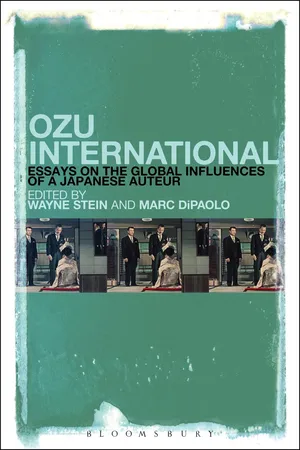
eBook - ePub
Ozu International
Essays on the Global Influences of a Japanese Auteur
- 224 pages
- English
- ePUB (mobile friendly)
- Available on iOS & Android
eBook - ePub
Ozu International
Essays on the Global Influences of a Japanese Auteur
About this book
Information
Part One
Ozu in Cultural Context: Considering Class, Gender, and Domestic Spaces
1
Tokyo Is a Nice Place: The Suburban, the Urban, and the Space in Between in Early Ozu
Yasujiro Ozu and cinematic urbanism are not subjects that have been regularly paired for analysis. However, many of the director’s films take place in the Japanese capital and essentially chart its development in both prewar and postwar periods. From his early silent comedies to later meditative dramas, Ozu’s cinema evidences a fascination with Tokyo, where he lived and worked for much of his life, aside from an early teaching post in a mountain area and two periods of military service. Tokyo is often present in Ozu’s work, and his films slowly but surely document its changes. If Ozu was subtle in his direction of actors and mise-en-scène, his treatment of urban space is equally low-key, to the point that changes to commercial centers and residential areas are glimpsed in between extended dinner table scenes. Ozu is often characterized as a director of “home dramas” dealing with middle-class domesticity by chronicling modernity through family units that share a certain level of socioeconomic mobility or stability (Russell 2011, 19–21). Such summary conforms to the widely held, and not entirely incorrect, view that Ozu is a director of films about families in states of transition—an observer who captures telling moments rather than a commentator trying to achieve a wider social picture. This has led to the popular consensus that Ozu is “the most Japanese of directors” (Dixon and Foster 2008, 86), working with minimalist detail as cultural representation is achieved through the distillation of exchanges. Yet while it is also true that, “the pace of an Ozu film is set by its conversation rather than by its action or camera movement” (Weston 2002, 313), his work achieves much of its social commentary through its use of space, particularly in those films that take place in Tokyo. The city is a constant presence in his films, represented by familial interiors, cutaways to exteriors as a means of transitioning between scenes, and background noise, while its socioeconomic climate is evidenced in the circumstances of characters as monetary matters infringe on domestic stability. As Mitchell Schwarzer notes,
Ozu’s sense of style depends neither on peculiarity nor perfection, and only occasionally does he use famous architecture. The shots range over traditional and modern buildings, from wooden apartments to high-rise apartments to vast factory complexes. (231)
The director’s Tokyo stories do not try to summarize the entire city; rather, they focus on old neighborhoods and new developments, examining the lives of its inhabitants in particular sectors of urban space, encouraging readings based on how the changing landscape of these locations enables character, narrative, and theme. Kristin Thompson and David Bordwell assert that, “Ozu spaces, demand to be read plurally, for their own sakes, challenging us to play, however vertiginiously, within them” (Thompson and Bordwell (1976, 73)). Neighborhood specificity is the most important aspect of Ozu’s use of urban space, with economic circumstances, networks of connection, parent–child relationships, and social hierarchies mostly contained within districts or suburbs. Aside from occasional glimpses of architectural landmarks in such films as The Only Son (Hitori musuko, 1936) and Tokyo Story, the capital is often represented as a space without a center, which is in-keeping with the development of the city. As Donald Richie in his essay, “A Lateral View,” explains,
Tokyo is actually in its construction more a collection of small towns, or neighbourhoods, than it is a big, hard-core city. It is not centralized, there is no good and bad side of the tracks, no zoning, no real slums. (191)
Examining urban space in the films of Ozu also challenges another popular perception: that the director made light, funny films in the prewar era and adopted more serious themes regarding the future of the Japanese family unit when he returned to Tokyo following his military service. The films he made toward the end of his career—Late Autumn (Akibiyori, 1960), The End of Summer (Kohayagawa-ke no aki, 1961), An Autumn Afternoon (Sanma no aji, 1962)—take place in the households of middle-class families and found them adjusting to shifting circumstances or value systems. Yet the prewar films of Ozu are of interest in this regard due to the more varied spaces in which their narratives are set.
This analysis will examine three Ozu films of the 1930s as means of illustrating the significance of space in his prewar output. I Was Born, But … (Umarete wa mita keredo, 1932) is set in the suburbs, where two young brothers live in relative comfort but their father must conform to salaryman culture, responding to the whims of his boss as a means of maintaining the surroundings that his family are becoming accustomed to. Passing Fancy (Degigokoro, 1933) takes place in the urban space of downtown Tokyo where a brewery worker tries his best to raise his son in an impoverished environment, and the presence of a beautiful woman who begins working at the local restaurant provides sufficient distraction from daily routine. The Only Son occurs in what can be described as an in-between space, a residential area that is located away from downtown or central Tokyo, but verges on a noisy and polluted industrial wasteland. As is often stated, themes, motifs and plots reoccur throughout the films of Ozu and Passing Fancy, I Was Born, But … and The Only Son are not exceptions: each film deals with parent–child relationships and the fragility of the family unit in an ever-changing Japan. However, this analysis will consider these films in relation to how this theme is represented through the appropriation of three distinct spaces (the suburban, the urban and the space in between) to serve character and narrative, thereby noting the significance of such locality to familial relations.
I Was Born, But … is a film about the development of suburban space and the hierarchies that form within that space, thereby complicating parent–child relationships as the Japanese family unit adjusts, or conforms, to a new way of life. Although the film is ostensibly an example of the nansensu genre (nonsense comedy) with the story told from the perspective of two children, it is introduced as, “A Picture Book for Adults” and illustrates what Bordwell (1988, 224) has identified as “the social use of power.” The space represented in I Was Born, But … is one of regeneration. After almost half of Tokyo was destroyed by the great Kanto Earthquake of September 1, 1923, Japan’s central government committed funds to rebuild the city, resulting not only in its restoration, but also in its expansion. In 1924, half a million structures existed in the Tokyo area, but by 1932 an additional half a million buildings had been added to its urban landscape, resulting in suburbanization and the rise of commuter culture, as families moved into the new developments located along the Tokyu Meguro line. This rail service opened in 1923 and provided access to the commercial or industrial centers. Along the lines were points that often developed first as small commercial districts, with residential areas then growing on the periphery (Allinson 1975, 52). The suburb in I Was Born, But … is a space that tries to replicate some of the cosiness of the furusato (hometown) with access to modern conveniences and the career prospects associated with Westernization, making it what Richie (1992, 190) describes as, “a kind of buffer zone between the home town and the city.” However, such hybridization does lead to conflicting value systems, especially for families that have been transplanted to the new development from elsewhere, such as the unit seen in Ozu’s film.
The film begins with the arrival of the Yoshii family in the Tokyo suburbs. Settling into their new home is delayed slightly when the wheel of the moving truck gets stuck in a muddy patch of the road, spinning around and signaling that this may not be an easy transition to a new environment. Mr. Yoshii (Tatsuo Saito) and his wife (Mitsuko Yoshikawa) have two sons, Keiji and Ryoichi (Tomio Aoki and Hideo Sugawara), who are basically good boys but also have mischievous tenancies. They initially avoid going to their new school, playing truant due to threats from a gang of neighborhood bullies. However, when a teacher informs their father of their absence, Keiji and Ryoichi have no choice but to attend classes. With help from an older delivery boy, they are eventually able to deal with the gang and win respect, but a further problem arises when they visit the home of Taro (Seiichi Kato), who is the son of their father’s boss, Iwasaki (Takeshi Sakamoto). Some of Iwasaki’s home movies are screened for the amusement of his friends and underlings, which show Mr. Yoshii playing the clown under Iwasaki’s direction; this suddenly alters Keiji and Ryoichi’s perception of their father, as they question if they can still respect him after behaving in such a manner. At home, Keiji and Ryoichi ask why their father has to humiliate himself. Mr. Yoshii explains that Iwasaki holds a superior position in the company and that he must do as asked, although he will later confide to his wife that he is also unhappy about the situation and hopes that their children will have better prospects. Keiji and Ryoichi go on hunger strike to show their frustration with their father, but cannot hold out for long and eat sweet cake for breakfast. The film ends with the boys acknowledging the social order: they do not show any objection when Mr. Yoshii accepts a lift to work from Iwasaki, then walk to school with Taro and their new friends.
Although the suburb here can be identified as an example of Westernization, it should be noted that this space does not directly resemble its American equivalent of the time period. Gary D. Allinson asserts that this kind of suburb should be, “compared with America’s horse car and electric streetcar suburbs of the nineteenth century, and most assuredly not with the automobile suburbs of the post-1920s” (52). The development of this suburb is based on the rail network that frequently runs through it, and Ozu’s familiar motif of the train is used on many occasions, passing by the Yoshii home and seen in the background as the children walk to school. Mr. Yoshii waits at the crossing each morning, with a close up of his briefcase at this point indicating that the train is an essential link between the city and the suburb. The motorcar of Iwasaki is seen at the end of the film, to further emphasize his wealth and status in relation to that of Mr. Yoshii, but the emphasis is on railway transportation as, “for the Japanese, if no longer for us, the train remains a vehicle for mystery and change” (Richie 1974, 14). This suburban landscape is also fairly open compared to that of the American suburbs, with houses looking much like plots that have sprung up in the countryside, and the trains running through the background suggesting that this is new terrain due to the need for a high-speed service to connect it to the commercial hub. This furthers the hybridization of spaces, the country and the city. As Alastair Phillips notes,
The Yoshii family’s new suburban home appears in the film as a kind of frontier space in this terrain against which natural ground is linked to the spontaneity and freedom of childhood and the built-up environment is associated with the pressures and constraints of adult life. (29–30)
The Yoshii family is an example of an emerging middle class as Mr. Yoshii is representative of the white-collar employees of the period whose improved social status was tied to the steady economic recovery of large business corporations (Vogel 1963, 4). Yet this was also a time of great uncertainty, as Japan was still in recession: the recovery would not be in full swing until 1934, with almost full employment not achieved until 1937 (Allen 1946, 90–144). Mr. Yoshii plays along with Iwasaki’s embarrassing requests because the family would be in dire financial straits if he were to be fired for disobeying his superior, making the white picket fence around his house as much of a trap as a sign of social mobility. The lengths that Mr. Yoshii goes to in order to please his boss means that respect within the family unit is readjusted through relocation. Misuyo Wada-Marciano observes that “throughout the story we are reminded that the sons expect their father to be a strong patriarchal figure, which magnifies the late impact of their disappointment in the father’s ability to be one” (Wada-Marciano, (2008, 57)). Disappointment encroaches on the suburban space as the boys feel they can no longer look up to their father, while Mr. Yoshii privately expr...
Table of contents
- Cover
- Halftitle Page
- Title Page
- Dedication Page
- Contents
- Preface: Ozu, Ray Carney, and the Problem of Ethical Spectatorship
- Acknowledgments
- Introduction
- Part One: Ozu in Cultural Context: Considering Class, Gender, and Domestic Spaces
- Part Two: Ozu’s International Reception and Influences
- Afterword: The Samsara of Ozu Cinema—Death and Rebirth in Our Daily Struggles
- About the Contributors
- A Mantra of Liberation
- Index
- Imprint
Trusted by 375,005 students
Access to over 1.5 million titles for a fair monthly price.
Study more efficiently using our study tools.
Frequently asked questions
Yes, you can cancel anytime from the Subscription tab in your account settings on the Perlego website. Your subscription will stay active until the end of your current billing period. Learn how to cancel your subscription
No, books cannot be downloaded as external files, such as PDFs, for use outside of Perlego. However, you can download books within the Perlego app for offline reading on mobile or tablet. Learn how to download books offline
Perlego offers two plans: Essential and Complete
- Essential is ideal for learners and professionals who enjoy exploring a wide range of subjects. Access the Essential Library with 800,000+ trusted titles and best-sellers across business, personal growth, and the humanities. Includes unlimited reading time and Standard Read Aloud voice.
- Complete: Perfect for advanced learners and researchers needing full, unrestricted access. Unlock 1.5M+ books across hundreds of subjects, including academic and specialized titles. The Complete Plan also includes advanced features like Premium Read Aloud and Research Assistant.
We are an online textbook subscription service, where you can get access to an entire online library for less than the price of a single book per month. With over 1.5 million books across 990+ topics, we’ve got you covered! Learn about our mission
Look out for the read-aloud symbol on your next book to see if you can listen to it. The read-aloud tool reads text aloud for you, highlighting the text as it is being read. You can pause it, speed it up and slow it down. Learn more about Read Aloud
Yes! You can use the Perlego app on both iOS and Android devices to read anytime, anywhere — even offline. Perfect for commutes or when you’re on the go.
Please note we cannot support devices running on iOS 13 and Android 7 or earlier. Learn more about using the app
Please note we cannot support devices running on iOS 13 and Android 7 or earlier. Learn more about using the app
Yes, you can access Ozu International by Wayne Stein, Marc DiPaolo, Wayne Stein,Marc DiPaolo in PDF and/or ePUB format, as well as other popular books in Media & Performing Arts & Film Direction & Production. We have over 1.5 million books available in our catalogue for you to explore.