Encompassing experimental film and video, essay film, gallery-based installation art, and digital art, Jihoon Kim establishes the concept of hybrid moving images as an array of impure images shaped by the encounters and negotiations between different media, while also using it to explore various theoretical issues, such as stillness and movement, indexicality, abstraction, materiality, afterlives of the celluloid cinema, archive, memory, apparatus, and the concept of medium as such.
Grounding its study in interdisciplinary framework of film studies, media studies, and contemporary art criticism, Between Film, Video, and the Digital offers a fresh insight on the post-media conditions of film and video under the pervasive influences of digital technologies, as well as on the crucial roles of media hybridity in the creative processes of giving birth to the emerging forms of the moving image. Incorporating in-depth readings of recent works by more than thirty artists and filmmakers, including Jim Campbell, Bill Viola, Sam Taylor-Johnson, David Claerbout, Fiona Tan, Takeshi Murata, Jennifer West, Ken Jacobs, Christoph Girardet and Matthias Müller, Hito Steyerl, Lynne Sachs, Harun Farocki, Doug Aitken, Douglas Gordon, Stan Douglas, Candice Breitz, among others, the book is the essential scholarly monograph for understanding how digital technologies simultaneously depend on and differ film previous time-based media, and how this juncture of similarities and differences signals a new regime of the art of the moving image.
eBook - ePub
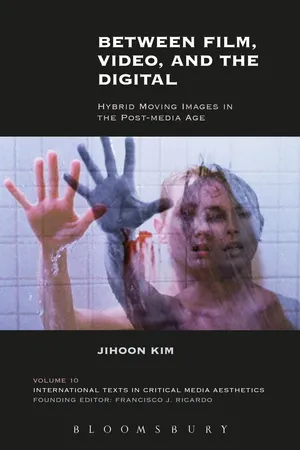
Between Film, Video, and the Digital
Hybrid Moving Images in the Post-Media Age
- 416 pages
- English
- ePUB (mobile friendly)
- Available on iOS & Android
eBook - ePub
About this book
Information
CHAPTER ONE
Videographic moving pictures: Remediating the “film stilled” and the “still film”
Introduction: “moving pictures” in the post-photographic era
In fall 1977, art critic Douglas Crimp organized an exhibition that showcased the work of Jack Goldstein, Robert Longo, and others. He then placed these works under the umbrella of “pictures”—also the title of the essay dedicated to the show—in the sense that they were “not confined to any particular medium.”1 By the term “pictures,” Crimp meant the various ways in which artists appropriate and interweave the technical components and representational conventions of different media (not simply photography, film, video, and performance, but also painting and drawing) to compose particular images, which are difficult for viewers to locate within a particular physical substance: “We are not in search of sources or origins, but of structures of signification: underneath each picture there is always another picture.”2 More interesting than this postmodern account is Crimp’s use as example “pictures” two films allied and resonant with photography: Goldstein’s The Jump (1979), in which the shimmering figure of a diver continually appears and disappears on the screen via rotoscoping, and Longo’s Sound Distance of a Good Man (1978), a film that blends a fixed frame as its only formal element with the “literal time of the performed events.”3 These two films defy the tenet of modernist medium specificity that demands stable, formal boundaries drawn by the medium’s material substrate, either by foregrounding a transition of the human figure from a still image to a moving one (Goldstein’s film) or by endowing the motionless subject, which appears to be a frozen image, with a lived duration to generate a subtle juxtaposition between past and present (Longo’s film).
Both forms can be called “moving pictures” in a sense; but in this case, the word “picture” must be understood not simply to assist “movement” denoted by the word “moving” but also to imply the mode of stillness, given that one of its primary meanings denotes a “representation made by various means (as painting, drawing, or photography).”4 Faced with this confusion, Arthur Danto has defined “moving pictures” as “pictures which move, not just (or necessarily at all) pictures of moving things.”5 Even so, he did not fully overcome the difficulty in finding the “difference between pictures and moving pictures,” insofar as there are cases “in which nothing except knowledge of their causes and of the categories which differentiate [one from the other] makes the difference between the two.”6 Seen in this light, the films of Goldstein and Longo deepen the difficulty, questioning the “knowledge” of the causes of their movement by revealing their reliance on photography and making porous the “categorical” distinctions between cinema and photography. Although made and showcased in the arena of contemporary art, the two filmic works also echoed the thread of experimental films at that time that highlighted and interrogated troubling yet intriguing relations between the two media by virtue of their specific “moving picture” forms.
We now see both artists and filmmakers turning their attention to these forms by way of different platforms and media expressions, from theatrical projection to moving image installation in a gallery, to CD-ROM and the World Wide Web.7 Notable in this crossbred trend is the growing use of digital video to rework the “moving pictures” inherited from or alluding to films that manifest their kinship with photography. Given that digital video is harnessed both for recording (as in the adoption of the camera for photography and cinematography) and for postproduction (as in the process for graphically manipulating the image based on the camera’s relation to profilmic reality), in this chapter I shall characterize these hybrid image forms, in which photographic, filmic, and digital attributes reside in conjunction with the correlation of the static and the animated, as “videographic moving pictures.” My concept exists in dialogue with several scholarly works in the fields of cinema studies and art history since the 2000s, which examine the hybridity and interconnection of photography and cinema in the spirit of challenging and dismantling the reductive medium-specific distinctions between the two, in response to the ubiquity of films, videos, and installations that confront viewers with the ambiguous exchange between stillness and movement.8 In particular, my terminology echoes some concepts recently devised in the field of photography studies that refer to the movement/stillness tension activated by contemporary works of photography and moving image: for instance, in describing Jeff Wall’s photographs, in which he employs the conventions of painting, photography, and film, Hilde Van Gelder and Helen Westgeest have used the term “multi-mediating pictures” to indicate that they activate the viewer’s “layered perception . . . of the multiplication of mediums.”9 Similarly, Ingrid Hölzl has coined the term “moving stills” to argue that the convergence of moving and unmoving images in digital media “is already laid out in the media history of photographic and filmic images and their hybrid forms.”10 While my own concept of “videographic moving pictures” shares the attention given by these two terms to the dissolution and intermingling of photography and film, it is distinct from them in that it stresses the vital role of digital video in shaping the aesthetic complexity of the particular images that present the cohabitation of stillness and movement.
From the standpoint of contemporary photography, the burgeoning of videographic moving pictures is placed within the sphere of “post-photography,” a term that represents both the growing replacement of the analogue camera and photochemical materials by electronic and digital technologies in the production and circulation of photographic imagery, and the ontological and aesthetic changes of photography that are introduced by the replacement of the machinery. Since the early 1990s, numerous writings have addressed the multidimensional impacts of these technologies on the traditional concepts and practices of photography. Regardless of their detailed differences in argument and position, critics and scholars who have engaged in this discursive field have largely singled out two important developments over art born of chemical photography. First, these newer technologies have displaced photography’s material and technical properties, and thereby undermined some of its fundamental characteristics, such as the ability to serve as the “indexical” image, an image that bears a physical connection to the real of the past due to the camera’s transcription of the trace of the real on the photochemical plate.11 The “post-photography” discourses both in photography and in film studies have largely asserted that the digital image weakens the traditional photography’s indexical link to physical reality because it can be produced without the physical presence of the object that it represents (in the case of the computer-generated imagery based on simulation), and because in digital capture, light must be converted into abstract codes discontinuous with physical space and time (in the case of digital photography).12 Second, the forms of image produced by post-photochemical technologies fundamentally ask whether photography is a definable medium generating a range of visual images distinguishable from those based on other media or technological means.13 Viewed together, these two lines of argument share the position that digitization erodes the boundaries between the lens-based and the graphically manipulated images, and thereby revive the question of whether the distinctiveness of the photographic image holds.14 The videographic moving picture is seen to substantiate both arguments: its movements, both the movement of an object or event in the image and the movement of the image itself, spring not simply from the inscription of the object or event in the electronic sensor of the recording apparatus, but also from partial and global transformation of the visual record on its material and technical levels. As a few critics in “post-photography” discourse have remarked, the rapid advance of the new media technologies sometimes undermines a distinction between photography and video. For these technologies enable any photographic image, an electronic and digital image on the material level, to be easily extracted from the flow of information from which the video image is derived.15 In these aspects, the videographic moving picture is an aspect of what Timothy Druckrey calls the “equivocal image” as the “consequence of the unsettled state of electronic representation.”16
Within the context of photographic art, the equivocal nature of the videographic moving picture aligns it with the photographic works of Jeff Wall, Thomas Struth, Thomas Demand, and Andreas Gursky, to name just a few, who have employed digital technologies to call into question the authenticity of the photographic image and to initiate a complex dialogue with the other systems of representation to which the broadest definition of the term “picture” can refer. Wall, arguably the most prominent practitioner, has, for instance, emblematized the resonance between the videographic moving picture and digital photography by bringing to the foreground an array of different media (painting, photography, and film) evoked by the term “picture.” His photographic work draws together the conventions of film within the frame, composed in a manner similar to painting so as to invite its viewer to see that “there is almost a single set of criteria for the three art forms.”17 Wall utilizes cinematographic methods (the performance of figures in a staged situation depicted by his camera, the use of the techniques and equipment devised or developed by cinematographers, etc.) as a key building block in arranging those conventions, while also strengthening the presence of the figures’ implied motion. He has also embraced electronic and digital technologies to delicately manipulate the surface of his photographs and thereby to make painting, photography, and film coexist in an ambiguous manner. Wall’s creation of these hybrid expressions is predicated upon his awareness of photography’s post-medium conditions: that is, electronic and digital technologies enable him to change his awareness of photography from a medium grounded in a static photochemical basis to one that shares the fluidity of representation present in painting and film. He writes that the photographic image within these conditions “will disappear from the immediate production-process, vanishing to the more distant horizon of the generation of electricity, and in that movement, the historical consciousness of the medium is altered.”18
And yet, it should be noted that the two challenges raised by contemporary photographic practices (a challenge to the notion of indexicality as a truthful record of the past, and to the notion of photography as a clearly demarcated form of art in opposition to others) do not necessarily lead to an absolute rupture with analogue photography; rather, they underscore a telling moment in which artists revisit and reconfigure, with the help of electronic and digital technologies, photography’s techniques, forms, and aesthetics in ways that go beyond its traditional medium-specific boundaries, including the photochemical materials that were known to guarantee photography’s value as indexical image, the privileging of the lens-based imagery over the graphically manipulated imagery, and, as I shall discuss in detail, photography’s stillness in contrast to the movement of the images in film and video. In this sense, the artists’ exploration of the boundaries of photography echoes a revisionist understanding of the “post-photographic” age, one distinct from the pervasive voices of anxiety about its dead end. David Tomas argues that post-photographic practices are simultaneously “historical (postphotography)” and “unhistorical (postphotography)” insofar as they operate under a tension between what has defined the photographic modes of production and what transcends them.19 Similarly, Abigail Solomon-Godeau claims that the work of Wall and Gursky, often rejected by a critical view that insists on the intertwined concepts of indexicality and medium specificity in modernist discourse, asks us to reconceptualize photography by considering “a more complex notion of an apparatus,” namely, by considering all elements of photography “that exceed the camera, the individual picture, and the individual photographer.”20 Peter Osborne arguably provides the most radical version of these revisionist discourses, asserting that photography must be understood as the “historical totality of photographic forms, or types of images produced in one way or another by the inscription of light.”21 In this view, photography is a historical concept not privileged by the chemical basis of traditional photography, but subject to the interacting development of all technologies (film, video, and digital) directly concerned with or affecting the production of photographic forms. Osborne’s non-essentialist redefinition of photography helps us to understand that contemporary photographic practices do not exhaust but instead exploit the forms of traditional photography, thus reconfiguring its ontological underpinnings even when they distance themselves from its traditional material basis.
In this revisionist view of the “post-photographic” era, the “cinematic”—the “historical totality” of cinematic forms and techniques, to use Osborne’s concept—is not simply a prominent object of appropriation, but a gateway through which the contemporary practices have recently reconstituted the photographic object. Tracing the historical lineage of these practices’ obsession with the cinematic, George Baker argues that they question and redraw the traditional boundaries of photography by embracing cinematic movement, which was regarded as the antithesis of photography’s frozenness. It was with the emergence of the artists categorized by Crimp as creators of “pictures” that photography’s kinship with cinema triggered formal innovations. Baker then maps out three paradigmatic cases of innovation: Cindy Sherman’s “film stills,” Wall’s appropriation of the conventions of cinematography and historical painting for the sake of implying a suspended moment of a narrative in progress (Baker calls Wall’s work the “talking picture” in this sense), and James Coleman’s reconstruction of films into projection of continuous still images. The contemporary generation of artists, ...
Table of contents
- Cover
- Half-Title
- Series
- Dedication
- Title
- Contents
- Editor’s Foreword
- Acknowledgments
- List of Illustrations
- Introduction: Hybrid moving images and the post-media conditions
- 1 Videographic moving pictures: Remediating the “film stilled” and the “still film”
- 2 Digital glitch video and mixed-mediaabstraction: Materialism and hybrid abstraction in the digital age
- 3 Transitional found footage practices: Video in and out of the cinematic fragments
- 4 Intermedial essay films: “Memories-in-between”
- 5 Cinematic video installations: Hybridized apparatuses inside the black box
- Afterword
- Notes
- Index
- Copyright
Trusted by 375,005 students
Access to over 1.5 million titles for a fair monthly price.
Study more efficiently using our study tools.
Frequently asked questions
Yes, you can cancel anytime from the Subscription tab in your account settings on the Perlego website. Your subscription will stay active until the end of your current billing period. Learn how to cancel your subscription
No, books cannot be downloaded as external files, such as PDFs, for use outside of Perlego. However, you can download books within the Perlego app for offline reading on mobile or tablet. Learn how to download books offline
We are an online textbook subscription service, where you can get access to an entire online library for less than the price of a single book per month. With over 1.5 million books across 990+ topics, we’ve got you covered! Learn about our mission
Look out for the read-aloud symbol on your next book to see if you can listen to it. The read-aloud tool reads text aloud for you, highlighting the text as it is being read. You can pause it, speed it up and slow it down. Learn more about Read Aloud
Yes! You can use the Perlego app on both iOS and Android devices to read anytime, anywhere — even offline. Perfect for commutes or when you’re on the go.
Please note we cannot support devices running on iOS 13 and Android 7 or earlier. Learn more about using the app
Please note we cannot support devices running on iOS 13 and Android 7 or earlier. Learn more about using the app
Yes, you can access Between Film, Video, and the Digital by Jihoon Kim in PDF and/or ePUB format, as well as other popular books in Arte & Arte generale. We have over 1.5 million books available in our catalogue for you to explore.