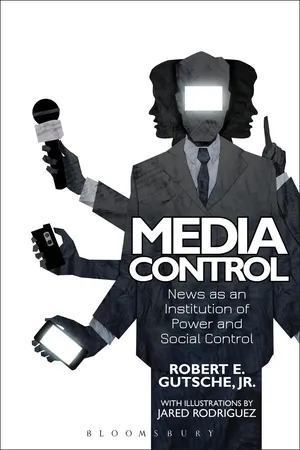
Media Control: News as an Institution of Power and Social Control challenges traditional (and even some radical) perceptions of how the news works. While it's clear that journalists don't operate objectively – reporters don't just cover news, but they make it – Media Control goes a step further by arguing that the cultural institution of news approaches and presents everyday information from particular and dominant cultural positions that benefit the power elite.
From analysing how the press operate as police agents by conducting surveillance and instituting social order through its coverage of crime and police action to bolstering private business and neoliberal principles by covering the news through notions of boosterism, Media Control presents the news through a cultural lens. Robert E. Gutsche, Jr. introduces or advances readers' applications of critical race theory and cultural studies scholarship to explore cultural meanings within news coverage of police action, the criminal justice system, and embedding into the news democratic values that are later used by the power elite to oppress and repress portions of the citizenry. Media Control helps the reader explicate how the power elite use the press and the veil of the Fourth Estate to further white ideologies and American Imperialism.
- 320 pages
- English
- ePUB (mobile friendly)
- Available on iOS & Android
eBook - ePub
About this book
Information
1
Power, Propaganda and the Purpose of News
Chapter Purpose
This chapter examines news as both a social and cultural construction. It begins by visiting news coverage of terrorist threats in 2013 that US officials said were collected through government surveillance programs and which led to the closing of US embassies across the globe. Press coverage suggested the threats were further evidence for expanding government spying, which at the time was under debate in Congress. Through the case, the chapter builds a foundation for understanding power, propaganda, and the role of the press in propagating dominant ideology.
Guiding Questions
1. What are some of the major ways to define power, and how does one identify and measure those definitions?
2. What role does the press play in either supporting or refuting popular definitions of power, and what are some examples of such coverage?
Key Terms
Information: Expressed knowledge shaped by cultural and social forces
The power elite: A collective of individuals and institutions that control a society’s economy, political order, and military with interests of maintaining order
Propaganda: A pejorative representation of information used as a means by which to marginalize and distract from realities counter to dominant ideology
Whiteness: Ideology of racial superiority by people considered to be white, which appears pervasive in dominant US cultural distinctions of class, language, race, and social norms
EXPLICATING THE EMBASSY EVACUATIONS: THE PURPOSE OF BANAL NEWS
On August 4, 2013, international press reported that the United States would close eighteen to twenty-two of its embassies (the numbers changed over the course of the coverage) for as long as a month following ominous “ongoing concerns about a threat stream indicating the potential for terrorist attacks emanating from al-Qaida in the Arabian Peninsula [AQAP].”1 Speaking on behalf of the government’s terror gurus, President Barack Obama spoke on NBC’s Tonight Show two days after the embassies were closed, saying:
… it’s entirely consistent to say that this tightly organized and relatively centralized al-Qaida that attacked us on 9/11 has been broken apart and is very weak and does not have a lot of operational capacity, and to say we still have these regionalized organizations like AQAP that can post a threat, that can drive potentially a truck bomb into an embassy wall and can kill some people.2
While it was not the president’s most articulate statement, his comments—and, maybe more than anything else, his appearance on the popular late-night comedy and entertainment show—revealed the normalcy of talking about “terrorism” in US society. We have become so accustomed to such discourse that it seems to make its way into nearly every setting for conversation. We worry about the threats to our lives by outside forces so much so that even the most obscure of movie theaters in US cities refused to show the 2014 comedy The Interview in which amateur hit men (their real jobs in the movie are as entertainment journalists) were selected by the CIA to assassinate North Korea’s Kim Jong-un, an alleged dictator.
In June of that year, North Korean officials threatened forceful action against the United States and its interests if the film was released—just one of the many instances of rabble-rousing by members of the North Korean government over the past decade. In December, Columbia Pictures, which distributed the film directed by Seth Rogan and Evan Goldberg, initially refused to release the film, citing concerns about terrorism and possibly even danger to members of the studio and moviegoers if the film ticked off North Korean leaders. Studio executives also said their decision to halt the release was related to a major hack to their parent company, Sony, which the FBI somehow blamed on the North Korean government through the hack group Guardians of Peace.
Only after Obama spoke out against the decisions to can the film by Columbia and Sony, saying the companies had succumbed to terrorism and that their decision suggested a chilling effect on the use of the First Amendment (remember, however, that Sony is a Japanese company and the First Amendment and “freedom of speech” are mainstays of US ideology), did Columbia Pictures release the film in select theaters. The viewers who braved the threat of violence (some cited the Colorado theater shooting during a showing of Batman in 2012 as reasons for not wanting to attend a controversial showing)3 were characterized as patriots—even if a bit worried for their safety.
ABC News, for instance, covered a showing in New Jersey—at one of the obscure theaters that had decided to show the film—this way:
Everyone knew what was coming—the controversial death scene in the movie about a fictitious assassination plot against North Korean leader Kim Jong-un—but then the lights cut out.
One packed movie theater was left bewildered when a sudden power outage struck 1,300 customers in Clifton, New Jersey, including Allwood Cinemas at a critical moment towards the final moments during a screening of “The Interview.”
Barry Cohen, who attended the 1:30 p.m. screening with his wife and grown son, said they “had no idea” what was going on.
“When it lasted more than five seconds, we though that maybe it was part of the movie and then we realized that it wasn’t,” Cohen told ABC News.
Even though a power outage would have caused confusion in any circumstance, the threat issued by a hacking group that it would attack theaters screening “The Interview” led to understandably hyped tensions, moviegoers said.
Some people ran out of the theater,” Cohen said. “There was another couple near us, the woman turned to her husband and said, ‘Let’s get out of here!’ She didn’t even wait for a refund or anything.”4
Mediatized integration of fear and rhetoric into even the most obscure of news events throughout the country contribute to an incessant need for public protection by US forces and local police. Over the past twenty years in this nation, driven by rhetoric surrounding 9/11 fears that “everyone is out to get us,” authorized violence, sometimes against our own people, has been set as a new kind of normalcy that has only been made overtly clear by reactions of corporations and citizens to threats of foreign force, such as the possibility that the North Korean military could possibly care enough to bomb a movie theater in Clifton, New Jersey.
Even the most bizarre fears—some of which are discussed later in this chapter—are treated with such legitimacy in the press that news coverage about terror attacks on US property and people blend with larger concerns about “attacks” on a US-style of life. Issues such as the alarming rates of autism among our youth, the mass murder of dark-skinned citizens at the hands of police, the threats to our environment from pollutants, increasing heat, rising sea levels, and diminishing access to clean water, are marginalized, in part because the sources of these threats are not so clear and the solutions for these issues are too costly to the power elite’s financial and cultural caches. “Terrorism,” on the other hand, holds more salience than climate change for news audiences and is something that can be addressed through violence, added “protection,” surveillance, and the arming of local police forces—the effects of which are showcased in the continued slaughter of young, black men (see Chapters 5 and 6).
Indeed, Obama’s involvement in discourse surrounding The Interview and in commenting about the pending doom under which the United States should live during his Tonight Show appearance reveals that media producers and politicians have an expectation that audiences have enough familiarity with unified, singular meanings of North Korea, al-Qaida, 9/11, and maybe even the president’s reference to the ominous acronym AQAP (“Al-Qaeda in the Arabian Peninsula”) that the entertainment venue was a perfect place for Obama to make his rationalization for closing US embassies. It is not even clear that members of the US Congress have these terms down, let alone that they have a complex understanding of these intricacies and the rhetoric being spilled to justify increased intrusion into any sense of privacy and independence from fear of our own government.
But, the terrorist threats—and who might have made them—were not what was really at issue during the Tonight Show talk. The session was just another moment in which media and fellow members of the power elite were able to set the stage for deepening the fears of the US public to support violent intervention into our lives.5
Terrorism as scapegoat
To further complicate things related to coverage of the embassy closings in 2013, US journalists speculated that the government’s spying, which had revealed the threats, came from powers awarded to US officials under the Foreign Surveillance Act—not the information gathered from Edward Snowden and the subsequent release of information related to mass NSA surveillance (see Introduction). With this speculation, the spy information was characterized as legitimate and not to be confused with any suspected government-led mass surveillance efforts under “scrutiny” by Congress that same month. Not surprisingly, press coverage further marginalized the NSA measures by treating debate over spying as a game of political Ping-Pong rather than a reality that may have been counter to traditional values of US democracy.
Political parties vied for TV attention rather than led a public movement to challenge the validity of spying powers that members of Congress had seemingly supplied themselves and that they employed in passing legislation that attempted to legalize such efforts or that set standards for oversight. The New York Times, for instance, described the political conflict as a “subject of a fiercely partisan debate, with Republicans accusing Obama administration officials of making misleading statements about connections between the attackers and Al Qaeda.” Additionally, the Times used the threats as a means by which to revive debate about a 2012 embassy attack in Benghazi, Libya, from which US Secretary of State Hillary Clinton suffered a political punch for somehow being solely responsible for an apparent lack of adequate security that contributed to the carnage; the attack had led to the death of the US ambassador to Libya, J. Christopher Stevens and at least two others. What has become referenced in the press since then only as “Benghazi” also became a key challenge against Clinton in the 2016 presidential election.6
Furthermore, just as officials and journalists cast nearly every “threat” to US interests and lives as imminent if without superior military protection and action, the 2013 embassy threats were an opportunity, via the press, to establish the authority of government officials who were there to save the day through increased militarization and surveillance programs. “To the members of Congress who want to reform the NSA program, great,” the press quoted US Sen. Lindsey Graham as saying, for example:
If you want to gut current legislation, you make us much less safe, and you’re putting our nation at risk. We need to have policies in place than can deal with the threats that exist, and they are real, and they are growing.7
Even press from the United Kingdom, a US ally, relayed a message from US Sen. Saxby Chambliss that he made on NBC’s Meet the Press the morning the closures were announced. His comments struck at yet another fear in the United States at the time—Muslims:
There has been an awful lot of [terror] chatter, which is very reminiscent of what we saw pre-9/11 … As we come to the end of Ramadan, which is always an interesting time for terrorists, and the upcoming 9/11 anniversary, this is the most serious threat that I have seen in the last several years.8
Few members of the mainstream US press called the announcement of these international threats for what they were—a point of distraction from US government spying. The United Kingdom’s Guardian, however, did not let the moment slip. One of their headlines told the story directly: “US embassy closures used to bolster case for NSA surveillance programs.” In the story, Guardian journalists wrote:
Privacy campaigners criticized the widespread linking of the latest terror alerts with the debate over the domestic powers of the NSA. Amie Stepanovich, a lawyer with the Electronic Privacy Information Center, said: “The NSA’s choice to publish these threats at this time perpetuates a culture of fear and unquestioning deference to surveillance in the United States.”9
In the United States, Patrick Smith, on the website Salon, touched upon this sentiment when he wrote several days after the embassy closings that:
the silence among our newspapers and broadcasters … confirms only how dangerously circumscribed Americans political discourse has become. It is all text and subtext now, and the subtext, by definition, is known but never allowed to pierce the surface of silence.10
Still, mainstream news coverage in the United States survived criticism of...
Table of contents
- Cover
- Halftitle Page
- Title Page
- Dedication Page
- Contents
- Preface
- Acknowledgments
- Introduction
- 1. Power, Propaganda and the Purpose of News
- 2. Making News: Purposes, Practices, and Pandering
- 3. Displacement and Punishment: The Press as Place-makers
- 4. News as Cultural Distraction: Controversy, Conspiracy, and Collective Forgetting
- 5. Normalizing Media Surveillance: Media Waiting, Watching, and Shaming
- 6. The Violence of Media Sousveillance: Identifying the Press as Police
- Conclusion: The Myth of Being “Post-Media” & Why Americans Will Always be Media Illiterate
- Glossary of Key Terms
- Index
- Imprint
Trusted by 375,005 students
Access to over 1.5 million titles for a fair monthly price.
Study more efficiently using our study tools.
Frequently asked questions
Yes, you can cancel anytime from the Subscription tab in your account settings on the Perlego website. Your subscription will stay active until the end of your current billing period. Learn how to cancel your subscription
No, books cannot be downloaded as external files, such as PDFs, for use outside of Perlego. However, you can download books within the Perlego app for offline reading on mobile or tablet. Learn how to download books offline
Perlego offers two plans: Essential and Complete
- Essential is ideal for learners and professionals who enjoy exploring a wide range of subjects. Access the Essential Library with 800,000+ trusted titles and best-sellers across business, personal growth, and the humanities. Includes unlimited reading time and Standard Read Aloud voice.
- Complete: Perfect for advanced learners and researchers needing full, unrestricted access. Unlock 1.5M+ books across hundreds of subjects, including academic and specialized titles. The Complete Plan also includes advanced features like Premium Read Aloud and Research Assistant.
We are an online textbook subscription service, where you can get access to an entire online library for less than the price of a single book per month. With over 1.5 million books across 990+ topics, we’ve got you covered! Learn about our mission
Look out for the read-aloud symbol on your next book to see if you can listen to it. The read-aloud tool reads text aloud for you, highlighting the text as it is being read. You can pause it, speed it up and slow it down. Learn more about Read Aloud
Yes! You can use the Perlego app on both iOS and Android devices to read anytime, anywhere — even offline. Perfect for commutes or when you’re on the go.
Please note we cannot support devices running on iOS 13 and Android 7 or earlier. Learn more about using the app
Please note we cannot support devices running on iOS 13 and Android 7 or earlier. Learn more about using the app
Yes, you can access Media Control by Robert E. Gutsche, Jr. in PDF and/or ePUB format, as well as other popular books in Languages & Linguistics & Journalism. We have over 1.5 million books available in our catalogue for you to explore.