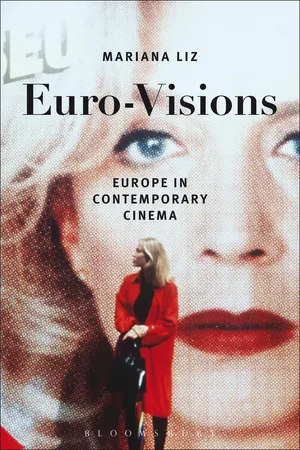
European cinema not only occupies a dominant place in film history, it is also a field that has been raising more interest with the expanding work on the transnational. Euro-Visions asks what idea of Europe emerges, is represented and constructed by contemporary European film.
Adopting a broad and wide-ranging approach, Euro-Visions mixes political sources, historical documents and filmic texts and offers an integration of policy and economic contexts with textual analysis. Mariana Liz examines costume dramas, biopics and war films, mainstream co-productions and tales of 'Fortress Europe' by renowned auteurs, showing how films from different European nations depict and contribute to the formation of the idea of Europe. Case studies include Girl with a Pearl Earring, La Vie en Rose, Black Book, Good Bye Lenin!, Match Point and The Silence of Lorna.
- 200 pages
- English
- ePUB (mobile friendly)
- Available on iOS & Android
eBook - ePub
About this book
Information
1
The Idea of Europe: When, What and Who
As the introduction to this book has shown, Europe is discussed by many different actors. Yet, what ‘Europe’ means varies significantly. Writing about European cinema, for instance, Dimitris Eleftheriotis (2001: 1) suggests that understanding Europe in geographical terms is the only way to avoid its problematic meaning. However, even the continent’s borders are contentious. This has been the case throughout Europe’s history, particularly in relation to its frontiers to the east. Not only is Russia’s relationship with Europe still debatable today, Eastern Europe as a whole was until very recently perceived as an ‘other’ within the continent. From a geopolitical point of view, as alliances such as the Council of Europe and the North Atlantic Treaty Organization (NATO) are consolidated, the notion of Europe becomes enmeshed with a Western or Northern perception of the world. The European Union (EU) itself is a good example of Europe’s blurry boundaries, as the members keep growing, a number of non-member countries participate in its programmes and not all members share the same legislation – as in the case of the opt-outs from the Schengen Agreement, as well as the Single Currency. What other approaches towards the definition of the idea of Europe should then be considered?
This chapter introduces the main issues in the study of the idea of Europe. First, it draws a brief history of the relevant scholarly literature. It examines the meanings attributed to Europe by cultural and political approaches, from the ongoing significance of the Hellenistic world and Christianity to the intimate link between Europe and democracy, law and human rights. Investigating the relationship between European, national and global forms of identification, as well as the ostensive contrasting notions of Euro-centrism and universality, this chapter also discusses Europe’s ‘others’. It thus follows a questioning of the ‘when’ and the ‘what’ with an analysis of the ‘who’ in terms of who defines and is defined by European identity.
The second half of the chapter turns to the examination of the ways in which the EU (named as the European Economic Community [EEC] before 1992) has contributed to this debate. It questions how the notion of European identity has featured in EU official documents and initiatives, as well as what idea of Europe emerges from the work of European institutions. The EU symbols, including the flag, the anthem and the motto ‘united in diversity’, are examined. In addition to looking at EU treaties and public communication, this section also draws on a series of interviews conducted in Brussels in 2009. Attitudes towards Europe have alternated between peaks of disparagement and enthusiasm; the advancement of the European integration process has had an impact on the body of work on the idea of Europe, in terms of volume and tone. Bringing together scholarly and institutional visions of Europe, this chapter provides historical and theoretical grounding to the subsequent study of EU audiovisual policy, as well as to the forthcoming analysis of contemporary European films. Euro-Visions is particularly concerned with the idea of Europe that is shaped by European integration. For a wider history of the meanings associated with Europe, see, for instance, Bell (2006).
The idea of Europe and European integration: A concise history
Although the concept of Europe and the identification with the European continent have existed for centuries – going back to ancient Greece – an institutional idea of Europe only emerged in the 1950s. Previous projects devoted to the maintenance of world peace and European integration include the League of Nations, founded in the aftermath of the First World War. But with the signing of the Treaty of Rome in 1957 (which would officially establish the EEC in January of the following year), what is today known as the EU appeared as the first federalist project capable of achieving concrete results. The year 1957 is thus a landmark in the history of the idea of Europe.
Hartmut Kaelble (cited in Sassatelli 2009: 20) signals two main phases in the study of European identity: first, from the post-war period, reaching a particular crescendo in the 1960s; and second, from the late 1980s to the present day. Directly influenced by the aftermath of the Second World War and the signing of the Treaty of Rome, the literature produced during this first phase can be divided into historical and political approaches, as it either discusses the idea of Europe as a continent with cultural significance or reflects the development of the EEC. From a historical perspective, Denys Hay’s Europe: The Emergence of an Idea (1957) is of particular relevance. Focused on the later Middle Ages, it looks at the notion of Europe and its relationship with Christendom – a distinctive (albeit problematic) element of the term’s cultural definition. Hay questions not only the interconnections between Europe and religion as a defining cultural trait, but also those between Europe and the Christian territory in physical and symbolic terms. Europe is both: a land and an idea. It is telling of the strong links between the idea of Europe and European integration that such concerns arose in the post-war era, as Europe was increasingly seen as a unified continent, in geographical and political terms.
Emerging in this period are also a number of pieces written by politicians, including the EEC’s ‘founding fathers’ (Konrad Adenauer, Alcide de Gasperi and Robert Schuman, among others), who directly address the European integration process and put forward a positive view of its development. An important example is Altiero Spinelli’s The European Adventure (1972) – a title that nevertheless denotes a sense of uncertainty and risk. Here, Spinelli argues for a federalist view of Europe, suggesting that, despite ‘confusing’ visions of Europe and national variations, there is a widespread pro-European attitude and strong popular enthusiasm for the EEC’s project (6).
The literature of the late 1980s and early 1990s on Europe was influenced by discussions about the Maastricht Treaty and the growing importance of culture within the EEC – examined in greater detail later. Two key texts are emblematic of this second phase. In Penser l’Europe (1987), Edgar Morin defines Europe with regard to its dialogical essence, arguing it is founded on opposites, united but diverse. For Morin, Europe is a communauté de destin, a community made together by its common destiny, or in other words, a community that was destined to be (191). He roots the understanding of Europe in a distant past, that of Greek and Roman heritage, vehemently condemning the continent’s colonial history. Similarly, Jacques Derrida (1992) argues that Europe needs to be reborn. He stresses the existence of another ‘heading’ (‘heading’ here meant in the sense of ‘orientation’), reminding us, like Morin, that it is possible for Europe to go in a different direction (14), that is, to overcome Euro-centrism as a dominant perspective on the world. Looking forward to a future that cannot adopt the strategies that led to war and destruction, both writers aim for a new configuration of the continent. Morin and Derrida place Europe in a chronological, rather than geographical, framework. The past, present and future of Europe, as well as the way in which they are brought together in a common narrative, are, as this book argues, crucial elements in the definition of this idea.
While the Europe discussed by Morin and Derrida is not overtly political, a reflection on its meaning cannot be disentangled from contemporary developments. Table 1.1 lists some of the most significant dates in the European integration process, pinpointing key policy changes and identifying the expanding number of EEC and EU member-states. As the integration process moved forward, other writings emerged that dealt with Europe’s institutional dimension.
Table 1.1 Timeline of most important EU dates and facts, including member-states
| Key events | Member-states | ||
| 1957 | The Treaty of Rome is signed, creating the European Economic Community (EEC) | BE, FR, IT, LU, NL, GFR (DE from 1990) | 6 |
| 1973 | Enlargement | DK, IE, UK | 9 |
| 1979 | First European Parliament elections | ||
| 1981 | Enlargement | GR | 10 |
| 1985 | Schengen Agreements are signed | ||
| 1986 | Enlargement | SP, PT | 12 |
| 1986 | The Single European Act, the first major revision of the Treaty of Rome, is signed | ||
| 1992 | The Maastricht Treaty or Treaty on the European Union is signed, formally establishing the European Union (EU) | ||
| 1995 | Enlargement | AT, FI, SE | 15 |
| 1997 | The Amsterdam Treaty is signed, incorporating the Schengen Agreements and creating a borderless Europe | ||
| 2002 | Euro coins and notes are introduced | ||
| 2004 | Enlargement | CY, CZ, EE, HU, LV, LT, MT, PL, SK, SI | 25 |
| 2004 | The Treaty establishing a Constitution for Europe is signed by 25 member-states | ||
| 2005 | The ratification process of the Constitutional Treaty comes to an end, unsuccessfully | ||
| 2007 | Enlargement | BG, RO | 27 |
| 2007 | The Lisbon Treaty is signed | ||
| 2013 | Enlargement | HR | 28 |
Soledad García (1993), for instance, discusses the issue of legitimacy, which is at the core of contemporary criticisms of the EU and its institutions (Herrmann, Risse and Brewer 2004; Checkel and Katzenstein 2009; Sternberg 2013). García (1993: 3) stresses the distinction between European elites (those working in Brussels) and citizens, questioning the ability of the EEC to communicate with and represent those affected by its policies. Equally negative is Gerard Delanty (1995: 5), who alerts readers to the dangers of bringing cultural identities into the political realm, as they can become ideologies. These topics will re-emerge in the discussion about the soft power of European cinema vis-à-vis European integration and the development of the idea of Europe.
García’s and Delanty’s works illustrate a new body of literature that explicitly merges the thinking on Europe with that on the EU, although these are written not from an institutional (as in Spinelli’s contribution) but from a scholarly point of view. Seen in conjunction with the work of Morin and Derrida, García’s and Delanty’s writing further points up a suspicion towards the idea of Europe, as what it asks stresses a radical questioning of the very existence of the EEC and then EU: can Europe rethink itself? Can it head in a different direction? Is it legitimate? Can we trust the EU’s discourse as more than just political ideology? The idea of Europe is thus mostly seen through a positive light between the 1950s and 1970s, but through a negative perspective from the 1980s to the early 2000s.
According to Michael Wintle (2009: 3), ‘enthusiasm for “Europe” has waxed and waned over the last few centuries’. It fluctuated even more in the twentieth century – and, as we will see, in the first decade of the 2000s. Whereas in the 1950s European integration theories were primarily aligned with anti-nationalist feelings emerging from the devastating effects of the Second World War, in the 1990s there was a rise in nationalism following the break-up of the Soviet Bloc and the conflict in the Balkans, leading to a new and profound questioning of Europe. Wintle also suggests attitudes towards Europe are in tune with changes in the capitalist economy (407). Hence, when the continent faced an economic crisis, such as during the Great Depression of the 1930s, European societies experienced a sense of Euro-despair (much like in the years following the euro-zone crisis which began in 2009). And when there was an economic expansion, namely, after the implementation of the Marshall Plan in Western European nations, the mood was of Euro-euphoria.
Euphoria also describes the general attitude towards Europe in the early 2000s. This was a period of widespread enthusiasm for the European integration project a...
Table of contents
- Cover
- Half-Title
- Title
- Dedication
- Contents
- List of Illustrations and Graphs
- List of Tables
- Acknowledgements
- Textual Note
- Introduction: Europe and European Cinema
- 1 The Idea of Europe: When, What and Who
- 2 The MEDIA Programme: Framing European Cinema
- 3 European History, European Memory: Trauma and Celebration between the Nation and the Globe
- 4 This Is Europe: From Tourist Haven to Secured Fortress
- Conclusion: Cinematic Visions of Europe
- Notes
- Bibliography
- Filmography
- Index
- Copyright
Trusted by 375,005 students
Access to over 1.5 million titles for a fair monthly price.
Study more efficiently using our study tools.
Frequently asked questions
Yes, you can cancel anytime from the Subscription tab in your account settings on the Perlego website. Your subscription will stay active until the end of your current billing period. Learn how to cancel your subscription
No, books cannot be downloaded as external files, such as PDFs, for use outside of Perlego. However, you can download books within the Perlego app for offline reading on mobile or tablet. Learn how to download books offline
Perlego offers two plans: Essential and Complete
- Essential is ideal for learners and professionals who enjoy exploring a wide range of subjects. Access the Essential Library with 800,000+ trusted titles and best-sellers across business, personal growth, and the humanities. Includes unlimited reading time and Standard Read Aloud voice.
- Complete: Perfect for advanced learners and researchers needing full, unrestricted access. Unlock 1.5M+ books across hundreds of subjects, including academic and specialized titles. The Complete Plan also includes advanced features like Premium Read Aloud and Research Assistant.
We are an online textbook subscription service, where you can get access to an entire online library for less than the price of a single book per month. With over 1.5 million books across 990+ topics, we’ve got you covered! Learn about our mission
Look out for the read-aloud symbol on your next book to see if you can listen to it. The read-aloud tool reads text aloud for you, highlighting the text as it is being read. You can pause it, speed it up and slow it down. Learn more about Read Aloud
Yes! You can use the Perlego app on both iOS and Android devices to read anytime, anywhere — even offline. Perfect for commutes or when you’re on the go.
Please note we cannot support devices running on iOS 13 and Android 7 or earlier. Learn more about using the app
Please note we cannot support devices running on iOS 13 and Android 7 or earlier. Learn more about using the app
Yes, you can access Euro-Visions by Mariana Liz in PDF and/or ePUB format, as well as other popular books in History & European History. We have over 1.5 million books available in our catalogue for you to explore.