eBook - ePub
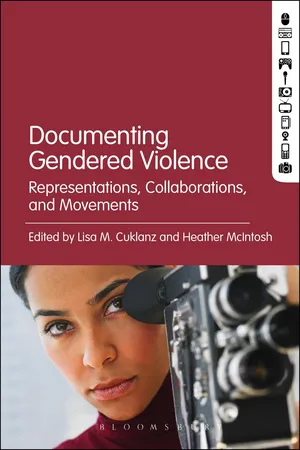
Documenting Gendered Violence
Representations, Collaborations, and Movements
- 288 pages
- English
- ePUB (mobile friendly)
- Available on iOS & Android
eBook - ePub
Documenting Gendered Violence
Representations, Collaborations, and Movements
About this book
Documenting Gendered Violence explores the intersections of documentary and gendered violence. Several contributors investigate representations through grounded textual analyses of key films and videos, including Sex Crimes Unit (2011) and The Invisible War (2012),and other documentary texts including Youtube, photographs, and theater. Other chapters use analysis and interviews to explore how gender violence issues impact production and how these documentaries become part of collaborations and awareness movements.
Information
1
Introduction: The Intersections of Documentary and Gendered Violence
Gender-based violence often occurs out of the public eye, reinforcing perpetrators’ actions with tacit impunity. Yet its representation in documentary forms presents a potential means of bringing hidden or private issues to a broad-based audience. Though documentaries frequently generate less revenue than more commercial fare, they have often had a great deal of influence on people, politics, and policy. The recent proliferation of documentaries about gender-based violence has the potential to transform public consciousness on a range of issues that present challenging subject matter for filmmakers, subjects, and audiences. Once appearing primarily in smaller art and educational venues, these documentaries are starting to show at mainstream film festivals and theaters, and on mainstream television. Due, in part, to the development of thoughtful and innovative techniques of representation, these documentaries provide growing visibility for issues and points of view that have often been discursively silenced. Documenting Gendered Violence: Representations, Collaborations, and Movements stands at this turning point in the representation, production, and advocacy of documentaries on gender-based violence. Through the set of chapters assembled here, we hope to advance the discussion of challenges and innovations in both production and representation of this complex and emotionally charged area.
Gender-based violence involves the subjugation of a person or group because of their gender. While males do become targets of gender-based violence, females make up the overwhelming majority of its victims. With its “Declaration on the Elimination of Violence against Women,” the United Nations defines “violence against women” as “any act of gender-based violence that results in, or is likely to result in, physical, sexual, or psychological harm or suffering to women, including threats of such acts, coercion, or arbitrary deprivation of liberty, whether occurring in public or in private life.”1 The experience of gender-based violence affects not only its survivors, but also their children, families, and communities. Gender-based violence includes a wide range of harmful acts such as rape, domestic violence, human trafficking, forced marriage, femicide, female genital mutilation, and sexual and other forms of harassment. Perpetrators are individuals, such as spouses; communities, often through patriarchal traditions; and even nations or states, such as through rape during wartime. Gender-based violence presents challenges in the production and representation of documentaries. The production of these works requires careful attention to the style and practices used in order to represent these sometimes unrepresentable truths and to avoid re-victimizing or re-traumatizing the survivors involved in the original violence or subsequent production. The awareness-raising efforts connected with these documentaries require balancing issues of representation against engaging audience interests.
Documenting Gendered Violence: Representations, Collaborations, and Movements interrogates the intersections and boundaries of documentary and gender-based violence. While many studies focus on a specific type of violence within a specific medium, the chapters in this volume offer a range of perspectives on these intersections. Whereas several authors address film and video, others address printed autobiography, theatrical performance, photography, and digital video. Some authors analyze documentary as texts, while others engage aspects of documentary production and raise questions about distribution in a multimedia, multi-channel environment. In addition to the breadth of coverage for documentary as a form, these chapters interrogate a range of gender violence types, including rape, domestic violence, and human trafficking. These chapters focus not only on the survivors, but also on the witnesses, the advocates, the producers, and the systems within and outside which they operate.
This examination of the range and breadth of production that can be understood within the general rubric of documentary is one central goal of this volume. We also incorporate a number of critical approaches. Several chapters engage in grounded textual analyses, while others base their analyses in interviews and other methodologies. Most importantly, these various analyses together provide insights into ways in which myriad representational styles can provide subtle and complex revelations about the operations of gender-based violence. Some common themes that emerge from these varied analyses include institutional limitations and controls, intersectionalities of gender and other identity categories, the relations of power among those involved, and the strength and resilience shown by many survivors in rebuilding their lives beyond trauma. Although gender-based violence presents many challenges for ethical and meaningful treatment in documentary, this volume elucidates innovative means of challenging stereotypes, privileging the points of view of survivors, and resisting elements and modes that can be experienced as re-victimizing. It also highlights some of the ways in which documentary efforts can fall short of these ambitious goals.
This introduction will outline some of the key ideas central to discussions of gender violence in documentary film and video. Many themes raised within these media recur across the other forms. The chapters addressing written autobiography, photography, documentary theater, and digital video offer more in-depth and medium-specific literature reviews. This introduction also analyzes key ideas about documentary as a cultural form and explores the motivations and developments of both the committed documentary and feminist documentary. It addresses questions of form and representation through divergent styles, and the roles that these styles play in ideological interrogation with the eye toward valuing both the realist and the experimental. Questions of power dynamics inherent in the filmmaker–participant relationship are outlined, and the insights of trauma theory offer ways to consider the unrepresentability of many instances of gender-based violence. The later sections address questions of audience, examining how documentaries position audience members within the processes of political engagement and the construction of witnesses. A brief overview of the key players and challenges in contemporary documentary production is provided.
Defining documentary
The definition of documentary is contested among makers, participants, audiences, and institutions. This definition of documentary is usually based on the ideas of reality and its construction, and incorporates debates about what constitutes reality and how it can be represented. While fictional works draw on elements of the fantastic and art draws on the elements of the expressive, documentary is based in the everyday worlds that humans create and occupy. However, creating this connection between documentary and reality tethers and collapses two complex ideas that frequently defy concise definition. As Spence and Novarro write, “it has always been easier to recognize a documentary than to define the term.”2 Since attempts to represent reality require judgments about what to include and exclude, as well as decisions about elements such as emphasis, approach, and point of view, the lines among documentary, fiction, and art become blurred.
Understandings of documentary forms often start with a document or a record. The earliest attempts to capture motion on film offer records of movement, of such images as horses running or people walking.3 In the 1890s the works created by the Lumière camera operators and Thomas Edison capturing people leaving work or sneezing are illustrious examples.4 Documentaries consist of multiple components, including documents themselves. Other conventions in documentary film and video include observational footage, or footage captured in the moment; participant interviews, or staged conversations; voiceover narration, or the disembodied voice describing events and details; re-enactments, or stagings of events otherwise unavailable to the camera; and archival materials, or materials from other sources such as television news and family photographs.
These conventions facilitate the construction of a documentary’s argument, or “truth claim,” which refers to the claim of truth that the documentary makes about reality. The truth claim remains problematic and highly debated among scholars, practitioners, and audiences, who have expressed a range of opinions about its rigidity, validity, and usefulness. The rigidity of the truth claim often appears as a point of critique of documentary texts within the popular press reactions to them. If the documentary fails to uphold the viewers’ ideas of what that reality is—even if some viewers know nothing of the reality shown—then the documentary’s claims to truth are oftentimes viewed as false. Stella Bruzzi describes this rigidity further: “Repeatedly invoked by documentary theory is the idealized notion, on the one hand, of the pure documentary in which the relationship between the image and the real is straightforward and, on the other, the very impossibility of this aspiration.”5 Documentary in practice rests between these two extremes. Bruzzi’s comments pinpoint a second problem with the truth claim: the impossibility of achieving it. Defining a “straightforward” relationship between what appears in a documentary and what appears in reality results in a binary: “objective” versus “biased.” If the relationship appears (note the slippery word) straightforward, then the documentary is perceived as objective. If the relationship appears other than straightforward, then the documentary is perceived as biased.
The objective-versus-biased-limits-discourse “argument” provides a more useful term for analyzing the relationship between documentary and the reality it constructs. Nichols asserts the inseparability of these concepts: “what films [documentaries] have to say about the enduring human condition or about the pressing issues of the day can never be separated from how they say it, how this saying moves and affects us, how we engage with a word, not with a theory of it.”6 Arguments about realities provide the sense-making about meanings within documentaries, and through these arguments, realities become accessible to audiences who exist outside them. The notion of “argument” distances documentaries from the limiting binaries and shifts them into the realm of discourses.
The committed documentary and social change
While documentary appears within education and industry, it has long played a role in social issue...
Table of contents
- Cover
- Halftitle Page
- Title Page
- Dedication Page
- Contents
- Acknowledgments
- Notes on Contributors
- 1. Introduction: The Intersections of Documentary and Gendered Violence
- 2. Creating a Sense of Reality in Sex Crimes Unit
- 3. Calling the Consumer Activist, Consuming the Trafficking Subject: Call + Response and the Terms of Legibility
- 4. “The Nation Wants to Know!”: Documenting Sexual Violence on Indian Prime-Time Television News
- 5. When Solidarity Melts into Air: Philippines-Born Women Migrants in Australia
- 6. Global Sex Work, Victim Identities, and Cybersexualities
- 7. “This Is about Way More than Bullies”: User-Generated Video, Narrative Multiplicity, and LGBTQ Youth Identity
- 8. A tráves de mis ojos: Fototestimonios with Children Growing Up in Immigrant and Migrant Communities in Northern California
- 9. Staging Gender Violence in the Congo: Reading Lynn Nottage’s Ruined as a Documentary Drama
- 10. Making The Invisible War Visible
- 11. The Committed Documentary and Contemporary Distribution: A Look at Sin by Silence
- 12. Anatomy of Filmmaking Practice: Documentary and Gendered Violence
- Select Filmography and Distributors List
- Index
- Imprint
Trusted by 375,005 students
Access to over 1.5 million titles for a fair monthly price.
Study more efficiently using our study tools.
Frequently asked questions
Yes, you can cancel anytime from the Subscription tab in your account settings on the Perlego website. Your subscription will stay active until the end of your current billing period. Learn how to cancel your subscription
No, books cannot be downloaded as external files, such as PDFs, for use outside of Perlego. However, you can download books within the Perlego app for offline reading on mobile or tablet. Learn how to download books offline
Perlego offers two plans: Essential and Complete
- Essential is ideal for learners and professionals who enjoy exploring a wide range of subjects. Access the Essential Library with 800,000+ trusted titles and best-sellers across business, personal growth, and the humanities. Includes unlimited reading time and Standard Read Aloud voice.
- Complete: Perfect for advanced learners and researchers needing full, unrestricted access. Unlock 1.5M+ books across hundreds of subjects, including academic and specialized titles. The Complete Plan also includes advanced features like Premium Read Aloud and Research Assistant.
We are an online textbook subscription service, where you can get access to an entire online library for less than the price of a single book per month. With over 1.5 million books across 990+ topics, we’ve got you covered! Learn about our mission
Look out for the read-aloud symbol on your next book to see if you can listen to it. The read-aloud tool reads text aloud for you, highlighting the text as it is being read. You can pause it, speed it up and slow it down. Learn more about Read Aloud
Yes! You can use the Perlego app on both iOS and Android devices to read anytime, anywhere — even offline. Perfect for commutes or when you’re on the go.
Please note we cannot support devices running on iOS 13 and Android 7 or earlier. Learn more about using the app
Please note we cannot support devices running on iOS 13 and Android 7 or earlier. Learn more about using the app
Yes, you can access Documenting Gendered Violence by Lisa M. Cuklanz, Heather McIntosh, Lisa M. Cuklanz,Heather McIntosh in PDF and/or ePUB format, as well as other popular books in Ciencias sociales & Estudios de género. We have over 1.5 million books available in our catalogue for you to explore.