- 216 pages
- English
- ePUB (mobile friendly)
- Available on iOS & Android
eBook - ePub
About this book
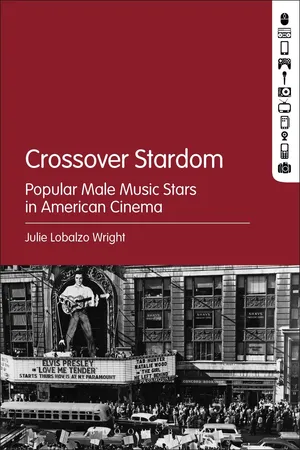
Crossover Stardom: Popular Male Stars in American Cinema focuses on male music stars who have attempted to achieve film stardom. Crossover stardom can describe stars who cross from one medium to another. Although 'crossover' has become a popular term to describe many modern stars who appear in various mediums, crossover stardom has a long history, going back to the beginning of the cinema. Lobalzo Wright begins with Bing Crosby, a significant Hollywood star in the studio era; moving to Elvis Presley in the 1950s and 1960s, as the studio system collapsed; to Kris Kristofferson in the New Hollywood period of the 1970s; and ending with Will Smith and Justin Timberlake, in the contemporary era, when corporate conglomerates dominate Hollywood. Thus, the study not only explores music stardom (and music genres) in various eras, and masculinity within these periods, it also surveys the history of American cinema from industrial and cultural perspectives, from the 1930s to today.
Information
1
The Crooner Film Star: Bing Crosby
Introduction
It is almost impossible to sum up the contribution Bing Crosby made to American popular culture in his seventy-four years on Earth. It has been said that in the 1940s “his voice was being heard somewhere in the world every minute of the day” (Macfarlane, 2007: 142). Crosby was a star of recorded music, radio, film, and even appeared on television later in his career. He was not the first singing star in Hollywood, nor the first radio star, but the first significant star who was able to parlay his established success on the radio into a film career. As Michael Feinstein surmised, “he created a legacy that is unequaled in its scope and achievement” (2007: xviii).
Crosby’s career began as part of a duo with childhood friend, Al Rinker, before joining the Paul Whiteman orchestra where they added a third member to the group, Harry Barris, and became known as The Rhythm Boys. Slowly, Crosby was singled out from the other members, leading to solo opportunities on radio and recordings. This was a significant period in not only Crosby’s career, building the star image that would come to dominate popular culture for over twenty years, but also represented a period of unprecedented change in American culture, including popular culture. In fact, Crosby sustained his stardom through significant social change in America (World War II and the immediate postwar period), but also major alterations that took place in the media, including mediums that Crosby would come to dominate—film and radio.
This chapter will consider Crosby as a crossover star, from radio to music recordings to film, discussing his place within American popular culture for more than forty years, but also the various alterations that took place to help facilitate Crosby’s immense stardom.
Early stardom: crooning and radio
Crosby became a star at a crucial period in the development of cinema when sound became commonplace, which transformed the industry, not just through the technology needed to alter cinema from silent to sound, but, also, certain genres and stars emerged in this period due to the standardization of sound. Musicals became one of, if not the, most popular film genres after sound, leading, also, to the proliferation of singing stars in Hollywood. Stars were sought from the stage before sound, especially vaudevillian stars who were utilized in comedy shorts and features. The adaption of sound, industry wide, meant that the talent pool was expanded to include performers who could sing and dance, in addition to possessing comedic talent.
Concurrently, radio was emerging as a significant entertainment format for Americans with many using radio as their primary entertainment source. With the rise of radio, the recording business altered through technological advancements and changing audience tastes. Technology, more than anything else, may have singlehandedly led to the rise of Bing Crosby. As Gary Giddins observed, “more than any other performer, Crosby would ride the tide of technology” (2001: 113) throughout his career. The microphone, popularity of radio, and the transition from sheet music to recorded music on phonographs all assisted in creating a singer who could transcend the physical limitations of connecting with audiences through voice-only mediums, such as the record and the radio. In fact, the 1947 quasi-biographical film The Road to Hollywood (Bud Pollard, Mack Sennett, Del Lord, and Leslie Pearce), which culled together various shorts Crosby made in the early 1930s, implied through narration that Crosby was the first “to successfully invade the wireless.” The adjective of invade was especially revealing because Crosby was celebrated and enamored for his ability to intimately connect to audiences through this singing voice, while also condemned and criticized by certain sectors of American society for his crooning style of singing.
Allison McCracken discusses in her book Real Men Don’t Sing: Crooning in American Culture (2015) the hostility toward crooning in the late 1920s into the 1930s that was bound up in American ideals about sexuality, masculinity, and the domestic space. Crooning was considered “feminine” because of its emotionalism, subject matter, and female appeal. Early crooners entered the domestic space through recorded albums and live radio performances, establishing intimacy with, mainly, female audiences. This intimacy as historian Michael Chanan has noted was enhanced by the “‘close-up’ radio broadcast, where small groups of performers would use a small, acoustically dead studio and work close to the microphone ... producing an effect of artificial intimacy as if the singer and song are transported into the presence of the listener” (1995: 60), both inhabiting the same space.
The romantic crooner “threat” was the foundation of many of Crosby’s early shorts in Hollywood, including I Surrender Dear (Mack Sennett, 1931). The short begins with Crosby singing to an audience at the Cafè Royale, including transfixed women who cannot take their eyes off the singer. The short then fades to a shot of a train with Crosby’s singing of “I Surrender Dear” acting as a sound bridge before cutting to a close-up of a radio. The short then cuts to a medium long shot of two women and one man in a train carriage listening to Crosby’s song with the youngest woman smiling, the older woman working on her needlepoint, and the man lying down looking pensive. In a medium shot, the mother says to her daughter, “Would you please shut off that noise”? The daughter responds, “Noise? Mother, that’s Bing Crosby” to which she states, “I don’t understand how you can be so interested in a radio star you’ve never seen.” Here, the film is directly linking Crosby to radio, in addition to, firmly locating his appeal, to younger women, in the sound of his voice. The voice is displaced from the body and is a reoccurring theme in many of Crosby’s early shorts and feature length films, while also situating the perceived danger in crooning in the disembodied voice.
The crooner was a new phenomenon, emerging during the Jazz Age and exposed the “transformative effects of microphone technology, which put soft-voiced singers on equal footing with classically trained singers and Broadway belters” (McCracken, 2015: 3). The amplified crooning voice was denigrated for its feminine connotations through the emotion the singers expressed and the deemphasized male body. As opposed to earlier singers, such as Al Jolson whose singing was physically demanding partly due to his need to aurally reach audience members without technological enhancements, crooners were able to sing with still bodies emoting sentimental songs. If masculinity is often judged through a man’s body, the shift from bodily performances to purely vocal performances onstage and in the home meant that masculinity became less about physical pursuits and was instead associated with feminine ideals: emotion and feeling. McCracken’s study explores how mass media, especially the relatively new radio medium, encouraged women to become active consumers, especially through romantically inclined cultural products, such as crooning stars like Rudy Vallée, whom McCracken dubs as “America’s first pop idol” (2015: 11). The Jazz Age laid the groundwork for crooners and the physical arousal many women felt for these singers. Crosby was not immune to the moral panic that arose from the success of crooners. However, as opposed to Vallée and various other crooners, such as Morton Downey and Russ Columbo, Crosby was able to prolong his stardom through the height of the public attacks by calming fears of effeminacy through the creation of a more masculine image. For many critics, crooning was associated with femininity and passivity and Crosby was able to introduce more masculine characteristics—“aggressiveness, physical activity, emotional detachment” (McCracken, 2015: 268)—into his star persona while also instilling his image with American middle-class values.
The evolution of Crosby’s image was necessitated by the negative reaction to the popularity of crooning in some sectors of American society as the criticism was especially damaging to a star building their stardom in a medium that served various commercial interests. Radio stars appeared on network shows with commercial sponsors. Although in reference to television on-screen talent, Susan Murray’s observations are as relevant to radio stars:
On-screen talent had to represent the sometimes competing commercial aims of both the sponsor (who wanted the star to be associated with its specific product) and the network (who used the star’s persona to represent the character of the network as well to attract a mass audience). (2005: xi)
Radio stars were required to balance the interests of the sponsor and network, and if these stars became film stars, as Crosby did, they also incorporated the film studio’s interests (Hilmes, 1999: 3).
While the film star system, especially developed in classical Hollywood, is well recognized with countless books and articles devoted to the subject, the radio star-system is less familiar, although radio operated a very similar structure.1 Advertising agencies developed an “audio star-system” in conjunction with networks by building continuity between the star persona and the product brand, ensuring there was a consistent image promoted across various media (Murray 2005: 22–25). Michele Hilmes argues the role of sponsors and ad agencies have been grossly overlooked in historical and industrial studies of radio and that networks actually had “little impact into the creative process” partly due to radio shows “network-hopping” mid-run for better rates or more favorable time slots (1999: 80–81). Furthermore, advertising agencies opened offices in Hollywood to manage their radio programs after they had moved from New York in the late 1930s to exploit Hollywood star talent (Meyers, 2014: 201).2 The interconnectedness between radio and advertising was most obviously displayed through the “integrated commercial message” (Hilmes, 1999: 86) that was seamlessly weaved into program narratives, titles, and show moments.
Crosby began appearing on the radio with The Rhythm Boys in 1928 before solo appearances in 1929 and 1930. His first fifteen-minute radio show began in 1931 debuting September 2 on CBS radio and running Monday through Saturday (Giddins, 2001: 256). This show eventually found a sponsor in Certified Cremo, “a cigar-making subsidiary of American Tobacco” and this led to Crosby being refereed to, for a short time, as the “Cremo Singer” (Giddins, 2001: 268). Crosby would go on to front programs sponsored by Woodbury soap, Kraft (food), Philco (electronics), Chesterfield cigarettes, Minute Maid, and General Electric. The diversity of these products was matched with advertising campaigns that utilized Crosby’s star image, including Remington electric shavers, Royal Crown cola, Mastercraft pipes, and Whitman’s Chocolates (among many others).
Cynthia B. Meyers charts the development of advertising agencies and radio in its “golden age” signaling out the J. Walter Thompson (JWT) agency as introducing advertising strategies that relied on testimonials from stars, helping to align their products with “desirable attributes, such as wealth, social status, or celebrity, in order to create positive feelings in the consumer about the product” (2014: 209). JWT helped to alter the way advertisements were integrated into the programs by introducing commercials that were “straight” with “no tricks ... no kidding” (Meyers, 2014: 221). This was achieved by beginning with an organically sounding lead-in from the host (Crosby) to the announcer of the program (in the case of Crosby’s Kraft Music Hall, Ken Carpenter), who then spoke in a casual manner for over a minute about what differentiates the sponsored product from others employing user-centered language. This type of sales pitch followed the typical mode of address on radio that emphasized the ordinariness and familiarity of the hosts and performers. Intimacy was the foundation of which programs were built through the performers directly addressing the audience and the way they presented their ordinariness. Richard Dyer notes the modes of performance developed by radio could be characterized as portraying: domestic intimacy, recognizable characters by type and individual, and performances that emphasize authenticity and ordinariness (1998: 139). It is unsurprising, then, that the preferred radio performance style coupled with the advertiser’s desire for appropriate spokespeople and the attacks on crooning meant Crosby’s still developing star image was unsustainable, especially if he wished to succeed in radio.
1930s: image alterations
In the early 1930s, Crosby was considered a playboy similar to his main rival Rudy Vallée, and Crosby’s...
Table of contents
- Cover
- Half Title
- Dedication
- Title Page
- Contents
- Illustrations
- Acknowledgments
- Introduction
- 1 The Crooner Film Star: Bing Crosby
- 2 The Rock ‘N’ Roll Film Star: Elvis Presley
- 3 The Country Film Star: Kris Kristofferson
- 4 The Rap Film Star: Will Smith
- 5 The Pop Film Star: Justin Timberlake
- Conclusion
- Bibliography
- Filmography
- Index
- Copyright Page
Trusted by 375,005 students
Access to over 1.5 million titles for a fair monthly price.
Study more efficiently using our study tools.
Frequently asked questions
Yes, you can cancel anytime from the Subscription tab in your account settings on the Perlego website. Your subscription will stay active until the end of your current billing period. Learn how to cancel your subscription
No, books cannot be downloaded as external files, such as PDFs, for use outside of Perlego. However, you can download books within the Perlego app for offline reading on mobile or tablet. Learn how to download books offline
Perlego offers two plans: Essential and Complete
- Essential is ideal for learners and professionals who enjoy exploring a wide range of subjects. Access the Essential Library with 800,000+ trusted titles and best-sellers across business, personal growth, and the humanities. Includes unlimited reading time and Standard Read Aloud voice.
- Complete: Perfect for advanced learners and researchers needing full, unrestricted access. Unlock 1.5M+ books across hundreds of subjects, including academic and specialized titles. The Complete Plan also includes advanced features like Premium Read Aloud and Research Assistant.
We are an online textbook subscription service, where you can get access to an entire online library for less than the price of a single book per month. With over 1.5 million books across 990+ topics, we’ve got you covered! Learn about our mission
Look out for the read-aloud symbol on your next book to see if you can listen to it. The read-aloud tool reads text aloud for you, highlighting the text as it is being read. You can pause it, speed it up and slow it down. Learn more about Read Aloud
Yes! You can use the Perlego app on both iOS and Android devices to read anytime, anywhere — even offline. Perfect for commutes or when you’re on the go.
Please note we cannot support devices running on iOS 13 and Android 7 or earlier. Learn more about using the app
Please note we cannot support devices running on iOS 13 and Android 7 or earlier. Learn more about using the app
Yes, you can access Crossover Stardom by Julie Lobalzo Wright in PDF and/or ePUB format, as well as other popular books in Social Sciences & Music. We have over 1.5 million books available in our catalogue for you to explore.