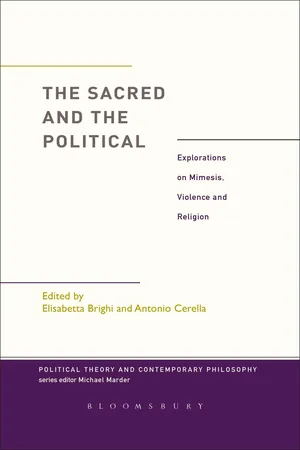
eBook - ePub
The Sacred and the Political
Explorations on Mimesis, Violence and Religion
- 288 pages
- English
- ePUB (mobile friendly)
- Available on iOS & Android
eBook - ePub
The Sacred and the Political
Explorations on Mimesis, Violence and Religion
About this book
What is the relationship between the sacred and the political, transcendence and immanence, religion and violence? And how has this complex relation affected the history of Western political reason? In this volume an international group of scholars explore these questions in light of mimetic theory as formulated by René Girard (1923-2015), one of the most original thinkers of our time. From Aristotle and his idea of tragedy, passing through Machiavelli and political modernity, up to contemporary biopolitics, this work provides an indispensable guide to those who want to assess the thorny interconnections of sacrality and politics in Western political thought and follow an unexplored yet critical path from ancient Greece to our post-secular condition. While looking at the past, this volume also seeks to illuminate the future relevance of the sacred/secular divide in the so-called 'age of globalization'.
Information
Introduction: Girard on Plato and Aristotle
Aristotle’s verdict on the use of violence in tragedy
Table of contents
- Cover
- Series
- Title Page
- Dedication
- Contents
- List of Contributors
- Acknowledgments
- Introduction. The Power of Sacrifice: René Girard and the Political
- 1 Aristotle on Mimesis and Violence: Things Hidden since the Foundation of Literary Theory
- 2 René Girard and Thomas Aquinas on Prophecy and the Purging of the Notion of Justice
- 3 Unlikely Twins? Machiavelli and Girard on Violence, Crisis and the Origins of the State
- 4 René Girard, Human Nature and Political Conflict
- 5 Spinoza, Girard and the Possibility of a Purely Immanent Democracy
- 6 René Girard’s Mimetic Theory: An “Anti-political Theology”?
- 7 A “Theoretical Double”: Violence, Religion and Social Order in Schmitt and Girard
- 8 Mimesis and Sartre’s Critique of Dialectical Reason
- 9 The Sacred and the Secular: René Girard and Gianni Vattimo on Modernity and Violence
- 10 The Myth of Origin: Archaeology and History in the Work of Agamben and Girard
- 11 The Age of Panic: On Mimetic Post-modernity
- Index
- Copyright
Trusted by 375,005 students
Access to over 1.5 million titles for a fair monthly price.
Study more efficiently using our study tools.
Frequently asked questions
Yes, you can cancel anytime from the Subscription tab in your account settings on the Perlego website. Your subscription will stay active until the end of your current billing period. Learn how to cancel your subscription
No, books cannot be downloaded as external files, such as PDFs, for use outside of Perlego. However, you can download books within the Perlego app for offline reading on mobile or tablet. Learn how to download books offline
Perlego offers two plans: Essential and Complete
- Essential is ideal for learners and professionals who enjoy exploring a wide range of subjects. Access the Essential Library with 800,000+ trusted titles and best-sellers across business, personal growth, and the humanities. Includes unlimited reading time and Standard Read Aloud voice.
- Complete: Perfect for advanced learners and researchers needing full, unrestricted access. Unlock 1.5M+ books across hundreds of subjects, including academic and specialized titles. The Complete Plan also includes advanced features like Premium Read Aloud and Research Assistant.
We are an online textbook subscription service, where you can get access to an entire online library for less than the price of a single book per month. With over 1.5 million books across 990+ topics, we’ve got you covered! Learn about our mission
Look out for the read-aloud symbol on your next book to see if you can listen to it. The read-aloud tool reads text aloud for you, highlighting the text as it is being read. You can pause it, speed it up and slow it down. Learn more about Read Aloud
Yes! You can use the Perlego app on both iOS and Android devices to read anytime, anywhere — even offline. Perfect for commutes or when you’re on the go.
Please note we cannot support devices running on iOS 13 and Android 7 or earlier. Learn more about using the app
Please note we cannot support devices running on iOS 13 and Android 7 or earlier. Learn more about using the app
Yes, you can access The Sacred and the Political by Elisabetta Brighi, Antonio Cerella, Elisabetta Brighi,Antonio Cerella in PDF and/or ePUB format, as well as other popular books in Philosophie & Philosophie politique. We have over 1.5 million books available in our catalogue for you to explore.