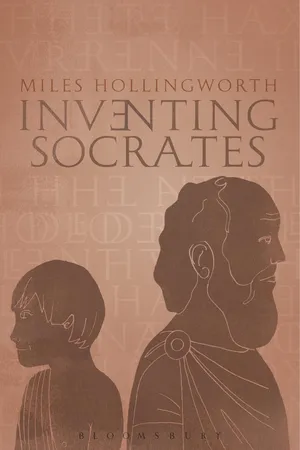
Inventing Socrates is a book about the consequences of knowledge and the coming of age. It is written in knowledge's Western setting, making allegorical as well as literal use of the event known as the 'birth of philosophy' – an event that began in ancient Greece in the 6th-century B.C., when a handful of thinkers first looked at the natural world through the critical eyes of fledgling science.
Very little of concrete fact is known about this first philosophy and its protagonists. Only scant fragments of their writings have survived; and these are nearly always poetical and esoteric, some no more than a single line. They are freighted with meanings that might take one in two different directions at once; and this ambidexterity between ancient and modern has always been their beguiling feature. Altogether these thinkers are known as the Presocratics, because they pioneered the rational methods that Socrates would take to the question of the good life. If Socrates stands today as an icon of Western self-esteem, these pioneers are said to show the emergence of that poise from the fug of myth and religion. Apparently they prove the evolution of Western intelligence and the value of living today – in the secular maturity of its latest, greatest hour. But what if their continuing readability and tactility were actually to become the demonstration against that?
This is not just, then, a book about the foundations of Western thought. It is a book about all that we invest in the ideas of ancient and modern. Left to right is the Western way of learning and growing, but, as Miles Hollingworth shows, the truths of the human condition are subterranean corridors running psychologically and eternally.
- 192 pages
- English
- ePUB (mobile friendly)
- Available on iOS & Android
eBook - ePub
Inventing Socrates
About this book
Information
1
Predestination
O my body! I dare not desert the likes of you in other men
and women, nor the likes of the parts of you,
I believe the likes of you are to stand or fall with the likes
of the soul, (and that they are the soul,)
WALT WHITMAN
What is the American poet Walt Whitman doing here at the head of Chapter 1 of a book, ostensibly on Presocratic philosophy? Why, for that matter, is this chapter titled ‘Predestination’? The whole rest of this book must be the full explanation, but I can get at the essence of it now in a kind of opening manifesto.
Now, more than ever they have been, the classic foundations of the Western tradition are in a position to send us some of the up-to-the-minute news of today’s world. Not too long ago, Western ideas and their relationship to social and political life were still in the thrills and momentums of the big experiments around the world. I mean experiments like the new world of America; the empires of Europe; and the declarations of human rights. The confidence behind all of these was their belief in the good life as a kind of religion. This Western style of worshipping whatever can stand to reason in the world seemed like a perfect and unimpeachable practice – borne out by a happy conjunction between the actual tactility of the laws of nature and the wilful selflessness of Christian values. ‘Altruism’ was what it saw each morning when it put on its uniform and looked in the mirror. Rationality was the true egalitarianism, and science and judgements of fact (the same everywhere) the ultimate proof of this. But mighty and reasonable as all of it has been, there is something that this tradition has always known and experienced and esteemed, but which it has had no natural way of accounting for in theory. This is the soul. The human soul has been there at work in every human culture there ever has been. Yet now it looks increasingly like it was better and more instinctively handled in the more ancient cultures of the world. Or indeed, in their counterparts in the present world – the cultures of the undeveloped world, with their undiminished sense for what can be called pantheism or anthropomorphism, but which is really a healthy regard for the fundamental needs of human sight lines.
No human being can at heart want to be a calculating machine. It is true that what Whitman calls the likes and the parts of us in other men and women can, on one view, be worked up into a classification scheme and a theory of knowledge. But that is not what he meant by his joyful lament: and we, too, seem to be living today in a popular culture in the West that is hankering once again after ritual, symbolism, code and conspiracy. At any rate, for some reassurance that after all this hard intelligence and number crunching, there may be some experience left to be had of the seeing that doesn’t go through things in the way that reductionism goes through things, but which activates our sensuality – and sensuality’s possessiveness.
The Western eye has been conditioned into the dogma that its interface with the world is to be Dewey Decimal and archival. Items are picked up and seen at precisely the same time as they are catalogued and put into their proper place. What we can all look forward to one day, so this posturing goes, will be various versions of augmented reality. But this is a conflicted dogma, at odds with the authentic and original truth-experience that, say, Whitman was after. This is the idea that the most valuable and unencumbered form of knowing that there is, is the way that you can feel your corporeal self animated and stabbed-through by frightening, tightening pangs of possessiveness. ‘The philosopher and every wise man, loves truth, loves reason’ – here is meant to be the sane and proper beginning for every pukka house of ideas. But before the soul ever loved reason, she was a lover plain and wild. And that was her spirit. And this means that before repression, or sublimation, or the good life, or whatever you want to call it, there is this that must always come first in any worthy assessment of who we are. And ‘this that must always come first’ must also therefore sit in a region that can be described by neither right nor wrong: for its striking feature is that it is playing like hair triggers on the kinds of things you would die for. Her head on your shoulder. The way she picked you out from all the world. Your children. Your brother. Your homeland. Its breeze on your face. All of these things exist in the world that came first, before theory came along. A world unashamed by all these things it lusted for, and indeed its self-love in lusting for them. Theory is how we blush, and try to fix this, and make all things work together for good, whatever ‘good’ is. But now I have a strong suspicion that for one reason or another, we have come full circle and reawakened our desire to return to this world that came first.
It encourages me to say quite openly that the Presocratics, and how they invented Socrates, are going to be our story once again – its best and its worst bits. We don’t have to read them any longer from any kind of respectful distance; indeed we shouldn’t given what I have been saying. For if the history of philosophy has been like a cabinet full of trophies, meant to make us feel better about ourselves and proud, then that is also all that it has been – alone and inanimate in a corner. Which is a shame because I believe that the story of how Socrates was invented was a psychological episode; and that for this reason it can be gone through again (by us and continuously) with materials of the natural and supernatural that we discover within ourselves. Within ourselves this morning, if we like.
A strange romance
Even though it is still early days, let me summarize what I have been saying, so that there can be no misunderstanding. The European adventure of ideas seems to me to be a strange romance. It is the romance of an honourable intention. It is on behalf of all men and women. It is not the romance of the home and the hearth, which is yours and yours alone by the sheer fact that it is no one else’s. The romance of the home and the hearth is apolitical in its originality and partiality – it is unrecognizable to anyone save its owner. It is your wife, but not qua Woman; it is your husband, but not qua Man. So when it has to be recognized as anything wider than this, it tends to be recognized politically, in terms of your legal rights and freedoms to ownership and enjoyment of it as a category concept – and then again in terms of those rights’ protection by the State. But to notice this is not to speak against this strange romance. There is no question that there is something genuinely noble and uplifting about, yes, political freedom in the West. But between this and the romance you can feel for what is yours and yours alone, there is a chasm of difference that can never be crossed.
There is, of course, an immediate answer to give at this point, which is a true answer. This is the answer of moral pluralism. In a properly constituted society of today, private citizens are no longer agents but spaces – spaces which are theirs to fill with their opinions and preferences. It is not the business of the State to impinge on the home and the hearth. Moral pluralism creates an atmosphere in which the romance of the home and the hearth can flourish. It is its guarantor and protector, and achieves this on its terms of operation. No, what I am pushing for with all my Whitman-talk about pre-rational sight lines and loves is something that belongs to the deep-private and the deep-subjective, but which can only be pointed to in relief like this against the apparatus of the State. On the one hand, you have to accept and admire that it is written into the very definition of the modern state that it should seek as little as possible to judge such inner things as I am intimating. But on the other hand, there is the problem that whilst statehood and civilization may have set up the pools and channels in which the blood of life has been able to settle and flow, this same settling and flowing has never brought us a step closer to understanding what lifeblood actually is. Neither has the painstaking measuring and describing of the pools and channels. Clearly, I suspect that Whitman knew what lifeblood is, and I am grateful to have his lyrical example for my book. For my part, I strongly suspect that by cracking open and reliving an episode like the birth of philosophy, we will get a little closer to realizing why it is now – in the year 2015 – that we are thirsting for lifeblood ourselves once again.
The Western tradition is therefore in the unusual situation of having its achievements as well as its shames derive from the same source. In the firstborn sense, it ‘owns’ the unmistakable idea that there is such a thing as free, reasoned thought – followed as its own imperative. This idea says that if you are a human being, wherever you are, and whatever situation you happen to be in, you owe it to yourself to cast off all your other imperatives to action and educate yourself into this one. What could be wiser than that? But at the same time, this evangelical zeal has furnished the world with the never-to-be-forgotten image of the colonial administrator and the notion of the ‘white man’s burden’. For a time this was very nearly indistinguishable from Western Christianity in mission throughout the world. But now, when its traditional religion is no longer being allowed this same status as the safeguard and vanguard of values and institutions, what the West prefers to be seen to be exporting are the plain civil liberties of good governance and behaviour. Nevertheless, for those wanting it, the sense of shame can linger on in the question whether the Western way of life can be justified in its promotion to other cultures as something superior to what they already have, developed to undeveloped; or in their own best interests, if they could only see them.
I do, though, want to have gone on record at this point as having said the following. In most cases where the Western way rides in to save the day, one is facing a moot, if not an absolutely irrelevant, question. There are situations in the world so desperate, so war-ravaged or simply so poverty-stricken that help for its own sake is all that is required – and Western nations happen to be in the position to give that help. So fair enough that it should be on their terms.
Something else too. The traditional, ethical language of freedom has made it out to be the virtue as wide as the very institution of democracy itself – or for that matter, of justice itself or society itself. But when you think about it, what we instinctively feel freedom to be has never been any such giant, catch-all prizes as these, but instead a succession of moments. Freedom, like marriage, is a sacrament that only ever seems to belong to the two bodies that go into making each of its moments. In the case of freedom, these are the oppressor and the oppressed. To anyone else looking on and speculating from the outside in, however clever or well informed they might be, freedom, like marriage, is just going to have to be a stranger to them. I mean that they will have to wait their turn, and retell its story through their own bodies. And this, we might agree, is appropriate: for things as important as freedom can only take off into their true feeling and meaning when they become possible to be recounted as your personal testimony. No amount of theory can ever prepare you for what it’s really going to be like because (again) not one jot of theory ever came first. Theory has always been in this position of coming after the fact of whatever it is pontificating about. It is the voyeur attitude. When, in his memoirs, Henry Kissinger tried to defend the general activities of American foreign policy on his watch, he dropped everything, went instinctive in this way I mean and went back to what freedom had first meant to him:
When I was a boy [America] was a dream, an incredible place where tolerance was natural and personal freedom unchallenged. Even when I learned later that America, too, had massive problems, I could never forget what an inspiration it had been to the victims of persecution, to my family, and to me during cruel and degrading years. I always remembered the thrill when I first walked the streets of New York City. Seeing a group of boys, I began to cross to the other side to avoid being beaten up. And then I remembered where I was.1
The Presocratics are so-called because they were the first philosophers in the West up to Socrates. The significance of Socrates as a watershed is that whilst the Presocratics are primarily said to have been interested in the phenomena of the physical world, Socrates represents the humanistic turn in philosophy. With him, philosophy became taken up with the business of human flourishing – or the ‘good life’, what is also called the science of living well. If the Presocratics were walking around today, we should probably call them scientists rather than philosophers on account of the distinction that we now make between these two disciplines. Science is something we generally think of as indistinguishable from its methods. These methods allow us to have clear ideas about the form and ethos of the answer that science will give to a problem, even if we haven’t yet worked out precisely what the content of that answer is going to be. Philosophy is rather a different kettle of fish. It is the tool we take up for those big, more or less irresolvable problems of life. The classics: like ‘What is the key to happiness?’ or ‘What does the just society look like?’ In fact, when you look at the perennially contested nature of these questions, you also realize that philosophy is less about arriving at pinpoint, empirical solutions than about helping us to reach intellectually respectable opinions. The popular image of Socrates as the bearded sage is testament to this difference.
By and large, the Presocratics felt that they were in the business of seeking out the underlying reasons for the way that our Cosmos is as it is. So we call them philosophers because this means that they were seeking rational explanations behind the giant goings-on that the natural world was facing them with. And we think of them as pioneering this acceleration of thought because behind them lay the older, more magical forms of explanation that they were rejecting in order to pursue their way. But insofar as their relationship to Socrates goes, it has long been traditional to do what I have just done – and insert this caveat about them being more like modern-day scientists on account of their primary interest in the empirical, inanimate world. Aristotle, who seems to have cultivated a good knowledge of his forerunners, had the following to say about this distinction in his Metaphysics:
Most of those who first philosophized thought that in the materials of things would be found their only beginnings or principles. That from which all beings come, that from which they first arise and into which they last go, the primary being persisting through its many transformations, this it is, they say, that is elemental and primary in things. Hence they think that nothing is either originated or destroyed, since such a nature is always conserved; just as we say that Socrates neither is originated absolutely when he becomes beautiful or educated, nor is he destroyed when he loses those traits, because the Socrates in whom these changes occur remains. So, too, nothing else is originated or destroyed without qualification; for there must be a nature, whether one or more than one, out of which things are generated, but which itself endures.2
Then again, there are the obvious reasons why the Presocratics wouldn’t really be able to pass as scientists today. The first of them, Thales, was born in Miletus in the seventh century B.C. – in the region of ancient Greece called Ionia, or what is today Izmir Province in Turkey. The last of them, Diogenes, was from Apollonia in Thrace – or present-day Sozôpol in Bulgaria. He was known to have been flourishing around the first part of the fifth century B.C. In between and including these two men are usually counted altogether seventeen philosophers. Of course, things are never as tight and neat as this. At one end, it remains an open question for scholarship quite how one can say that modern philosophical thinking began, of a sudden, with Thales. Clearly something did begin with him; but common sense warns us that the birth of an intellectual phenomenon like Western philosophy must have been preceded by a long period of gestation in the womb. Here, this ‘womb’ consists of ancient religion and myth; and true enough, the ideas and theories of the Presocratics have all by now been shown by scholarship to build upon and develop the emotional confidence of Greek literature and art. And at the other end to this, we find that Diogenes’ flourishing around 440–430 B.C. would have actually made him a contemporary of Socrates. So here, too, the termini break down. Additionally, there is the fact that it is now possible to include along the way a handful of women philosophers, ordinarily left off the lists. The most well known notwithstanding being Theano (believed to have been Pythagoras’ wife) and her daughters, Myia, Damo and Arignote.3 Their feminine take on affairs becomes especially important given the innate sexuality of Presocratic thought. That is to say, the Presocratics belonged to a long lost age in which sex was not the battleground it is today. For them, it was the major theme and power in the symphony of men, gods and nature that they were watching play out before them. They were its glad and fortunate subjects and could never have imagined the attitude of our popular conception of it, in which we overmaster and control it, the better to make it just another of the sweets in the jar. The point of sex, to them, was rather that it was the boldest of the hands that Fate plays with. Just two cards, male and female: but so many shades of each: and who should go to whom? To get into the Presocratic mind on this, think of true love. People are finding it with each other all the time, yet given all the billions of people on this earth, what are the chances of that? Fate must be a mighty and terrible goddess to manage this matchmaking. Or I am speaking of ghosts, and nonsense, and there is no such thing as true love but only biology and itch and impulse. Let me at any rate quote Parmenides for the Presocratic side here:
The narrower rings were filled with unmixed fire, those next to them with night, and after them rushes their share of flame; and in the midst of them is the Goddess who steers all; for she it is that begins all the works of hateful birth and begetting, sending female to mix with male and male in turn with female.4
And:
On the right boys, on the left girls … 5
In these matters and others, the Presocratics show, time and again, that they are the masters of symbolism – of how a few deftly sketched connections can join the dots within our parts. We are in the habit of saying that ‘wonder’, that most human of abilities, is motivated by a desire to understand and grasp things not yet owned – things outside and independent of us. But the truth is that we are only able to wonder because of that w...
Table of contents
- Cover
- Halftitle Page
- Title Page
- Dedication Page
- Contents
- 1. Predestination
- 2. The Way of Truth
- 3. The Soul of Blood
- 4. The Fatal Masks
- Notes
- Bibliography
- Index
- Imprint
Trusted by 375,005 students
Access to over 1.5 million titles for a fair monthly price.
Study more efficiently using our study tools.
Frequently asked questions
Yes, you can cancel anytime from the Subscription tab in your account settings on the Perlego website. Your subscription will stay active until the end of your current billing period. Learn how to cancel your subscription
No, books cannot be downloaded as external files, such as PDFs, for use outside of Perlego. However, you can download books within the Perlego app for offline reading on mobile or tablet. Learn how to download books offline
Perlego offers two plans: Essential and Complete
- Essential is ideal for learners and professionals who enjoy exploring a wide range of subjects. Access the Essential Library with 800,000+ trusted titles and best-sellers across business, personal growth, and the humanities. Includes unlimited reading time and Standard Read Aloud voice.
- Complete: Perfect for advanced learners and researchers needing full, unrestricted access. Unlock 1.5M+ books across hundreds of subjects, including academic and specialized titles. The Complete Plan also includes advanced features like Premium Read Aloud and Research Assistant.
We are an online textbook subscription service, where you can get access to an entire online library for less than the price of a single book per month. With over 1.5 million books across 990+ topics, we’ve got you covered! Learn about our mission
Look out for the read-aloud symbol on your next book to see if you can listen to it. The read-aloud tool reads text aloud for you, highlighting the text as it is being read. You can pause it, speed it up and slow it down. Learn more about Read Aloud
Yes! You can use the Perlego app on both iOS and Android devices to read anytime, anywhere — even offline. Perfect for commutes or when you’re on the go.
Please note we cannot support devices running on iOS 13 and Android 7 or earlier. Learn more about using the app
Please note we cannot support devices running on iOS 13 and Android 7 or earlier. Learn more about using the app
Yes, you can access Inventing Socrates by Miles Hollingworth in PDF and/or ePUB format, as well as other popular books in Theology & Religion & Christian Theology. We have over 1.5 million books available in our catalogue for you to explore.