Over the past decade, there has been a growing interest among analytic philosophers in the topic of life's meaning. What is striking about this surge of work is that nearly all of it is by naturalists theorizing from non-theistic starting points.
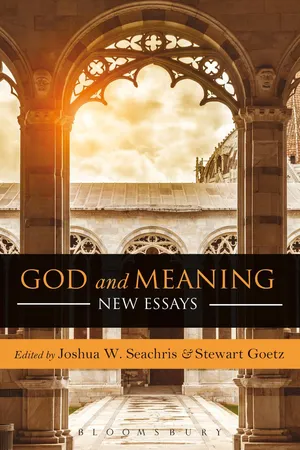
This book answers the need for a theistic philosophical perspective on the meaning of life. Bringing together some of the leading thinkers in analytic philosophy of religion and theology, God and Meaning touches on important issues in metaphysics, epistemology, ethics, philosophy of religion, and biblical theology that intersect with life's meaning. In particular: What does the question "What is the meaning of life?" mean? How can we know if life has meaning and what that meaning is? Might God enhance life's meaningfulness in some ways but detract from it in others? Is the most meaningful life one of perfect happiness? What is the relationship between eternity and life's meaning? How does the Old Testament book of Ecclesiastes illumine the topic? Should we hope that a kind of transcendent meaning exists?
Presenting a state-of-the-art assessment of current philosophical positions on these and many other questions, God and Meaning is an invaluable resource for all students and scholars of the philosophy of religion.
eBook - ePub
God and Meaning
New Essays
- 272 pages
- English
- ePUB (mobile friendly)
- Available on iOS & Android
eBook - ePub
About this book
Information
Part One
Clarifying the Question: Conceptual and Theistic Tools
1
The Meaning of Life and Scripture’s Redemptive-Historical Narrative: Illuminating Convergences
Joshua W. Seachris
1. Introduction
The body of work within analytic philosophy on the topic of life’s meaning continues to expand.1 Nearly all of this development, however, is on the topic of meaning in life. Very little research directly addresses the meaning of life. As it turns out, the difference between “in” and “of” tracks interesting philosophical issues and is more than a trivial grammatical preference of one preposition over another.
The phrase “meaning of life” is part of the classic formulation of the question, “What is the meaning of life?” That question is accompanied by cosmic, desire-to-know (and often teleological and religiously oriented) connotations. In other work, I argue that such connotations track what I call the question’s cosmic-intelligibility dimension. First and foremost, it is cosmic in scope and one in which the questioner is primarily concerned with the task of making sense of—intelligibility before praxis.2 This dimension includes important questions that are part and parcel of the meaning of life (e.g., Why is there something rather than nothing? What is it all about? What is the point or purpose of it all? Why is there pain and suffering? How is it all going to end?).
Unfortunately, contemporary discussions have largely pushed such questions aside in favor of addressing another aspect of life’s meaning—the individualist-normative dimension, one that more directly tracks the realm of value, has a desire-to-live-well emphasis, and that is, as Thaddeus Metz notes in his recent book, primarily individualist in orientation.3 The bulk of the contemporary discussion centers on trying to chart the normative territory of meaningful life (e.g., by considering questions like, What is meaningful life? What makes one’s life valuable? In virtue of what is one’s life worthy of great esteem? What makes one’s life significant?). Discussions focused solely on the individualist-normative dimension are truncated though. A thick conception of life’s meaning should make space for both dimensions.4
In contemporary discussions the cosmic-intelligibility dimension receives much less attention than the individualist-normative dimension. In fact, the form of the question most closely associated with concerns over cosmic intelligibility—What is the meaning of life?—is still met with criticism or simply neglected by contemporary analytic philosophers, who are nonetheless amenable to the question in its other, more normatively expressed forms. For example, Susan Wolf, who affirms something like the distinction I advocate above, notes that the question, when considered in its classic formulation, is fraught with all kinds of problems, conceptual and otherwise, and therefore not worthy of serious philosophical attention.5 Echoing Wolf, James Klagge makes a similar claim, “ ‘What is the meaning of life?’ This question sounds profound but has no answer. ‘What kinds of lives are meaningful?’ This sounds less profound, but it may at least have an answer . . .”6
Most of the other essays in this collection focus on normative aspects of the meaning of life question. Despite my misgivings above about a truncated dialectic focused almost exclusively on the normative, I am happy that my theistic colleagues direct their attention here. This is where many of the cutting-edge discussions are occurring, with more naturalists than theists participating. Such discussions can benefit from the addition of theistic interlocutors. But if I am correct in claiming that the question has another, equally important dimension centered on the quest for cosmic intelligibility, then fresh work is needed here too by theists, by those from nontheistic religious traditions, and by those who identify as naturalists.
By and large, my contribution here is Christian theistic in theological-philosophical orientation, though much of what I say in Section I presupposes no religious conceptual resources. My goal in this essay is to connect three topics: (1) the meaning of life, (2) the narrative interpretation of the question, “What is the meaning of life?,”7 and (3) Scripture’s redemptive-historical narrative (hereafter, R-HN). I show that the question in its classic form, “What is the meaning of life?” is intelligible, is naturally and plausibly understood to be the request for an ultimate ontological-normative framework expressed in a narrative or narrative-like explanation,8 and that the central narrative thread of Scripture directly answers the question of life’s meaning under its classical formulation.
2. The meaning of life as narrative
In a separate work, I develop and defend the claim that the question in its classic form, “What is the meaning of life?” should be interpreted as the request for a narrative that narrates across those features of life of greatest existential import to human beings (I call this the narrative interpretation).9 On the narrative interpretation, when asking about the meaning of life we should view ourselves as requesting a narrative that helps us make sense of the universe and our lives within it (cosmic-intelligibility dimension) and that speaks to our desire to lead meaningful lives (individualist-normative dimension); in other words, a narrative that addresses existentially oriented epistemic and normative desires. It is the entire narrative itself that is the meaning of life, not an individual narrative element (e.g., the element that narrates purpose).
2.1 The narrative interpretation: An analogy
The question, “What is the meaning of life?” is analogous to the question asked in the following scenario. Consider the case of a father whose three young sons play in the basement while he finishes a book chapter in his study. During the middle of typing a sentence, he hears screaming and yelling: a scuffle is underway. He quickly heads to the playroom, there finding his sons pushing and yelling. Getting their attention, he raises his voice and asks, “What is the meaning of this?” Upon hearing their father’s words, the two older sons immediately understand three things:
1.The meaning of their father’s request.
2.That the way the father phrases his request, using the term “meaning,” is entirely natural for the context in which it is spoken.
3.The sort of thing that would count as an appropriate answer.
It would be unlikely that his sons respond by asking, “But, daddy, what do you mean by that question?” Or, “Daddy, why did you use the word ‘meaning?’ ” So what does the father mean when he asks, “What is the meaning of this?”
The short answer is that he desires an explanation as an interpretive framework (or background knowledge) through which to understand the state of affairs he observes—his children fighting. This explanation will likely include, among other elements, information about how and why the scuffle started. He needs access to such information in order to make sense of the data before him and then to take appropriate action. From these additional details, an explanation or narrative can be constructed, helping him to understand and respond to the scuffle, only a portion of which he has witnessed. Importantly, the fuller accurate narrative is the meaning the father seeks when asking, “What is the meaning of this?” Equally as important is the fact that the father is not only concerned about the purpose of his sons’ fight. Though he wants to know something about his sons’ intentions, the meaning he seeks is something broader than purpose alone. Meaning, though related, should not be equated with purpose, whether in this context or that of the meaning of life.
One might reasonably ask at this point, why refer to what the father requests as a narrative at all, and not just an explanation? This is an important question, one that I consider in greater detail elsewhere.10 In this essay, I can offer only a brief response. Narrative is a fluid category, and it is therefore plausible to think of what the father requests and what the sons offer in terms of narrative or story.11 Presumably, his sons will start by presenting the problem—who the characters are, under what circumstances their conflict began, and so on. They will likely recount a series of meaningfully related causes and effects leading up to the moment when their father found them. They may say something about their intentions and mental states in general, weaving teleological threads throughout their account. This is all very story-like, even if not a story in some paradigmatic sense like The Brothers Karamazov is a story. Whether or not one chooses to view the sons’ explanation as a narrative or nonnarrative mode of discourse, importantly, the entire explanation is the meaning their father seeks, not simply one portion of it.12 Equally as important, such meaning is wider than narration of purpose alone.
To ask the question “What is the meaning of life?” is to ask a question similar to the father who asked his sons, “What is the meaning of this [scuffle]?” Over the course of our existence, we encounter aspects of the world that have what I call an existential charge in virtue of their relationship to our interconnected yearnings to make sense of certain aspects of the world, our place within it, and to live meaningful lives. These existentially charged aspects give rise to questions for which we seek an explanatory narrative framework in order to make sense out of them. In this sense, the existentially charged aspects of the universe that we encounter are akin to the portion of his sons’ scuffle that the father witnessed. Like the father, we lack important parts of the narrative, at least for a season, and we desire to fill the existentially relevant informational gaps in our understanding of the universe we inhabit, and then to live accordingly.
2.2 Nuancing the narrative interpretation
If the meaning of life is a narrative, what kind of narrative is it? What makes it a meaning of life narrative, or, more to the point, what makes it the meaning of life? It will be a different narrative than, say, a narrative about westward expansion in the United States or the celestial history of the Milky Way galaxy. These narratives narrate aspects of the world that are not directly relevant to the meaning of life question. For any narrative to count as a meaning of life narrative, it must cross some relevant explanatory threshold by narrating across a cluster of existentially charged aspects of our world, those that are part and parcel of the human condition.
What are these aspects that possess an “existential charge?” I call them and accompanying questions around which a meaning of life narrative is constructed, ECQ (existentially charged life aspects and accompanying questions). A narrative constructed around ECQ is what I call a “candidate meaning of life narrative” (CdMLN). A CdMLN constitutes an ultimate metan...
Table of contents
- Cover
- Half-Title
- Title
- Dedication
- Contents
- Acknowledgments
- Introduction
- Part 1 Clarifying the Question: Conceptual and Theistic Tools
- Part 2 Meaningfulness and God
- Part 3 Meaningfulness, Time, and Eternity
- Part 4 The Purpose(s) of Life
- Part 5 Meaning in Ecclesiastes
- Notes on Contributors
- Bibliography
- Index
- Copyright
Trusted by 375,005 students
Access to over 1.5 million titles for a fair monthly price.
Study more efficiently using our study tools.
Frequently asked questions
Yes, you can cancel anytime from the Subscription tab in your account settings on the Perlego website. Your subscription will stay active until the end of your current billing period. Learn how to cancel your subscription
No, books cannot be downloaded as external files, such as PDFs, for use outside of Perlego. However, you can download books within the Perlego app for offline reading on mobile or tablet. Learn how to download books offline
Perlego offers two plans: Essential and Complete
- Essential is ideal for learners and professionals who enjoy exploring a wide range of subjects. Access the Essential Library with 800,000+ trusted titles and best-sellers across business, personal growth, and the humanities. Includes unlimited reading time and Standard Read Aloud voice.
- Complete: Perfect for advanced learners and researchers needing full, unrestricted access. Unlock 1.5M+ books across hundreds of subjects, including academic and specialized titles. The Complete Plan also includes advanced features like Premium Read Aloud and Research Assistant.
We are an online textbook subscription service, where you can get access to an entire online library for less than the price of a single book per month. With over 1.5 million books across 990+ topics, we’ve got you covered! Learn about our mission
Look out for the read-aloud symbol on your next book to see if you can listen to it. The read-aloud tool reads text aloud for you, highlighting the text as it is being read. You can pause it, speed it up and slow it down. Learn more about Read Aloud
Yes! You can use the Perlego app on both iOS and Android devices to read anytime, anywhere — even offline. Perfect for commutes or when you’re on the go.
Please note we cannot support devices running on iOS 13 and Android 7 or earlier. Learn more about using the app
Please note we cannot support devices running on iOS 13 and Android 7 or earlier. Learn more about using the app
Yes, you can access God and Meaning by Joshua W. Seachris, Stewart Goetz, Joshua W. Seachris,Stewart Goetz in PDF and/or ePUB format, as well as other popular books in Philosophy & Epistemology in Philosophy. We have over 1.5 million books available in our catalogue for you to explore.