The invention of the present-tense novel is a literary event whose importance is on par with the discovery of perspective in painting. From the first novels shaped by interior monologues and the use of the present tense in the tradition of modernism, the present tense has, over the course of its century-long evolution, changed the conditions of fictional narration, along with our conceptions of time in a philosophical and linguistic framework. Indeed, to understand the work of an increasing number of contemporary writers – J.M. Coetzee, Tom McCarthy, Thomas Pynchon, to name only a few – it is necessary to both understand the distinct linguistic and literary qualities of the present tense as well as its historical transformation into a genuine tense of contemporary storytelling.
For the first time in literary scholarship, Present Tense: A Poetics offers an account of a profound development in 20th- and 21st-century fiction.
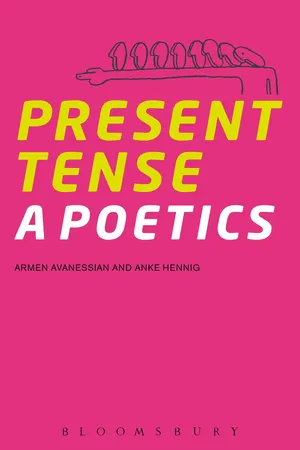
- 272 pages
- English
- ePUB (mobile friendly)
- Available on iOS & Android
eBook - ePub
About this book
Information
1
The present-tense novel
At the beginning of the twentieth century, the present tense is still considered to be the tense of the factual. In this first chapter, we would like to trace how the present tense becomes fictionalized in a process that integrates it into the novel and how, in this process, it takes over a function previously reserved for the past tense. We will elaborate this move with the help of excerpts from a number of literary works by, for instance, William Thackeray and Émile Zola for narrated fiction; Sergei Tretyakov for factographies; Virginia Woolf for classical modernity; Robert Walser and Wolfgang Hildesheimer for the modern present tense; and Claude Simon and Thomas Pynchon for altermodernism. In the first steps of the change of tense from past tense to present tense the modern novel operates, it does not break with the way the tenses function in classical fiction. The present tense maintains the function of factuality, which is why, in prose texts, it designates nothing but the “prosaic” present. In fact, the increased appearance of present tenses in the novel is bound up with an emphasis on the present as well as with ideal notions of the documentary and the factual.
In the wake of modernity’s reference to the present, we observe an imagination of time past. In altermodernism, the present tense in the novel acquires another, a new and previously inconceivable, significance. The relevant factor here is, above all, a breaking point in classical narrated fiction that results from using past tenses to constitute fiction, for the epic past tense precisely does not signify the past but transforms it into a fictional present. Due to the presentifying effect of the epic past tense, the past could never appear as such in the novel. Altermodernism, then, experiments with the present tense as with a tense thanks to which the past can be imagined as having passed.
We can only understand what happens in the process if we recognize that the literary techniques of fiction and of narration condition one another. The experience of a fictional present in nineteenth-century narrated fiction presupposes the organized interplay of prospectivity on the level of the fabula and retrospectivity on the level of the sujet. Reconstruction in narration goes back to before the moments of a prospective course of events. In so doing it presentifies these unforeseeably futural moments—the technique of fictional presentification and the processes of retrospective narration act together. Looking at “narration in the present tense,” we thus retrace the structural shifts (between fabula and sujet) in the modern and altermodern novel that lead not only to a fictionalization but also to a “narrativizing” of the present tense, to the constitution of a narrative present tense. Narratologically, this development takes place in two stages.
First, the modern present tense abandons the narratological dogma of retrospectivity. (At this stage, however, the question of whether the present tense has its own form of time does not come up.) The assumption that there is an orderly interplay in which the prospective course of the fabula is retrospectively recovered by the sujet is abandoned. Fabula and sujet are paradoxically synchronous. This can be seen in the interior monologue as well as in factualist procedural protocols that claim to record the chronological progress of an implicitly factual action in parallel with this progress. When and wherever it succeeds in doing so, modern narration becomes aware of the fact that such an endeavor involuntarily produces fictionality. At the same time, it makes it possible to realize that the retrospection presupposed by the texts of narrated fiction (qua epic past tense) is not an imperative of “pure narration.” Rather, retrospection as such is already fictional. Initially, this means no more than that there is no fictional text in which the narrated factually precedes the narration—a fact that seems so obvious that it has hardly ever been contested. Once it is taken seriously, however, it leads to the recognition that narration and fiction are forms of time that can enter into completely different configurations.
In a second step, the altermodern present tense relates to the breaking point that had emerged under the aegis of classical fiction and had served a presentifying past tense to block the experience of the past as such. The altermodern present-tense novel attempts to narrate the past by analyzing the processes by means of which the reader constructs the course of a fabula from a sujet at hand. In the practice of reading, fabula and sujet show themselves to be always synchronously present. This is the case even when the relation between the two is one of retrospection because the sujet “looks back” at the fabula. It is against this background that we describe the history of the present tense and of the re-foundation of the novel made possible by its employment.
Precondition: Classical narrated fiction and discourse
In order to present changes in time relations and especially changes of tense in the modern and altermodern novel, we first have to look into the preconditions of the developments of tense that interest us. Classic nineteenth-century narrated fiction can serve as a foil here. This kind of fiction is characterized by narration in the fictional past tense, in which narrative retreats in favor of what is narrated, the sujet in favor of the fictional fabula. Here, the field of inquiry has been staked out by Käte Hamburger and Harald Weinrich.
Käte Hamburger opens her discussion on the use of tenses in the novel with the fundamental thesis that in the novel, the past tense changes its meaning. It loses “its grammatical function of designating what is past,”1 and instead marks the entry into a timeless present of fiction. According to Hamburger, literary tenses are to be regarded both as producing fiction and as themselves fictional. The irregular use of tense in literature is responsible for opening up the experience of fiction for the reader: “Tomorrow was Christmas.”2 This also means that the temporal meaning of literary tenses is not to be confused with an extra-fictional temporal meaning: The detemporalized tense past tense no longer signifies the past but the fictional here and now. Whether the unfolding of events is narrated analeptically or proleptically, all of its moments are equally fictionally present although they are in the past tense.
In Hamburger’s approach, which aspires to ground fiction in linguistic theory, two other theorems are relevant, even if the theorem of tense-structured fictionality retains the greatest significance for the development of literary history (from the past tense to the present tense) as well as for narratological discussions (of fictionality, of third-person/first-person narration, of deixis). The first of these theorems holds that the entry into the “timeless present” of fiction involves a disappearance of narration,3 which makes it impossible to interpret the fictional sentences as propositions (of whatever kind) by a narrator. They become fictional because they lose their propositional character.4 This is why, for Hamburger, only third-person narratives can be fictional, and first-person narratives cannot. The latter can only be considered to be fictitious.
Contrary to John Searle’s assumption that there is no linguistically tangible characteristic of fiction, Ann Banfield has radicalized Hamburger’s theorem. For her, fictional sentences are “unspeakable sentences.”5 No one speaks the sentences of fiction, and it is not even possible to imagine a communicative situation in which they could be spoken.6 Between this much-discussed thesis7 and the question of the (time-figuring) function performed by tenses in fictional texts, it is possible to establish only an ex negativo correlation. From this perspective, the only thing that can be said about “unspeakable” sentences is that they lack a concrete temporal connection (what Hamburger conceptualizes as the “timelessness of fiction”), while “speakable” sentences come with a tangible temporality and a connection with a tangible present or past.
The relation to time is similarly mediated in the case of the retreat of narration behind the narrative (or of the sujet behind the fabula) discerned by Hamburger, in which the medium of narration renders itself invisible in the service of the narrative. Since what is conveyed by the medium is never found in the place and at the time in and at which it is presented to us by the medium, the narrative can be seen not only as timeless, but also as placeless. In the narratological version of this principle, the sujet, by retreating behind the fabula, loses its spatial and temporal situatedness as an act of narration. This gives rise to the impression that, in some mysterious way, the fabula narrates itself (as if) by itself.
Narratologists have often cast doubt on Hamburger’s theses about the timelessness of fiction. They have objected that the distinction between third-person and first-person narrative, so central for Hamburger, does not match up with the experience of reading in which there is no difference between fictitious and fictional sentences. For this reason, the past tense in fictional texts generally signifies the past—not only in first-person narrations (which Hamburger would not deny) but also in third-person narrations. Such objections, however, are based on a confusion of the form of time of narration, i.e., retrospection, with the extra-fictional temporal meaning of the past tense. The claim that it is the past that is meant can obviously only refer to intrafictional temporal circumstances and not to fiction as a whole. What does not exist, and in that sense is fictive, cannot be past—although, within fiction, we can easily look back at a “yesterday” from a “today.”
This is why Dorrit Cohn, in a modification of Hamb...
Table of contents
- Title
- Contents
- Acknowledgments
- Introduction
- 1 The present-tense novel
- 2 Readings in methodology
- 3 The imaginary present tense
- 4 Tense philosophy
- Conclusion
- Glossary
- Notes
- Index
- Copyright
Trusted by 375,005 students
Access to over 1.5 million titles for a fair monthly price.
Study more efficiently using our study tools.
Frequently asked questions
Yes, you can cancel anytime from the Subscription tab in your account settings on the Perlego website. Your subscription will stay active until the end of your current billing period. Learn how to cancel your subscription
No, books cannot be downloaded as external files, such as PDFs, for use outside of Perlego. However, you can download books within the Perlego app for offline reading on mobile or tablet. Learn how to download books offline
Perlego offers two plans: Essential and Complete
- Essential is ideal for learners and professionals who enjoy exploring a wide range of subjects. Access the Essential Library with 800,000+ trusted titles and best-sellers across business, personal growth, and the humanities. Includes unlimited reading time and Standard Read Aloud voice.
- Complete: Perfect for advanced learners and researchers needing full, unrestricted access. Unlock 1.5M+ books across hundreds of subjects, including academic and specialized titles. The Complete Plan also includes advanced features like Premium Read Aloud and Research Assistant.
We are an online textbook subscription service, where you can get access to an entire online library for less than the price of a single book per month. With over 1.5 million books across 990+ topics, we’ve got you covered! Learn about our mission
Look out for the read-aloud symbol on your next book to see if you can listen to it. The read-aloud tool reads text aloud for you, highlighting the text as it is being read. You can pause it, speed it up and slow it down. Learn more about Read Aloud
Yes! You can use the Perlego app on both iOS and Android devices to read anytime, anywhere — even offline. Perfect for commutes or when you’re on the go.
Please note we cannot support devices running on iOS 13 and Android 7 or earlier. Learn more about using the app
Please note we cannot support devices running on iOS 13 and Android 7 or earlier. Learn more about using the app
Yes, you can access Present Tense by Armen Avanessian,Anke Hennig in PDF and/or ePUB format, as well as other popular books in Letteratura & Critica letteraria di letteratura comparata. We have over 1.5 million books available in our catalogue for you to explore.