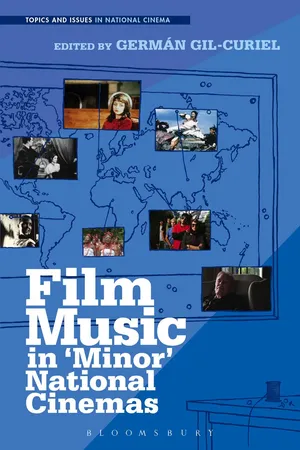
Taking its cue from Deleuze's definition of minor cinema as one which engages in a creative act of becoming, this collection explores the multifarious ways that music has been used in the cinemas of various countries in Australasia, Africa, Latin America and even in Europe that have hitherto received little attention. The authors consider such film music with a focus on the role it has played creating, problematizing, and sometimes contesting, the nation.
Film Music in 'Minor' National Cinemas addresses the relationships between film music and the national cinemas beyond Hollywood and the European countries that comprise most of the literature in the field. Broad in scope, it includes chapters that analyze the contribution of specific composers and songwriters to their national cinemas, and the way music works in films dealing with national narratives or issues; the role of music in the shaping of national stars and specific use of genres; audience reception of films on national music traditions; and the use of music in emerging digital video industries.
- 264 pages
- English
- ePUB (mobile friendly)
- Available on iOS & Android
eBook - ePub
Film Music in 'Minor' National Cinemas
About this book
Information
1
Introduction: Modalities of Music in ‘Minor Cinema’
Jonathan P. J. Stock
University College Cork, Ireland
The essays in this volume trace the outcomes of moments where those involved in making film in various world locales reflect upon their home societies’ expressive and aspirational needs, putting them into perspective against wider international norms, trends and possibilities in the practice of film music. Their responses run all the way from self-aware reaction against what might be called mainstream film and its musical conventions (as in the newsreel example with which Balaisis begins his account of Cuban revolutionary film) through to approaches intended to be more accommodating and assimilative (among them, the Chinese instance analysed by Gil-Curiel, which he describes as at once both nationalist and cosmopolitan).
As this already implies, music in global cinema isn’t a uniform corpus. Nor does it always work within the bounds of a single set of operating procedures. Even when a key aim of those involved is projecting a representation of collectively conceived national values, film music very typically stems from what can be quite special and individual selections on the part of individual composers, performers and directors, a striking number of whom lead diasporic or at least multi-sited lives. And in many instances, the music of film is also tasked with summoning up particularities of class, gender, regional and historical setting (among other variables), not just the nation more generically. The resulting music is therefore expressively multivalent, it turns place into space, it tunes action and reaction, and it fuses the ethical and the aesthetic, which means that its reception inevitably becomes a personal affair, with each viewer required to form their own sense of a shared set of visual, sonic and contextual cues.
The concept of ‘minor cinema’, which springs from philosophical work by Gilles Deleuze and Félix Guattari, is a rallying point for the book as a whole. Minor cinema, in its initial conception, was located firmly in the postcolonial moment, and it involved the imaginative remaking of national spaces through emancipatory usages of the language of ‘major cinema’. De La Garza notes (this volume) a telling emphasis: ‘Gilles Deleuze’s definition of the “minor in cinema” … does not represent or address a people as oppressed and subjected, but anticipates instead “a people to be created, a consciousness to be brought into existence”. ’ Making cinema, then, was part of the project of (re)making the nation. It was an act of advocacy, rather than simply an exercise of description.
Over its lifetime, this concept has been redeveloped by a number of writers, including several in this volume. And of course the world’s political makeup has shifted radically with postcolonial nation-building per se now a receding priority in some areas. Capturing this new reality, and eschewing explicit reference to the political, Johnson (this volume) summarizes minor cinema as: ‘a small-scale, low budget type of film production that on the one hand aims for excellence in the national market …, while at the same time is not produced solely with the intention of reaching a mass audience internationally’. That said, it is striking how many of the films analysed in this volume remain open to, or are even specifically aimed at large-scale, international consumption. One might conclude that if its range of political standpoints has diversified, ‘minor cinema’ remains as always-already concerned with the workings of power in intercultural settings as it was for Deleuze and Guattari (and, of course, for an earlier generation of directors such as Marcel Camus, whose 1959 work Orfeu Negro [Black Orpheus] is featured in Hans Hess’s chapter on Brazil). In place of an emphasis on nation-building alone, I read in these chapters more complex cinematic acts that involve illuminating minority identities versus the boundary-making of the larger nation state, and those that explore the various tendrils of international capitalism as they encircle individuals and the nation alike, such that the music’s evoking of personhood, place and time may come to mark out an appeal to exotic otherness rather than to self-determination.
It is tempting to explore for a moment the suggestive potential of a musical understanding of the term ‘minor’. In tonal theory, the terms minor and major refer not to age, power or population differentials but to contrasting sets of notes from which a musical piece is composed. A composition using the minor scale is not necessarily any smaller in sonic range or other musical components (instrumentation, timbre, genre, etc.) than one using the major scale. Nor is it any less expressive. Indeed, on a technical level, the minor is potentially the more interesting of the two insofar as its note set has distinct ascending and descending patterns: while C Major comprises the note set of C, D, E, F, G, A and B whether upward or downward, C Minor can be played C, D, E flat, F, G, A and B on the way up and C, B flat, A flat, G, F, E flat and D on the way down. The major scale has seven available pitches, the minor rewards its listener with a richer set of nine. Of course, larger musical compositions can progress through multiple keys, typically both major and minor (and older and newer music uses yet other note sets as its building blocks) such that a composer isn’t faced with an either/or choice so much as which first, and where next.
This notion of a widely shared system within which a composer or music compiler chooses between (and typically alternates) contrasting expressive modalities may be useful as a metaphor when thinking of the situation of music in global film more widely. It reminds us that films from the locations touched on in this book may emerge from industrial systems and expressive cultures no smaller than those closely associated with Hollywood. Even more, it prompts us to attend to the agency underpinning musical work in cinema. That is, we can analyse how and why those responsible for the music in film select what they do from the wide set of resources that includes style traits historically and contemporaneously associated with Hollywood norms and that, in much of the world, additionally includes the sonic traces of local, regional, national or minority music cultures. In the context of this book, we often read of producers turning to traditional music not only to provide geographical groundedness but for its massively resonant potential when placed in intersection with such issues as cultural politics, nationalism, migration or nostalgia. Santos-Aquino in this volume, for instance, offers a striking case in point in her discussion of films of Bahman Ghobadi that deploy Kurdish traditional (and popular) music to give expressive voice to a people marginalized in contemporary Iran. Finally, this notion that the individuals involved in film making choose between contrasting musical modalities agency has the virtue of not applying any one political outcome to a single set of style-related choices. Nagayama’s chapter illustrates this idea well, through its exploration of the complex politics of a genre of ‘China melody’ produced at the height of Japan’s building of an empire on mainland East Asia in the 1930s and 1940s. And, in pointing to the specific listenership of Japanese soldiers deployed overseas throughout this period, her chapter also reminds us to keep the particularities of audience in view when discussing the meaning of film and film music and when dissecting the apparent intentions of those who created the films themselves.
If ‘minor’ cinema is locally produced while also globally conscious, then this new collection mirrors that in its own design, drawing together the perspectives of a team of expert scholars on a body of film that in itself represents a rich set of international subjectivities. These chapters make a claim for the significance and interest of the music of cinema from around the world, which they understand to employ expressive modalities that overlap but are not entirely congruent with those of the global mainstream. Most of all, they argue that attending closely to the distinctive musical evocations of world film offers us a key tool in understanding the interplay of cinema and society worldwide.
2
Aural Dialectics and Revolutionary Media in Cuba
Nicholas Balaisis
University of Waterloo, Canada
In the first year of the group we developed a revolutionary system for studying the theory and practice of music by combining all possible styles: from Beethoven to John Coltrane, Gilberto Gil to Ravi Shankar, Anton von Webern to Xenakis, Frank Zappa to Blood, Sweat and Tears, Sindo Garay to Juan Blanco, and of course, from Bach to the Beatles.
Grupo Experimental Sonora ICAIC (Instituto Cubano del Arte y la Industria Cinematográficos)
Musical dialectics and radical cinema
In an early post-revolutionary Cuban newsreel in 1960 (#49), we witness the collective enthusiasm displayed as a result of the creation of a national film institute. The short newsreel graphically depicts the radical changes in film production following the Cuban revolution, where US film companies were deposed from the island, and the Cuban government nationalized film production through the creation of the ICAIC. One of the notable aspects of the short film is the dynamic use of music that underscores the dramatic images and voiceover. The one-minute newsreel opens with the screeching face of the Warner Brothers’ iconic lion over which a voiceover summarizes the history of US film companies in Cuba from the point of view of the revolution: ‘For many years, North American films poisoned Cuban screens, advocating imperialism and preaching violence and crime.’ Underscoring these opening images is the American pop hit, ‘Rock Around the Clock’, recorded by Bill Haley and the Comets in 1954.1 The upbeat rockabilly notes of the American hit song form a striking contrast with the severe voiceover noting the ‘poisonous’ effects of American culture on Cuban movie screens. The American rock song then gives way to a triumphant orchestral score that seems to better suit the celebratory images onscreen: ICAIC president Alfredo Guevara denouncing ‘yankee’ film distribution on the island. The voiceover concludes that, because of the Cuban revolution, it is now possible for Cubans to see ‘revolutionary’ films from all over the world. The final image of the reel shows a worker on the roof of the building of the now-exiled Warner Brothers in Havana, knocking out the iconic company name with a sledgehammer.
The dynamic use of music in this early Cuban newsreel evidences a key feature of film music in Cuban national cinema following the revolution in 1959, namely, a dialectical relationship to political ideology. The newsreel evinces a very clear ideological programme: it denounces US imperialism as expressed through Hollywood cinema, and celebrates the role and work of the newly formed Cuban government in creating policies and institutions that support an autonomous national film culture. The use of an American pop rock hit to underscore this message is a peculiar choice given this overt political message. On one hand, the choice of a popular American hit song seems an odd choice given the fact that the film’s message explicitly denounces the poisonous effects of American culture in Cuba. Indeed, ‘Rock Around the Clock’, which stood for eight weeks on top of the Billboard music charts in 1955, conjures strong images of Americana – soda fountains, rockabilly, greasers – and stands in sharp contrast to the image of Cuban workers laying waste to another icon of American culture, Warner Brothers. On the other hand, the rock song is intriguing and effective, as the film seems to re-appropriate a popular American rock hit and use its dynamism and energy to emphasize Cuban cultural autonomy, an autonomy that came very much at the expense of American cultural and economic interests. The use of the rock song punctuates a dialectical effect in the film, a formal effect that is more expansively articulated in Tomás Gutiérrez Alea’s famous essay, ‘The Viewer’s Dialectic’. In the essay, Alea decries Hollywood cinema as serving as an ideological refuge for viewers, lulling them into a ‘daydream’ by encouraging viewers’ ‘false illusions’ (Alea, 1997: 112). In his proposition for renewed national cinema, Alea argues that cinema should be a dialectical stimulus for critical viewer awareness, a stimulus that will propel the viewer into greater political consciousness:
We understand what cinema’s social function should be in Cuba in these times: it should contribute in the most effective way possible to elevating viewers’ revolutionary consciousness and to arming them for the ideological struggle which they have to wage against all kinds of reactionary tendencies and it should also contribute to their enjoyment of life (Alea, 1997: 110).
While the newsreel advances a relatively straight political message (and thus could be read as an arm of state propaganda), the use of music in the sequence complicates the delivery of the ideological message. In other words, the music brings about a kind of dialectic that does not allow the image to be absorbed passively by the viewer but works to elevate viewer consciousness through critical contrast. By re-appropriating a hit American rock song for use in a newsreel denouncing American culture, the short newsreel re-codes the meaning of the song, putting it to use in the service of a new context: the building of revolutionary Cuba. By using such a recognizable piece of American culture in a new context, the film invites the viewer into a critical dialogue with Cuban and American culture: employing its aesthetic force in a renewed context.
This essay discusses one particular aspect of film music in the context of Cuban national cinema: its relationship to political ideology. I argue that music occupies a complex ideological space within the post-revolutionary cinematic tradition in Cuba. On one hand, music was used in deliberately experimental and self-conscious ways to challenge what in Cuba were seen as the inherent ideological biases within Hollywood and Latin American film, and to produce new revolutionary national subjects. On the other hand, I argue that music has also been used as a site for registering ideological critique of the revolutionary project in Cuba, serving as a proxy for Cuban voices that do not have access to a free press or other forms of the public sphere (Balaisis, 2010). This argument is informed by Gilles Deleuze’s notion of minor cinema within the context of emerging postcolonial national cinemas. In Cinema 2: The Time Image, Deleuze argues that what he calls ‘minor’ cinema is largely concerned not with representation but experimentation and the creative act of becoming: ‘the prefiguration of the people who are missing’ (2003: 224). For Deleuze, postcolonial cinemas of the 1960s in particular, wrestle with the fundamental absence of their collective self-representation onscreen. The experimental energies witnessed in many of these films, therefore, reflect an attempt to ‘invent’ the nation and people in the postcolonial context:
Art, and e...
Table of contents
- Topics and Issues in National Cinema
- Other Volumes in the Series:
- Title
- Contents
- Acknowledgements
- Contributors
- 1 Introduction: Modalities of Music in ‘Minor Cinema’ Jonathan P. J. Stock
- 2 Aural Dialectics and Revolutionary Media in Cuba Nicholas Balaisis
- 3 Sobre las Olas, Waltz and Films: Classical Music and Mexican Identity Armida de la Garza
- 4 Black Orpheus Hans Hess
- 5 Chinese Identity: Poetics of Cinema and Music in Hero Germán Gil-Curiel
- 6 ‘The Continental Melody’ – Soldiers and Japan’s Imperial Screen Chikako Nagayama
- 7 Collective Nostalgia and Anxiety in Korean Film Music: Im Kwǒnt’aek’s Use of P’ansori in Sǒp’yǒnje Jooyeon Rhee
- 8 Music and the ‘Minor’: Musical Expression as Oral Testimony in the Films of Bahman Ghobadi Rowena Santos Aquino
- 9 Subtle Idiosyncracy: Sound and Music in the Australian Animated Short Film The Lost Thing (2010) Rebecca Coyle, Jon Fitzgerald and Philip Hayward
- 10 Minor Cinema and Major Music in New Zealand: No. 2 and Don McGlashan Henry Johnson
- 11 Between the Text and the Sub-text: a Reading of Selected Benin Musical Video-Films from Nigeria Osakue S. Omoera and Charles O. Aluede
- 12 Music and African Identity in the Films of Flora Gomes Carolin Overhoff Ferreira
- Index
- Copyright
Trusted by 375,005 students
Access to over 1.5 million titles for a fair monthly price.
Study more efficiently using our study tools.
Frequently asked questions
Yes, you can cancel anytime from the Subscription tab in your account settings on the Perlego website. Your subscription will stay active until the end of your current billing period. Learn how to cancel your subscription
No, books cannot be downloaded as external files, such as PDFs, for use outside of Perlego. However, you can download books within the Perlego app for offline reading on mobile or tablet. Learn how to download books offline
Perlego offers two plans: Essential and Complete
- Essential is ideal for learners and professionals who enjoy exploring a wide range of subjects. Access the Essential Library with 800,000+ trusted titles and best-sellers across business, personal growth, and the humanities. Includes unlimited reading time and Standard Read Aloud voice.
- Complete: Perfect for advanced learners and researchers needing full, unrestricted access. Unlock 1.5M+ books across hundreds of subjects, including academic and specialized titles. The Complete Plan also includes advanced features like Premium Read Aloud and Research Assistant.
We are an online textbook subscription service, where you can get access to an entire online library for less than the price of a single book per month. With over 1.5 million books across 990+ topics, we’ve got you covered! Learn about our mission
Look out for the read-aloud symbol on your next book to see if you can listen to it. The read-aloud tool reads text aloud for you, highlighting the text as it is being read. You can pause it, speed it up and slow it down. Learn more about Read Aloud
Yes! You can use the Perlego app on both iOS and Android devices to read anytime, anywhere — even offline. Perfect for commutes or when you’re on the go.
Please note we cannot support devices running on iOS 13 and Android 7 or earlier. Learn more about using the app
Please note we cannot support devices running on iOS 13 and Android 7 or earlier. Learn more about using the app
Yes, you can access Film Music in 'Minor' National Cinemas by Germán Gil-Curiel in PDF and/or ePUB format, as well as other popular books in Media & Performing Arts & Music. We have over 1.5 million books available in our catalogue for you to explore.