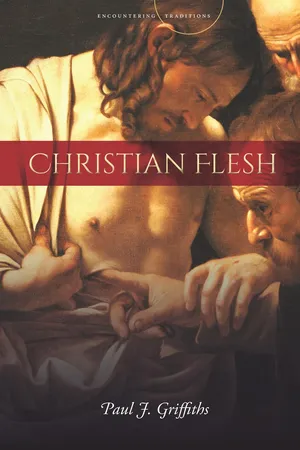
A sustained and systematic theological reflection on the idea that being a Christian is, first and last, a matter of the flesh, Christian Flesh shows us what being a Christian means for fleshly existence. Depicting and analyzing what the Christian tradition has to say about the flesh of Christians in relation to that of Christ, the book shows that some kinds of fleshly activity conform well to being a Christian, while others are in tension with it. But to lead a Christian life is to be unconstrained by ordinary ethical norms. Arguing that no particular case of fleshly activity is forbidden, Paul J. Griffiths illustrates his message through extended case studies of what it is for Christians to eat, to clothe themselves, and to engage in physical intimacy.
- 176 pages
- English
- ePUB (mobile friendly)
- Available on iOS & Android
eBook - ePub
Christian Flesh
About this book
Information
Publisher
Stanford University PressYear
2018Print ISBN
9781503606746
9781503606258
eBook ISBN
9781503606753
1
FLESH DEVASTATED
HUMAN FLESH, like all other flesh, is neither what it could be nor what it should be. It suffers and dies; is subject to disease from within and wounds from without; and finds itself in an apparently uncaring world to which it feels itself unnecessary. It is a disappointment to itself, and the care and maintenance of that disappointment require unremitting and debilitating effort. Christians take this state of things to be among the effects of a primordial cataclysm, a fall from order and harmony into chaos and decay. Once, human flesh was not like this, and eventually it will again not be like this. Others may eschew any general causal account, while agreeing that the flesh’s agonies and disappointments are real; or they may offer causal accounts different from and sometimes incompatible with those belonging to Christianity, seeing, for example, fleshly suffering as an evolutionary spandrel, or as an epiphenomenon of desire. But there’s wide agreement that flesh gives cause for lament, as there also is about what those causes are—suffering, decay, and death principal among them. Buddhists provide a particularly lively and precise analysis of this triad.
This book’s first part depicts, with a Christian eye, human flesh as it now is—lively, erotic, haptic, suffering, condemned to death. That is the horizon for devastated flesh. Within that horizon, flesh is here distinguished from body as animate from inanimate (1.1) and is shown as constituted by the receipt and gift of touch (1.2), as at once bounded and porous (1.3), as ecstatically erotic (1.4), and as fragile (1.5).
* * *
1.1 Flesh and Body
Flesh is living body. Bodies without life are matter extended in spacetime, perhaps exiguously or discontinuously, but still extended; inanimate things are bodies simpliciter. Fleshly bodies, because they’re bodies, are also matter extended in spacetime; they differ from other bodies in being alive. That’s what makes them bodies of flesh. The history of a body of flesh is the history of a life. Its principle of organization, what makes it the fleshly body it is and not some other, is the principle of a life. Its boundaries, temporal and spatial, are the boundaries of a life.
—But isn’t this a merely stipulative definition, inadequate to the use of “flesh” and “body” in ordinary English as well as in Christian talk? Aren’t both words sometimes used to mark a value rather than as a description, and “flesh” usually a negative one? John writes, in his Gospel, Spiritus est, qui vivificat, caro non prodest—it’s the Spirit who gives life, but the flesh produces nothing; and Paul writes, in Romans, “If you live according to the flesh (secundum carnem) you’ll die; but if by the Spirit you put the body’s works (opera corporis) to death, you’ll live.”
—Yes; but against that, verbum caro factum est: it’s flesh that the Word becomes, and flesh that’s offered as a means to eternal life. The Word becomes flesh, but the Church is Christ’s body; living according to the flesh is opposed to living according to the Spirit, but Christ’s flesh, when eaten, gives the gift of immortality; “incarnation” is a flesh-word (from caro), but is as likely as not to be rendered into English as “embodiment.” There’s no deep consistency in the use of these words among Christians or speakers of English. Sometimes they’re interchangeable and sometimes not; sometimes one or the other carries value, and sometimes not. “Flesh,” here, for the sake of clarity and consistency, always means “living body,” with no value added. “Body,” unmarked, means anything extended in timespace that doesn’t live, also with no value added. The distinction between what lives and what doesn’t is one of importance. It’s useful to have a clear and consistent lexical usage to mark it, even if such clarity and consistency is stipulatively clearer and cleaner than the general Christian (or English) usage.
Christians say that what makes a body live is its soul. According to that usage, to say that a body lives is exactly to say that it is ensouled, animate; that word contains the Latin anima, which is ordinarily rendered “soul” in English. All fleshly bodies, therefore, are ensouled: wherever there’s flesh, there’s also a soul. At a minimum, “soul” serves as a linguistic marker for whatever it is that permits a body to live, whatever it is that animates a body and thereby makes it flesh rather than body.
Most of the time it’s easy enough to distinguish what lives from what doesn’t without specifying just what it is that makes a living thing live. Distinguishing what lives from what doesn’t, flesh from body, comes, for humans, easily and early, mostly by osmosis supplemented, when needed, by explicit catechesis. It happens, for the most part, as with all sortals, by considering particular things in light of paradigmatic cases. Trees and humans and snakes and birds and spiders all, obviously enough, live; rocks and stars and houses and fire and light all, almost equally obviously, don’t. Encounters with new things in the world lead to assessment in terms of these clear cases, and then decision as to whether this, whatever it is, lives or doesn’t. Ordinarily, there’s no difficulty and no need for precision or abstraction in defining what it is that makes a body live.
Sometimes, however, there is a difficulty. Sometimes it’s not clear to averagely skilled users of English whether to say of something they come across that it lives or doesn’t. There are things that seem in some respects machinelike and therefore nonliving, but in other respects living, as when a computer converses in apparently reasonable ways. Or there are things such as self-replicating crystals that seem in some respects mineral-like, but are also self-moving and therefore perhaps living. And intuitions about when vegetable matter ceases to live—when it moves from (living) apple flesh, say, to rotting apple corpse—vary widely. Many, perhaps most, speakers of English are likely to say that the pips in an apple core they’re eating aren’t alive; but, when asked to notice that those pips might grow into a tree if planted, may revise their opinion.
For the most part, though, and most of the time, difficult cases and their concomitant criterial problems don’t arise. It’s ordinarily only when philosophy is done that criterial and definitional questions arise, and when they do they’re difficult to resolve. But the criterial problem is almost entirely epistemic; it’s not that there aren’t good conceptual ways of distinguishing the living from the nonliving; it’s rather that the ordinary ways of doing that sometimes fail to provide help in making decisions about whether some particular thing lives or doesn’t, is flesh or body.
Flesh, as living body, comes in kinds corresponding to the kinds of living things, whatever those turn out to be. There’s plant flesh, insect flesh, fishy flesh, avian flesh, and so on, as well as human flesh. It’s not clear to what extent the ordinary, schoolbook classifications of living things into kinds (kingdom-phylum-class-family-genus-species) pick out natural kinds, kinds of things that exist, that is, independently of our acts of classifying them. They may exist in that way, but it’s not obvious that they do. What is clear is that, for example, sorting living things according to similarity of genome yields different classifications than does sorting them by similarity of form. And those are not the only possible ways of sorting them. Our schoolbook classifications of living things are therefore best thought of as devices of convenience. It’s not clear whether they are indeed anything more than that, and for most purposes, nothing much hinges on the question. Christians, certainly, need be wedded neither to broadly Aristotelean morphological classifications of living things, nor to genomic ones, even though both are usable and useful for particular purposes.
There are similar occasional difficulties of decision about what counts as human. Formal definitions are easy: theologically, a living thing is human if and only if it belongs to the kind that numbers among its members the human nature of Jesus. If it does, then the double-natured person Jesus Christ died for it; and if it doesn’t, then he didn’t. But this definition won’t always yield an easy decision about whether this or that fleshly creature meets the case, as Christian difficulties (imaginary and actual) in deciding who (or what) may be baptized show. Alternatively, it’s possible stipulatively to specify that a living creature is human if and only if its genome is of a certain sort; but that stipulation has the same drawback as the theological one, which is that there are some cases in which it’s difficult to tell whether a fleshly creature has or lacks the appropriate genome. If, as is evident, members of what are ordinarily taken, genomically, to be one species, can breed with members of another, producing such things as wolvogs and mules, then the genomic criterion yields no easy decision about how to classify such things. The same is true of morphological definitions. This difficulty applies, too, to human interbreedings, of which there’s decisive genetic evidence (homo sapiens with homo neanderthalensis, for example). Again, though, it’s ordinarily possible to do what’s needed, which is to determine without difficulty whether this or that living thing ought be thought of as human. In cases where there’s real difficulty, the proper Christian response is one of relaxed generosity: if faced with flesh that there’s first-blush reason to think human (to think, among other things, that Jesus died for it), the flesh in question is best treated as human—and therefore baptized—until there’s decisive reason to conclude that it isn’t. Better to mistake a nonhuman for a human than a human for a nonhuman.
* * *
1.2 Haptic Flesh
Flesh—all flesh, not just human flesh—has a double mode of interacting with the world in which it finds itself. The first is by touching other flesh, and the second by touching inanimate bodies. The two modes of interaction are always different in the order of being and usually different in the order of seeming. That is, the difference is real, whether or not it’s apparent; touching (animate) flesh really differs from contacting (inanimate) body, and it usually also seems different.
When lovers kiss or caress they touch one another’s flesh; when dogs nudge human hands with their noses, flesh touches flesh; so also when gardeners bury their noses in blowsy begonia blooms, when lions close their jaws on gazelles’ napes, and when mosquitoes suck human blood. These are all fleshly exchanges ranging in kind from the caress to the blow, from the orgasmic embrace to the wounding that brings death. Such touches aren’t accidental to flesh. Without them there’s no flesh. It’s only in being caressed and wounded by other flesh that flesh is given, as gift, the capacity itself to caress and wound. For mammalian flesh, to which human flesh belongs, the flesh-constituting gift exchange begins in the womb and ends only when death makes flesh into corpse. Not all fleshly touch is a caress: few humans reach adulthood without blows, injuries, and wounds, fleshly touches that turn flesh temporarily into an object transfixed by force. The caress provides flesh with the capacity to caress, and the blow gives it the capacity to wound. Fleshly capacity to touch other flesh is received without remainder as gift, even if the gift is often violent in this devastated world. Without the fleshly touch of others, flesh rapidly becomes body: it dies.
Flesh also interacts with the world by way of simple contact with inanimate bodies. This mode of interaction, omnipresent though it is (human flesh, once out of the womb, is always in contact with inanimate bodies, and necessarily so), is less important than fleshly touch for the constitution of flesh as flesh. Nonliving bodies neither caress nor wound, and therefore don’t give the distinctive fleshly gift of being able to do those things. The pen between the fingers, the wood of the desk under the hand, the soft cotton of the undershirt next to the skin, the chair’s cushion resisting the pressure of the buttocks—none of these is fleshly touch. In the order of being, contact between (animate) flesh and (inanimate) bodies is different in kind from fleshly touch, at least as different as the meeting of two solid bodies from the interpenetration of two gases.
This difference is also usually, but not infallibly, evident in the order of seeming. That is, tactile exchanges with flesh ordinarily seem different than do contacts with bodies. Stepping barefoot on a slug prompts a different response than does stepping barefoot on a sharp stone, and not just because one is soft and the other hard. Flesh acknowledges flesh differently than it does body. Similarly, a lover’s slap on the cheek prompts a different response than does a similarly forceful blow from a pebble falling by chance from scree above. The one is a caress that may also be construed as a blow; the other is mere contact. They seem different as well as being different. They provide different things. This isn’t to say that how things seem is also how they are. Flesh is sometimes caressed in ways that seem like mere contact, as when human flesh is involuntarily pressed into intimacy on the London Underground or the Chicago El; and flesh is sometimes contacted in ways that begin to seem like a caress, as when a zephyr strokes the skin. But for the most part, there’s a good-enough match between the orders of being and seeming in matters of touch.
Contacts with inanimate bodies provide flesh with something essential, even if nothing flesh-constituting. They give the flesh what all bodies have, which is locatedness. Fleshly contacts with the inanimate provide flesh a place in timespace, a here-now-ness that is a defining characteristic of everything extended in timespace. There are various modes of locatedness, some of them puzzling because they seem to be (and perhaps are) discontinuous or exiguously thin; most of these modes of locatedness belong to bodies rather than to flesh, but it’s possible that some also belong to flesh. If, for instance, angels and demons (who are fallen angels) have flesh, which is a claim disputed among Christians, then it’s likely that their flesh is capable of discontinuous location in these ways; and Jesus’s ascended flesh is simultaneously available eucharistically in widely dispersed places, and thus capable of a kind of spatiotemporal discontinuity.
Human flesh is, then, brought into being and maintained as flesh by touch from other flesh; and it’s given its place in a spatiotemporally extended world by constant contacts with bodies. Without these tactile exchanges, there is no flesh; with them, flesh is. These are its fundamental and characteristic modes of interacting with the world: flesh touches and is touched, contacts and is contacted. These interactions are what makes flesh flesh and what gives it its place in a world.
—But how can it be that flesh is discriminated from body by the fact that it lives, and yet also that flesh is constituted as flesh only by its fleshly connections with other flesh? Doesn’t this mean that living bodies isolated from all other flesh by accident or experiment, taken, perhaps, by scientists or aliens and placed in a sterile, inanimate environment, would become at once flesh and not? Flesh because it yet lives; and not-flesh because it’s without the touch of other flesh, which is necessary for flesh to come to be flesh and continue to be flesh?
—Yes. But a distinction is necessary. Since the beginning of things, no flesh has come into being without touch. This is obvious in the case of sexual reproduction in all its varieties. It’s equally the case, even if not quite so obviously so, in nonsexual reproduction. Cellular division, for instance, by means of which (it might be said; though other accounts might also be given—there are interesting mereological difficulties here) new cells—new living things, new fleshly things—come to be, requires for its occurrence intimate fleshly touch as the wall of one cell stretches, expands, and opens to make way for another. Reproduction of plant flesh by way of seeds can be accounted for similarly. The seed comes to be as seed because of intimate fleshly contact with (other parts of) the plant of which it is a seed. It is a living thing waiting only upon appropriate external circumstance to grow. Touch by flesh, then, is requisite for flesh to come to be. The experiment of placing flesh in a flesh-free environment doesn’t call this aspect of flesh’s definition—as living, and as constituted by touch—into question. One way to characterize such experiments is to say that they move flesh gradually toward body, away from life, that is, and toward death. Aging does the same. As human flesh ages, it becomes more and more like body. It loses, progressively, the characteristics of life. Sequestering flesh from touches by other flesh has similar effects. Flesh so sequestered approaches body because not only its coming-to-be as flesh, but also its continuing-to-be as such requires that kind of touch. Sequestered flesh is, therefore, flesh because it lives, but also flesh on the way to body because it has been deprived of one among the several conditions for its continuation as flesh—namely, the caresses (and blows) given by other flesh.
There is one exception to the principles just laid down. Once, in the order of time, the cosmos, all that is, included no flesh. There were no living bodies in it. And then, again in the order of time, flesh came to be. That flesh, the flesh that came to be when and where there had been none, wasn’t brought into being by fleshly touch. For Christians, and perhaps also for Jews and Muslims, it was brought into being by the inspiration of (inanimate) bodies, which is to say by the LORD’s breathing into them. This is an instance of creation out of nothing: it brings life from not-life. For pagan (that is, neither Christian nor Jewish nor Muslim) theorists, there is as yet no widely agreed account of how life emerged from what doesn’t live, and attempts to understand and replicate the process by which this occurred, whatever it was, have not (yet) been successful. Christians and others agree, however, that there was a time when non-divine life was not, and that its coming to be can’t be accounted for by appeal to any of the ways in which it multiplies once it already exists.
Flesh is haptic, which is to say that flesh touches and is touched, contacts and is contacted. Those activities are what make it flesh; they are constitutive and defining of it. “Haptic” is an English word derived from the Greek haptikos, “capable of touch/touchy.” The word became English (and French, and German) only in the nineteenth century, and has been adopted by those who study the sense of touch physiologically and, to a lesser extent, by those who study, historically, the ways in which touch has been thought about and represented. In its technical physiological use, “haptic” embraces at least the following. First, proprioperception, which is the flesh’s perception of position and motion—of its location in the world and movement from place to place therein: it seems like something to me as the door swings wide, a new vista of space opens, and my flesh resonates now to this new space and the configuration of objects in it, and not to the space occupied before, on the door’s other side. Second, kinaesthesis, which is the fleshly sense of effort and tension in muscles, tendons, and joints accompanying movement: it feels, or can feel if I’m paying attention, like something to me when my thigh muscles bunch in getting up from a chair, and when my foot pronates in taking a step. Third, the feeling of pressure and temperature on the skin, as when my flesh responds, feelingly, to the low humidity and high temperature of an afternoon in the high Arizona desert. Fourth, the sensation produced by direct contact between skin and some object external to it, as when my shin makes harsh contact with a table’s edge in a dark room, or when my lover’s lips brush the back of my neck.
To call flesh haptic is to say that it places itself and is placed, feels itself and is felt, in all these ways. These modes of interaction with the world, animate and inanimate, are proper to it. This might suggest that fleshly interactions with the world are exclusively a matter of touch: that the other sensory modalities have nothing to do with it. This is partly right and partly not.
Human flesh does more than touch other flesh and other bodies. It sees, hears, smells, tastes, speaks, moves, and thinks. All these have fleshly components, and most do not, and perhaps cannot, occur in the absence of flesh. Discarnate cognition is, from a Christian point of view, possible: the triune LORD does it, and so do discarnate souls, the separated souls in the intermediate state between death and resurrection. But they aren’t, strictly speaking, human creatures because human creaturehood requires flesh, and so, definitionally, all properly human cognition has a fleshly component or concomitant.
Even when non-haptic activities occur along with the flesh, in the flesh, they’re neither the flesh’s characteristic activity (they may be performed by unfleshly beings, though such beings are by definition n...
Table of contents
- Cover
- Copyright
- Title Page
- Series Page
- Dedication
- Epigraphs
- Contents
- Preface
- Acknowledgments
- 1. Flesh Devastated
- 2. Flesh Transfigured
- 3. Flesh Cleaved
- 4. Clothes
- 5. Food
- 6. Caresses
- Works Consulted
- Index
- Series List
Trusted by 375,005 students
Access to over 1.5 million titles for a fair monthly price.
Study more efficiently using our study tools.
Frequently asked questions
Yes, you can cancel anytime from the Subscription tab in your account settings on the Perlego website. Your subscription will stay active until the end of your current billing period. Learn how to cancel your subscription
No, books cannot be downloaded as external files, such as PDFs, for use outside of Perlego. However, you can download books within the Perlego app for offline reading on mobile or tablet. Learn how to download books offline
Perlego offers two plans: Essential and Complete
- Essential is ideal for learners and professionals who enjoy exploring a wide range of subjects. Access the Essential Library with 800,000+ trusted titles and best-sellers across business, personal growth, and the humanities. Includes unlimited reading time and Standard Read Aloud voice.
- Complete: Perfect for advanced learners and researchers needing full, unrestricted access. Unlock 1.5M+ books across hundreds of subjects, including academic and specialized titles. The Complete Plan also includes advanced features like Premium Read Aloud and Research Assistant.
We are an online textbook subscription service, where you can get access to an entire online library for less than the price of a single book per month. With over 1.5 million books across 990+ topics, we’ve got you covered! Learn about our mission
Look out for the read-aloud symbol on your next book to see if you can listen to it. The read-aloud tool reads text aloud for you, highlighting the text as it is being read. You can pause it, speed it up and slow it down. Learn more about Read Aloud
Yes! You can use the Perlego app on both iOS and Android devices to read anytime, anywhere — even offline. Perfect for commutes or when you’re on the go.
Please note we cannot support devices running on iOS 13 and Android 7 or earlier. Learn more about using the app
Please note we cannot support devices running on iOS 13 and Android 7 or earlier. Learn more about using the app
Yes, you can access Christian Flesh by Paul J. Griffiths in PDF and/or ePUB format, as well as other popular books in Theology & Religion & Biblical Studies. We have over 1.5 million books available in our catalogue for you to explore.