It has been 25 years since Dominique Janicaud derisively proclaimed the "theological turn" in French phenomenology due to the return of God to philosophy through the influence of "religious" thinkers such as Lévinas, Ricoeur, and Marion. Since then, the "theological turn" has flowered into a fully-fledged movement on both sides of the Atlantic. But, what will be the shape and direction of the second generation of the "theological turn"?
In this important new book, Emmanuel Falque engages with all the major twentieth-century French phenomenologists—something heretofore unavailable in English. He argues that rather than being content to argue for the return of God to philosophy, something fought for and developed by the foregoing generation of the "theological turn," it is necessary to stage a philosophical confrontation, or disputatio, with them and their work in order to ensure the ongoing vitality of the unexpected contemporary relationship between philosophy and theology. Drawing on the legacies of Jaspers and Heidegger, who both staged their own "loving struggles" to arrive at defining philosophical conclusions, Falque confronts, interrogates, and learns from his most influential philosophical forebears to steer the "theological turn" in a new direction. Offering a novel and creative philosophy of the body, Falque argues for a reorientation of philosophy of religion generally and the "theological turn" specifically from a philosophy of revelation from above to a philosophy of the limit from below.
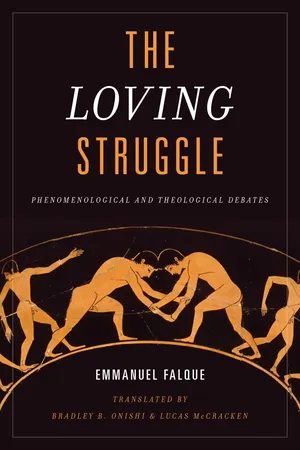
eBook - ePub
The Loving Struggle
Phenomenological and Theological Debates
- 304 pages
- English
- ePUB (mobile friendly)
- Available on iOS & Android
eBook - ePub
The Loving Struggle
Phenomenological and Theological Debates
About this book
Information
Part I
Limitation
Chapter 1
Khôra or The Great Bifurcation
Jacques Derrida
‘Pascal had his chasm . . . / Alas! Everything is an abyss.’ 1 Baudelaire’s famous words touch the bottomless depths of what a meaningless chaos would mean—or rather could not mean. However, more original than chaos, deeper than the chasm, and even more meaningless than the abyss, there lies the ‘amorphous’ or, even better, the ‘the receptacle’ and, as it were, the wet-nurse of all becoming: Khôra. It is ‘an impenetrable and obscure state of being’, Plato says in a precursory way in Timaeus, that ‘demands careful elucidation’ (49a). ‘This is a difficult matter’ (49a), the philosopher goes on to insist, such that only ‘a god’ acting as our ‘savior’ could ‘take us safely ashore’ by some ‘unexpected and unsolicited exposition’, and thereby ‘lead us to a reasonable comprehension [of Khôra]’ (48d). Moreover, this ‘invisible and formless sort of being . . . partakes of the intelligible in a baffling way’ and ‘resists the grasp of thought’ (51a). We will speak of it therefore only by ‘a sort of spurious reasoning’ (52b), allowing ourselves to enter ‘into the realm of a dream from which we cannot awaken’ (52b). We shall see it as a kind of ‘fleeting shadow’, ‘clinging to existence as best it may’, on the verge of being ‘nothing at all’ (52c). 2
Such limits—or better, such a discourse on limits—have seldom been reached in the history of philosophy. These Platonic words could make us smile, either, at best, because it is a question of ‘myth’, or, at worst, because the philosopher would have opened the door to ‘margins’ which contemporary thought would later strive to adopt. However, the discourse on the ‘limit’ is to be articulated in an extreme manner, and at the extremities of thought, in that it has nothing to do with ‘limitation’. Whereas the discourse on the limit reaches the threshold of a finitude without opposition (either finite or infinite), limitation receives its restriction, on the contrary, as the abstraction of a plenitude that it fails to fulfil (the limitation of the infinite by the finite). The determination of the modern human being as a ‘figure of finitude’, in Michel Foucault or Gilles Deleuze (who were close to Jacques Derrida in this regard) deals with the ‘limit’ rather than ‘limitation’, the ‘immanent frame’ rather than ‘the terraced fountain’. 3
Thus, when considering the ‘limit’ and Derrida’s desire to navigate the extremities of discourse—‘negative theology’, of course, but also Khôra—, it is no surprise that we must engage in a dialogue, be it only a transitory one, with his mode of philosophizing. In effect, I will show that Khôra marks a ‘great bifurcation’ between two modes or pathways for philosophy in general: either the ‘higher way’ of negative theology (On the Name), or the ‘lower way’ sought by a non-reflexive philosophy (Khôra).
At this crossroads, much attention has been paid, and rightly so, to the former (On the Name), at least in France, but the latter (Khôra) has been quite neglected. Current discourse takes place as if this crucial dialogue on the excess of negation (negative theology, beginning with On the Name) has somewhat eclipsed the one about limitation (positive limit, beginning with Khôra). However, the famous and remarkable public discussion between Derrida and Jean-Luc Marion at Villanova University on 27 September 1997 displayed even then the divergence between these two ways of thinking and thereby already opened us onto an alternative to the higher way of negative theology. ‘Jacques seems to go towards Khôra and you seem to go towards revelation’, notes Richard Kearney, turning towards Jean-Luc Marion, ‘how do we know that we have been visited by a supereminent excess and not just simply invaded by khôra?’ asks John Caputo to close the debate. 4 Derrida’s text (‘How to Avoid Speaking: Denials’), to which the debate refers, nevertheless articulates the one and the other, negative theology and Khôra, or rather, opposes the one to the other, the hyperbole of the agaton to Khôra’s parabola. 5 Marion’s ‘In the Name, or How to Avoid Speaking of It’ responds to it point by point, but by abandoning or almost abandoning Khôra altogether, pointing to a perplexity that I would be remiss not to share, if only in a preliminary way. At the end of ‘Derrida and the Impossibility of the Gift’, we read: ‘Allow me to repeat [Derrida’s] own words (“I am not convinced”) to express my reluctance before the privilege he grants to khôra—and my persistence in recognizing the larger, because weaker, empire of givenness.’ 6
6. The Emergence of Khôra
Another Logic?
Why should we, along with Derrida, turn now towards Khôra? It is not motivated (far from it) out of any excessive deference to the philosopher, nor due to a particular taste for discourses playing at and with the limits of philosophy, nor for defying all logic. Many French philosophers, probably quite rightly, thought that in going thusly towards the margins of philosophy, Derrida was risking going beyond the limits of thought. Though wrongly in this regard, he was often and still is subject to a certain ostracism in France. Under the pretext of a so-called phenomenological orthodoxy, Derrida—the unclassifiable—has remained, for some time at least, non-classified. Referring to this ‘“logic other than the logic of the logos”’, Khôra would not only be outside metaphysics but also outside philosophy itself. 7 In thinking the unthinkable, one would therefore not think at all, and any dialogue on this particular point would close before opening in the first place. While a certain theological reading of Derrida prioritizes the apophatic over the ‘choretic’, or Dionysius’ Mystical Theology over Plato’s Timaeus, it is still the case that the Greek word khôra itself refers to something negative that Christian apophasis does not reach, but to which God himself, in his kenosis, could not remain indifferent. We must ask, then, how to speak of Khôra, or better, how not to speak of Khôra, since it appears to have been inevitable for Derrida, and likewise for negative theology itself; hence, the Christian cannot ignore Khôra. 8
Khôra is neither a place nor a god, neither a thing nor no-thing, neither an order nor a dis-order, neither a gift nor a withdrawal, as specified in the second commentary which Derrida devotes to it (Khôra, 1987). Instead, it is ‘some-thing that is not a thing’; a ‘“there is” that gives nothing in giving the “there”’ (without, however, being identified with the ‘es gibt’); a word without any definite article that makes definite all articles (we say Khôra rather than ‘the’ Khôra); a simple mode of being that escapes all beings and nevertheless underpins the ground of being: ‘There is Khôra but Khôra does not exist.’ 9 One could certainly object, once again, that such talk is mere wordplay. However, thanks precisely to Plato, the philosopher reaches in this limit a discursive mode of seeking the infra of discourse, a place of being weaving together all our modes of being, a descent downwards (Khôra) rather than a flight upwards (negative theology), a path like the Timaeus through the essential formlessness of the world and of the human rather than the Dionysian ascension of Moses to the divine (mystical theology). ‘This silence, from the depths of which khôra seems to call her name’, Derrida specifies in the ‘Prière d’insérer’ to Khôra, ‘is perhaps no longer even a modality or a reserve of speech. No more than this bottomless depth promises the night of a day. On the subject of Khôra, there is neither negative theology nor any thought of the Good, the One, or of God beyond Being.’ 10
On this Side of Meaning
Without directly adapting Derrida’s path here, at least in terms of his flight to the ‘margins’ of philosophy, which remain to be found, we will nevertheless recognize in an exemplary way that Khôra contains something of the very limit which I am striving to reach both in the ‘chaotic depths’ of the unattainable, or almost unattainable, within phenomenology’s framework of significance (as I explored in the Wedding Feast of the Lamb) and in the infra-linguistic, which the orientation towards pure expressivity would never be able to tap into (as I attend to in Crossing the Rubicon).
In order to make clear the urgency of this question, it serves us here to recall a parallel point in my previous work, Crossing the Rubicon:
Nevertheless another step forward must be taken. There is, or there was, the time of ‘pure experience’, and one might say, mute still, that, like Husserl tells us, ‘must be brought to express its own meaning’. But now, it is time to let the dumb speak for himself in other ways than speech, or perhaps even in the unique mode of corporality. More accurately, the ‘pre-reflexive’ will perhaps no longer find its end or goal in the reflexive alone (including in the context of phenomenology) as if it were only preparing for it or establishing its foundation as in Husserl’s phenomenology, any more than the unconscious will orient itself towar...
Table of contents
- Cover
- Half-Title
- Title
- Copyright
- Dedication
- Contents
- Translator’s Preface
- Introduction to the English Translation Is the Theological Turn Still Relevant? Finitude, Affect, and Embodiment
- Opening
- PART I: LIMITATION
- PART II: REVELATION
- PART III: INCARNATION
- PART IV: EXPERIENCE
- Epilogue: The Hedgehog and the Fox: Jean Greisch
- Bibliography
- Index
- About the Author
- About the Book
Trusted by 375,005 students
Access to over 1.5 million titles for a fair monthly price.
Study more efficiently using our study tools.
Frequently asked questions
Yes, you can cancel anytime from the Subscription tab in your account settings on the Perlego website. Your subscription will stay active until the end of your current billing period. Learn how to cancel your subscription
No, books cannot be downloaded as external files, such as PDFs, for use outside of Perlego. However, you can download books within the Perlego app for offline reading on mobile or tablet. Learn how to download books offline
Perlego offers two plans: Essential and Complete
- Essential is ideal for learners and professionals who enjoy exploring a wide range of subjects. Access the Essential Library with 800,000+ trusted titles and best-sellers across business, personal growth, and the humanities. Includes unlimited reading time and Standard Read Aloud voice.
- Complete: Perfect for advanced learners and researchers needing full, unrestricted access. Unlock 1.5M+ books across hundreds of subjects, including academic and specialized titles. The Complete Plan also includes advanced features like Premium Read Aloud and Research Assistant.
We are an online textbook subscription service, where you can get access to an entire online library for less than the price of a single book per month. With over 1.5 million books across 990+ topics, we’ve got you covered! Learn about our mission
Look out for the read-aloud symbol on your next book to see if you can listen to it. The read-aloud tool reads text aloud for you, highlighting the text as it is being read. You can pause it, speed it up and slow it down. Learn more about Read Aloud
Yes! You can use the Perlego app on both iOS and Android devices to read anytime, anywhere — even offline. Perfect for commutes or when you’re on the go.
Please note we cannot support devices running on iOS 13 and Android 7 or earlier. Learn more about using the app
Please note we cannot support devices running on iOS 13 and Android 7 or earlier. Learn more about using the app
Yes, you can access The Loving Struggle by Emmanuel Falque, Bradley B. Onishi, Lucas McCracken, Bradley B. Onishi,Lucas McCracken in PDF and/or ePUB format, as well as other popular books in Philosophy & Phenomenology in Philosophy. We have over 1.5 million books available in our catalogue for you to explore.