
eBook - ePub
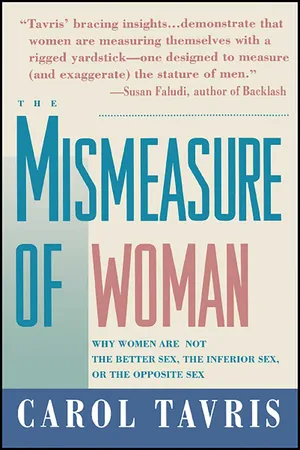
Mismeasure of Woman
Why Women are Not the Better Sex, the Inferior Sex, or the Opposite Sex
- 400 pages
- English
- ePUB (mobile friendly)
- Available on iOS & Android
eBook - ePub
Mismeasure of Woman
Why Women are Not the Better Sex, the Inferior Sex, or the Opposite Sex
About this book
When "man is the measure of all things, " woman is forever trying to measure up. In this enlightening book, Carol Tavris unmasks the widespread but invisible custom -- pervasive in the social sciences, medicine, law, and history -- of treating men as the normal standard, women as abnormal. Tavris expands our vision of normalcy by illuminating the similarities between women and men and showing that the real differences lie not in gender, but in power, resources, and life experiences.
Winner of the American Association for Applied and Preventive Psychology's Distinguished Media Contribution Award
Frequently asked questions
Yes, you can cancel anytime from the Subscription tab in your account settings on the Perlego website. Your subscription will stay active until the end of your current billing period. Learn how to cancel your subscription.
No, books cannot be downloaded as external files, such as PDFs, for use outside of Perlego. However, you can download books within the Perlego app for offline reading on mobile or tablet. Learn more here.
Perlego offers two plans: Essential and Complete
- Essential is ideal for learners and professionals who enjoy exploring a wide range of subjects. Access the Essential Library with 800,000+ trusted titles and best-sellers across business, personal growth, and the humanities. Includes unlimited reading time and Standard Read Aloud voice.
- Complete: Perfect for advanced learners and researchers needing full, unrestricted access. Unlock 1.4M+ books across hundreds of subjects, including academic and specialized titles. The Complete Plan also includes advanced features like Premium Read Aloud and Research Assistant.
We are an online textbook subscription service, where you can get access to an entire online library for less than the price of a single book per month. With over 1 million books across 1000+ topics, weâve got you covered! Learn more here.
Look out for the read-aloud symbol on your next book to see if you can listen to it. The read-aloud tool reads text aloud for you, highlighting the text as it is being read. You can pause it, speed it up and slow it down. Learn more here.
Yes! You can use the Perlego app on both iOS or Android devices to read anytime, anywhere â even offline. Perfect for commutes or when youâre on the go.
Please note we cannot support devices running on iOS 13 and Android 7 or earlier. Learn more about using the app.
Yes, you can access Mismeasure of Woman by Carol Tavris in PDF and/or ePUB format, as well as other popular books in Social Sciences & Gender Studies. We have over one million books available in our catalogue for you to explore.
Information
1
Measuring Up
Why women are not inferior to men
Do you sometimes feel inadequate and worthless? Do you dislike your body? Are you nagged by the fear that you donât really deserve to be happy and successful? Do you frequently compare yourself to others and come up short? When things go wrong, do you automatically blame yourself? . . . If you can answer yes to one or several of these questions, youâre probably suffering from low self-esteem, a problem that plagues large numbers of women.1
If you were to flip through a random selection of research articles, magazines, and popular books about differences between the sexes, you would encounter many problems that apparently plague large numbers of women. For instance:
â Women have lower self-esteem than men do.
â Women do not value their efforts as much as men do, even when they are doing the same work.
â Women are less self-confident than men; when asked to predict how they will do in the future, they are less optimistic than men about their abilities.
â Women are more likely than men to repress their anger and to say they are âhurtâ than to admit they are angry.
â Women have more difficulty than men in developing a separate identity, a sense of self.
Well, these are all things to worry about, arenât they? Surely it is desirable for women to have high self-esteem, value their work, be self-confident, express anger clearly, and develop autonomy. Surely it is important to explore the problem of why women are so insecure and what can be done about it.2
To find the premises underlying these well-meaning efforts to understand womenâs problems, letâs dissect a very good recent study. The researcher asked some young women and men to take tests of creativity, such as inventing new uses for ordinary objects. She was not actually interested in whether men or women are more creative (in this case, they did not differ), but rather in the reasons they give for their success or failure on the tests during a mock job interview afterward.
The investigator reported that women are less self-confident than men: The women attributed their successes less often to their own abilities than to luck, and they reported less overall confidence in their present and future performance. Why, she asked, do women make âless self-servingâ explanations than men do? âThe feminine social goal of appearing modest,â she concluded, âinhibits women in making self-promoting attributions in an achievement situation which involves face-to-face interaction.â3
Now, ignore the lumpy language of research psychology and notice that the goal of this study was to explain why the women didnât behave like the men. To see this more clearly, simply rephrase the question and its answer. The investigator might have said: âWhy do men make more self-serving explanations than women do? The masculine social goal of appearing self-confident inhibits them from making modest explanations of their abilities or acknowledging the help of others and the role of chance.â
Of course, the habit of seeing womenâs behavior as something to be explained in relation to the male norm makes sense in a world that takes the male norm for granted. In this case, the researcher showed that the female habit of modesty actually does women a disservice in job interviews, because they appear to be unconcerned with achievement and unwilling to promote themselves. This bit of information would be useful to women and men from England, Japan, and other cultures that value modesty, if they want to do business in America,
Nevertheless, in this study, as in many others, the menâs responses are used to define the norm, framing the very questions and solutions that investigators explore. But suppose for a moment that we lived in a world where psychologists used women as the basis of comparison. We might then be reading articles and books that analyze the following problems that plague men:
â Men are more conceited than women.
â Men overvalue the work they do.
â Men are not as realistic and modest as women in assessing their abilities.
â Men are more likely than women to accuse and attack others when they are unhappy, instead of stating that they feel hurt and inviting sympathy.,
â Men have more difficulty than women in forming and maintaining attachments.
Now the same âproblemsâ have to do with male overconfidence, unrealistic self-assessment, aggression, and isolation, not with womenâs inadequacies. But you wonât find many popular books trying to help men like George Steinbrenner or Donald Trump, who, as far as Iâm concerned, suffer from excessive self-esteem.
In recent years, women have been uncovering many of the implicit biases that resulted from using men as the human standard. But the universal man is deeply embedded in our lives and habits of thought, and women who deviate from his ways are still regarded as,. well, deviant. To illustrate the persistence of the normal man and the difficulty he poses for women who hope to measure up, I offer three stories of how he affects the evaluation of womenâs bodies, psychology, and brains.
â Body: Beauty and the bust
The cartoonist Nicole Hollander once described what she thought the world would be like without men. âThere would be no crime,â she said, âand lots of happy, fat women.â
Itâs a wonderful line, funny because it strikes right at the heart of the guilty secret (or outright worry) of most women; the endless obsession with weight and body shape. Every woman 1 know has a âweight problem.â My thin friends worry about gaining weight, my plumper friends struggle to lose it. My friends are governed by diets: they are either on one, about to start one, delighted at having finished one, or miserable that they canât stick with one. I sympathize with them; Iâm that way too. This obsession, which is so damaging to womenâs self-concept, happiness, and self-esteem, perfectly highlights the dilemma for women of being like men or different from them, and the origins of that dilemma in the larger social picture.
Over the years, the ideal figure for a woman has changed, from eras that accentuate the differences from the male body to those that minimize them. In this century alone we have seen rapid shifts from the Lillian Russell/Marilyn Monroe standard, which was voluptuous and curvaceous, to the 1920s Flapper/1960s Twiggy standard, which was unisex slim, to todayâs odd hybrid: full-breasted but narrowhipped. Psychologist Brett Silverstein and his associates have cleverly documented this changing female ideal by calculating âbust-to-waistâ and âwaist-to-hipâ ratios of the measurements of women in popular womenâs magazines.4 You get larger ratios in eras that celebrate the big-breasted figure, and a smaller ratio in eras that endorse the boyish shape.
In the early 1950s, for instance, Playboy centerfolds, beauty contest winners, and fashion models weighed much more and were several inches more ample in bust and hips than they were in the 1970s and 1980s. The 1951 Miss Sweden was Sâ7H tall and weighed 151 pounds; the 1983 Miss Sweden was 5â9â tall and weighed 109 pounds.5 The phrase âpleasantly plump,â which was still a compliment in the 1950s, became an oxymoron in the 1960s. Actress Valerie Harper, who truly was pleasantly plump, was not happy with her body until she became alarmingly gaunt.
Why do these ideals change? Curvy, full-breasted women are in fashion during pro-maternal eras, in which motherhood and domesticity are considered womenâs most important roles: this was the case in the early 1900s, the 1950s, and, increasingly, today. In contrast, thin, muscular, boyish bodies are in fashion whenever women have entered the work force, specifically the traditionally male occupations: this was the case in the 1920s and again in the late 1960s and 1970s. In the 1920s, women used to bind their breasts with tape so their breasts would not be prominent in the dress styles of the day. The 1970s âworking girlâ that Mary Tyler Moore played for seven years on television didnât have to do this; she was as thin as a reed. Jane Fonda transformed her voluptuous Barbarella shape into an aerobically toned muscular one.
Why should the kind of work that people do affect ideal body image? Men and women, Silverstein discovered, associate the round, big-breasted body with femininity. And they associate femininity with nurturance, dependence, passivity, domesticityâand, unhappily, incompetence. The normal male body, in contrast, conveys intelligence, strength, and ability. Therefore, women who want to be thought intelligent, professional, and competentâi.e., âmasculineââmust look more male-ish. (Men, too, have fallen prey to this equation. Fat, once a sign of a manâs wealth and success in the early decades of this century, now signifies womanly softness and lack of masculinity.)
Indeed, in every era when educational and occupational opportunities for women have increased, the ideal body for women became thin, athletic, small-busted, and narrow-hipped. A 1935 Fortune article described the professional, âintelligently dressed woman,â contrasting her with the âblond stenographer with the slick sleazy stockings and the redundant breasts.â Redundant breasts? The idea returned in the careerist 1970s and 1980s. A 1984 career guide for women advised its readers: âThe sex goddess look is at odds with a professional business look. If you have a large bust donât accentuate it.â
In such egalitarian times, the number of articles and books on dieting increases astronomically, and eating disorders and âfat panicâ among women and girls become epidemic. Most white teenage girls no longer regard normal and necessary adolescent weight gain as normal signs of maturation, but as signs of (unpleasant) fatness. A representative survey of more than 2,000 girls in Michigan, ages eleven to eighteen, found that nearly 40 percent considered themselves overweight; dieting and dissatisfaction with body image were the typical responses to the onset of puberty.6 Many other studies of nationally representative samples find that dieting, unrealistic body image, and dissatisfaction with weight are chronic stressors for women.7
Women who value achievement, higher education, and professional careers are especially likely to be obsessed with thinness and to suffer from various eating disorders, such as anorexia and bulimia. âEating disorders and the obsession with weight control,â says Silverstein, âare an ironic price of âwomenâs liberation.â They occur when the level of discrimination against women decreases enough to let women into higher education and the professionsâbut not enough to break the association between femininity and incompetence.â8
This link seems to be particularly troubling for women who are insecure about their competence and who feel that their fathers did not think they were intelligent and did not support their ambitions. To resolve this dilemma, they try literally to measure up: to become as thin as a man, since they canât actually become one. According to O. Wayne Wooley and Susan Wooley, who direct a research program and eating-disorders clinic at the University of Cincinnatiâs College of Medicine, many bulimic young women are seeking their fathersâ recognition of their competence, which they donât get because they are female. âTo become like their fathers, our patients feel compelled to be thin,â they observe, âânot just to minimize their womanliness, but also because thinness, in this culture, is a sign of achievement and mastery.â9
All women remain affected to some degree by the portrayals of the ideal woman in the media, and those portrayals, in spite of the popularity of Roseanne Barr, are getting worse. âWomen receive more messages to be slim and stay in shape than do men,â says Silverstein, who analyzed popular television characters and articles and ads in magazines. On television in the late 1980s, 69 percent of the female characters were very thin, compared to only 17.5 percent of the male characters. Only five percent of the female characters were heavy, compared to 25.5 percent of the males. In 48 issues of popular womenâs magazines that Silverstein surveyed, the total number of ads for diet foods was 63; the comparable number in popular menâs magazines was 1. As for articles dealing with body shape or size, the score was womenâs magazines 96, menâs 8.
With the dawn of the 1990s, media images of women began to celebrate a hybrid form that is all but impossible for most women: big-breasted but narrow-hipped. (Accordingly, Jane Fonda got breast implants.) This hybrid reflects the ambivalence in American society toward womenâs roles and the, expectation that women must be both professionally competent and maternal. The majority of women, including mothers of young children, work outside the home, yet we are also in an era of strong pro-maternal sentiment.
As one sign of the times, those âredundant breastsâ are back in vogue: After a decade of the popularity of breast-reduction surgeries, breast-enlargement procedures are on the increase. âBe Your Best,â blares an ad for the âBreast Enhancement Medical Centerâ in Los Angeles. These three words are placed across the modelâs breasts, as if to convey the real message, âBe Your Bust.â The message is catching on. More than 70,000 women in the United States...
Table of contents
- Cover
- Dedication
- Epigraph
- Introduction: The Universal Male
- 1. Measuring Up: Why women am not inferior to men
- 2. Beautiful Souls and Different Voices: Why women are not superior to men
- 3. The 70-Kilogram Man and the Pregnant Person: Why women are not the same as men
- 4. Misdiagnosing the Body: Premenstrual syndrome, postmenstrual syndrome, and other normal âdiseasesâ
- 5. Misdiagnosing the Mind: Why women are âsickâ but men have âproblemsâ
- 6. Bedtime Stories: Three fables of female sexuality
- 7. Loveâs Experts, Loveâs Victims: How women cornered, the love market
- 8. Speaking of Gender: The darkened, eye restored,
- Acknowledgments
- About the Author
- Notes
- Bibliography
- Index
- Copyright