
- 304 pages
- English
- ePUB (mobile friendly)
- Available on iOS & Android
eBook - ePub
About this book
Using in-depth case studies, Can’t Just Stop examines the science behind both mild and extreme compulsive behavior—“a fascinating read about human behavior and how it can go haywire” (The Charlotte Observer).
Whether shopping with military precision or hanging the tea towels just so, compulsion is something most of us have witnessed in daily life. But compulsions exist along a broad continuum and, at the opposite end of these mild forms, exist life-altering disorders.
Sharon Begley’s meticulously researched book is the first to examine all of these behaviors together—from obsessive-compulsive disorder (OCD) to hoarding, to compulsive exercise, even compulsions to do good. They may look profoundly different, but these behaviors are all ways of coping with varying degrees of anxiety. Sharing personal stories from dozens of interviewees, “Begley combines a personal topic with thoughtfulness and sensitivity” (Library Journal) and gives meaningful context to their plight. Along the way she explores the role of compulsion in our fast-paced culture, the brain science behind it, and strange manifestations of the behavior throughout history.
Can’t Just Stop makes compulsion comprehensible and accessible, with “fresh insight that could fundamentally alter how we think of, and treat, mental illness going forward” (Publishers Weekly).
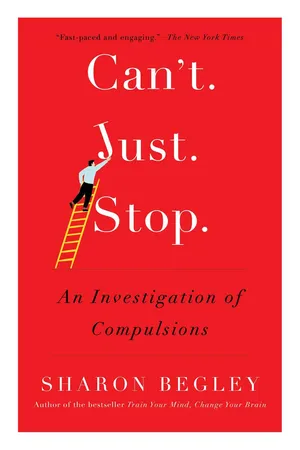
Whether shopping with military precision or hanging the tea towels just so, compulsion is something most of us have witnessed in daily life. But compulsions exist along a broad continuum and, at the opposite end of these mild forms, exist life-altering disorders.
Sharon Begley’s meticulously researched book is the first to examine all of these behaviors together—from obsessive-compulsive disorder (OCD) to hoarding, to compulsive exercise, even compulsions to do good. They may look profoundly different, but these behaviors are all ways of coping with varying degrees of anxiety. Sharing personal stories from dozens of interviewees, “Begley combines a personal topic with thoughtfulness and sensitivity” (Library Journal) and gives meaningful context to their plight. Along the way she explores the role of compulsion in our fast-paced culture, the brain science behind it, and strange manifestations of the behavior throughout history.
Can’t Just Stop makes compulsion comprehensible and accessible, with “fresh insight that could fundamentally alter how we think of, and treat, mental illness going forward” (Publishers Weekly).
Frequently asked questions
Yes, you can cancel anytime from the Subscription tab in your account settings on the Perlego website. Your subscription will stay active until the end of your current billing period. Learn how to cancel your subscription.
No, books cannot be downloaded as external files, such as PDFs, for use outside of Perlego. However, you can download books within the Perlego app for offline reading on mobile or tablet. Learn more here.
Perlego offers two plans: Essential and Complete
- Essential is ideal for learners and professionals who enjoy exploring a wide range of subjects. Access the Essential Library with 800,000+ trusted titles and best-sellers across business, personal growth, and the humanities. Includes unlimited reading time and Standard Read Aloud voice.
- Complete: Perfect for advanced learners and researchers needing full, unrestricted access. Unlock 1.4M+ books across hundreds of subjects, including academic and specialized titles. The Complete Plan also includes advanced features like Premium Read Aloud and Research Assistant.
We are an online textbook subscription service, where you can get access to an entire online library for less than the price of a single book per month. With over 1 million books across 1000+ topics, weâve got you covered! Learn more here.
Look out for the read-aloud symbol on your next book to see if you can listen to it. The read-aloud tool reads text aloud for you, highlighting the text as it is being read. You can pause it, speed it up and slow it down. Learn more here.
Yes! You can use the Perlego app on both iOS or Android devices to read anytime, anywhere â even offline. Perfect for commutes or when youâre on the go.
Please note we cannot support devices running on iOS 13 and Android 7 or earlier. Learn more about using the app.
Yes, you can access Can't Just Stop by Sharon Begley in PDF and/or ePUB format, as well as other popular books in Psychology & Abnormal Psychology. We have over one million books available in our catalogue for you to explore.
Information
CHAPTER ONE
What Is a Compulsion?
A GENERATION OR SO AGO, it became trendy to describe all sorts of excessive behaviors as addictions, meaning an intense appetite for an activity, as in âIâm addicted to shoppingâ . . . or to weaving, yoga, jogging, work, meditating, making money (as a 1980 book called Wealth Addiction argued) or even to playing Rubikâs Cube (a 1981 story in the New York Times deemed it âan addictive inventionâ). Once neurobiologists discovered that the same brain circuitry underlying addictions to nicotine, opiates, and other substances is also involved in, for instance, a chocoholicâs craving for Teuscher truffles, pop sociologists were off to the races. Suddenly, we were all addicted to email and working and Angry Birds playing and Facebook posting and . . . well, everything that some people do in excess became an addiction. The only significant scientific barrier to this trendâpsychiatry did not recognize any behavior as addictive in the formal sense of the termâfell in 2013. That spring, the American Psychiatric Association published the latest edition of its Diagnostic and Statistical Manual of Mental Disorders, widely regarded as the bible of the field, and for the first time it recognized a behavioral addiction: gambling.
Gambling made the cut because it met the three criteria that, for decades, have been the defining characteristics of an addiction. First, the behavior (or substance) is intensely pleasurable, at least initially, and sinks its claws into soon-to-be addicts the first time they experience it. Second, engaging in the addictive behavior produces tolerance, in which an addict needs more and more of something to derive the same hedonic hit. And, finally, ceasing to engage in the addictive behavior triggers agonizing withdrawal symptoms on a par with those that torture the addict who is trying to kick a heroin habit.
By these criteria, âaddictionsâ to the electronic crack of the twenty-first century donât look like addictions, and they donât feel like it either, most crucially because they lack the defining hedonic quality. For me, at least, compulsively checking for emails feels more like what people with obsessive-compulsive disorder experience right before the urge to wash their hands or straighten a picture or step on the magical fourth sidewalk crack (because if they donât their mother will die). It feels like something you have to do, not something you want to do; something that alleviates anxiety (Is an elusive source finally getting back to me, but about to try a competitor unless I reply in the next five seconds?), rarely something that brings pleasure.
They are compulsions, not addictions.
Whatâs the difference? The two terms are often used interchangeably in casual conversation (âcompulsive shoppingâ vs. a âshopping addictionâ) with a mention of âimpulsiveâ often thrown in for good measure. But since this is a book about compulsions and not addictions, let me explain how experts understand the differences.
To wit: surprisingly, alarmingly, disappointingly, exasperatingly poorly.
A Taxonomic Odyssey
Without ratting out people who were kind enough to sit still for my persistent questioning, Iâll simply note that they did not fill me with confidence about the solidity of the scientific foundation underpinning the understanding of compulsive behaviors. âWell, a behavioral addiction is governed by things like neurons and hormones,â one tentatively began. âBut a compulsive behavior is psychological, but is governed by physical mechanisms.â Huh? The muddle was captured nicely, if inadvertently, by a 2008 paper in which the authors invent something they name âimpulsive-compulsive sexual behaviorâ and define it as âone type of addictive behavior.â Trifecta: a behavior thatâs impulsive, compulsive, and addictive.
The lines dividing a compulsive behavior from an addictive one from an impulsive one seem to shift like tastes in fashion, and the confusion between and among them was practically codified by the many iterations of the American Psychiatric Association and its Diagnostic and Statistical Manual. Over the decades, the editions of the mega-selling DSM have rotated addiction, compulsion, and impulse through the definitions of syndromes, including eating disorders and anxiety disorders, as if the three were interchangeable. The DSM hasnât even managed to draw clear boundaries around OCD, which youâd think would be firmly ensconced as a compulsive disorder by virtue of its name, if nothing else. But no: early editions of the DSM described obsessive-compulsive disorder as marked by recurrent and persistent impulses to do this or that. When the APAâs experts began working on what would become the DSM-5, their working names for pathological Internet use and pathological shopping were âC-I Internet usageâ and âC-I shoppingââwhere the C stood for compulsive and the I for impulsive. The idea was that the excessive behaviors have features of both: impulsivity is the proximate cause, but a compulsive drive makes the behavior persist.
To get a sense of how muddled the taxonomy was, consider trichotillomania, which afflicted Amy, whom you met in the Introduction. In 1987 it entered that yearâs DSM (edition III-R) as an impulse-control disorder, along with kleptomania, pyromania, and intermittent explosive disorder, among others. That reflected the common meaning of impulsivity as ârapid, unplanned behavior with little foresight of or regard for the negative consequences,â as Yale University psychiatrist Marc Potenza defined it one day when I visited his office in downtown New Haven, Connecticut. But the 1994 edition, DSM-IV, added two criteria for diagnosing trichotillomania: âan increasing sense of tension immediately before pulling out the hair or when attempting to resist the behavior,â and âpleasure, gratification, or relief when pulling out the hair.â Both of these are exactly what defines a compulsion. Yet trichotillomania sat among the impulse-control disorders until 2013, when the DSM-5 (it switched that year from Roman numerals to Arabic) plucked it out of the impulse-control disorders and stuck it at the end of the chapter on OCD as a ârelated disorder.â Oh, and the DSM-5 eliminated the criteria that hair pulling be preceded by tension and lead to reliefâand yet there it sits, in the OCD chapter, a chapter for a disorder whose defining characteristic is the anxiety that spurs an action that relieves said anxiety.
Tricâs wanderings in the psychiatric wilderness are nothing compared to those of pathological gambling. The 1994 DSM had put compulsive gambling (my emphasis) in a grab-bag category called âimpulse-control disorders not elsewhere classified,â along with kleptomania, pyromania, and others. Again, that reflected the thinking that someone might impulsively decide to play the ponies and then, through some poorly understood mechanism, segue into doing so compulsively. In 2013, gambling also pulled off the trifecta: having previously been called compulsive and classified as impulsive, it became the first behavioral disorder to be formally categorized as an addiction.
At least the new classification made sense, in that it hewed to the traditional three-part understanding of addiction (initial hedonic hit leading to intense desire for the substance or, now, the experience; tolerance; withdrawal) in the context of drugs. For starters, pathological gamblers experience cravings as powerful as a junkieâs. While itâs obviously tricky to quantify a subjective experience like craving, there is some empirical evidence that the brain mechanisms underlying an addiction to gambling overlap with those in an addiction to alcohol, nicotine, pain pills, or illegal drugs: when pathological gamblers watch videos of people playing craps or roulette or another casino game, the regions of their brainsâ frontal cortex and limbic system that spike with activity are nearly identical to the regions that go haywire in cocaine addicts who watch videos of people doing lines. In addition, pathological gamblers build up tolerance to gambling just as alcoholics do to booze or junkies to heroin: to get the same pleasurable rush from gambling, they have to make larger and larger bets. And finally, pathological gamblers experience psychological withdrawal when they try to quit or even taper off, again akin to what substance abusers suffer. Cravings, tolerance, withdrawal: pathological gambling qualifies as an addiction.
In part, addiction and compulsion get mixed up because both words are used in ordinary language as well as clinical terminology, said Tom Stafford, a cognitive scientist at Englandâs University of Sheffield who studies compulsive video-gaming. âMany people are cavalier about saying theyâre addicted to sports, or to shopping, or to their iPhone,â he told me. âThere isnât a clear line between an addiction like alcohol and a behavior they are very compelled to do, but Iâd rather use the term compulsion for these behaviors.â
It isnât just casual use of the terms that causes confusion. âItâs a real scientific controversy, how and in what ways addictions are or are not like compulsive behaviors,â James Hansell, a professor and clinical psychologist at George Washington University and coauthor of a popular textbook on abnormal psychology, told me. Hansell paused, as if trying to find properly diplomatic language: âThere is a primitive quality to this, trying to define what is a compulsion and whatâs an addiction.âI
Indeed, many researchers feel that the understanding, not just the nomenclature, of excessive behavior âhas been shifting under our feet,â as psychologist Carolyn Rodriguez of Columbia University said when I visited her office at Columbia University Medical Center. âTerms we had been usingâlike addiction, compulsion, and impulse controlâare being looked at in a new light.â Is there any hedonic hit from executing a compulsion? Rodriguez flipped through her mental Rolodex of patients. âIn talking to them, I wouldnât say it feels good,â she answered. âIt just relieves anxiety.â That relief might feel good, but itâs a different kind of good than the pleasure that giving in to an addiction brings. Executing a compulsion brings an ebbing of the tide of angst, a lifting of the cap from a shaken soda bottle about to explode. People who feel compelled have a mental itch they need to scratch, like a poison ivy of the mind. One of Rodriguezâs patients, she told me, âhas intrusive thoughts about the name James. It makes him so anxious that if he ever sees itâlike in the newspaperâhe has to write Edward to cancel it out, and use Visine to wash away the sense that âJamesâ has contaminated his eyes.â Rodriguez paused. âThese people really suffer.â
Fortunately, a growing number of experts have begun to grapple with the failure to clearly distinguish addictions from compulsions from poor impulse control, and not merely to classify behaviors correctly for the sake of tidiness. There is a practical motivation, too: if therapists arenât sure whether the behavior that has hijacked your life is a compulsion, an addiction, or a manifestation of lousy impulse control, theyâre not likely to identify the most effective therapy. The treatment for a behavioral addiction is very different from that for a compulsive behavior, which in turn is different from the treatment for an impulse-control disorder. âYou do need to get it right to determine effective treatment,â Yaleâs Potenza said.
What finally emerged is this three-part taxonomy:
An addiction begins with a flash of pleasure overlaid by an itch for danger; itâs fun to gamble or to drink, and it also puts you at risk (for losing your rent money, for acting like an idiot). You like how you feel when you win or when you get a buzz on. The addict-to-be takes a drag on a cigarette and finds that the nicotine hit makes him feel energized or mentally sharper. But eventually the substance or behavior ceases to bring pleasure, not only at the original levels of use but even at the extreme levels that typically characterize an addiction. Smokers lament that the forty-third cigarette of the day just isnât as pleasurable as the third smoke used to be. What once brought the high no longer does, necessitating ever-increasing doses, in substance abuse and in a gamblerâs greater bets. Despite the diminishing hedonic return on investment, so to speak, to cease engaging in the addictive behavior causes abject misery and, often, physical withdrawal pains like the shakes, irritability, or moodiness. Pleasure, tolerance, withdrawal: the Big Three of addiction.
Impulsive behaviors involve acting without planning or even thought, driven by pleasure seeking and an urge for immediate gratification. They have an element of risk seekingâHey, I bet it would be a blast to swan dive off this cliff!âwhere the risk is expected to lead to a feeling of reward. Pyromania and kleptomania are classic impulsive behaviors because theyâre all about seeking pleasure and excitement. As a result, impulsivity can be the first step toward a behavioral or substance addiction. Something (a stimulus) triggers a response, and the pathway from the stimulus to response does not pass through the cognitive or even the emotional brain, at least not consciously. Instead, an urge zips from your most primitive brain center to your motor cortexâClaim that wonderful sofa someone left at the curb; grab that luscious-looking cherry cheesecake from the dessert cartâwithout so much as a pit stop in regions that control higher-order cognitive functions (Where the heck would you put another couch? You know youâll feel guilty if you eat that). You do it reflexively. Like addictions, impulsive behaviors âhave a hedonic quality,â Jeff Szymanski, executive director of the International OCD Foundation (IOCDF), told me when we met in his hotel suite during the Foundationâs 2013 annual meeting. â âI stole and got away with it,â âI lit this fire and got all these cool fire trucks to show upââvery much like, âI gambled and won.â Itâs not about reducing anxiety.â We give in to impulses because we expect to be rewarded with a feeling of pleasure or gratification or excitement. Impulses make us grab the 500-calorie muffin when we were sure when we entered the store that all we wanted was a skinny latte. Like addictive behaviors, impulsive ones offer the allure of something pleasurable. Impulsive behaviors become impulse-control disorders when you repeatedly give in to your urges and suffer detrimental consequences.
Compulsions, in contrast to addictive and impulsive behaviors, are all about avoiding unpleasant outcomes. They are born in anxiety and remain strangers to joy. They are repetitive behaviors we engage in over and over and over again to alleviate the angst brought on by the possibility of negative consequences. But the actual behavior is often unpleasantâor at least not particularly rewarding, especially after umpteen rounds of it. At its simplest, the anxiety takes the form of the thought If I donât do this, something terrible will happen. If I donât check my BlackBerry constantly, Iâll miss seeing emails the millisecond they land, and will therefore not reply in time to an urgent invitation or demand from my boss, or will just feel like I donât know what is going on. If I do not check my fiancĂ©âs Web history, I will not know whether he is cheating. If I do not religiously organize my closets, my home will be engulfed in chaos. If I donât shop, it will be proof that I canât afford nice things and am headed for homelessness. If I donât hang on to each precious object and instead bow to my familyâs wishes that I shovel out the clutter, I will feel exposed and vulnerable, like my most treasured memories have been buried in a landfill.
Underlying every compulsion is the need to avoid what causes you pain or angst. âA compulsive behavior is one thatâs done with the intent of decreasing an overwhelming sense of anxiety,â said Szymanski, who before becoming executive director of the foundation in 2008 treated patients at McLean Hospitalâs Obsessive Compulsive Disorder Institute. Unlike addictions with their frisson of risk taking, he said, âa compulsive behavior is risk averse,â driven by the need to avoid harm and executed with the goal of reducing the anxiety triggered by the thought of that harm. I must do this to quell my fear and anxiety. The roots of compulsion lie in the brain circuit in charge of detecting threats. This circuit, receiving a message from the visual cortex that a stranger is lurking in the dark doorway up ahead on the deserted street where youâre walking alone, screams, danger, danger! âThatâs anxiety,â said Szymanski. âItâs the feeling that something is not quite right and that you may be in some sort of danger. You have a crushing emotion that you would do anything to get rid of.â
Soon after interviewing Szymanski, I trekked up to the Bronx to meet Simon Rego, a psychologist at Montefiore Medical Center who specializes in OCD. âAs long as the function is to relieve distress or anxiety or prevent a catastrophe that you firmly believe will otherwise happen, itâs a compulsion,â he said. âPeople will do a compulsion until âit feels right.â Compulsions come from a sense that if I canât do this, Iâm terrified about what will happen. The relief from distress can be pleasurable, if you think that calling a halt to smacking your head against a stone wall is pleasurable, but not in the same way that an addictive behavior is pleasurable.â
Thus, a compulsive behavior is one that you engage in to squelch anxiety. Thatâs clearest in OCD, where a compulsion is paired with and preceded by a specific obsession, an anxiety-provoking thought that you canât shake. You are obsessed with the thought that your hands are dirty and so you compulsively wash; you are obsessed with the thought that you left the stove on and so you keep returning home to check; you are obsessed with the belief that stepping on a sidewalk crack will bring a world of tragedy down upon your family and so you meticulously pick your way across the concrete.
The examples of the self-destructive rituals that OCD sufferers resort to in order to alleviate anxiety are legion. David, whom I visited in his Brooklyn apartment, apologized that he had not showered before I arrived. The reason, he said, was that when he showers he feels so compelled to scrub every square millimeter of his skin, an...
Table of contents
- Cover
- Introduction
- Chapter One: What Is a Compulsion?
- Chapter Two: Obsessive-Compulsive Disorder, or Is Fred in the Refrigerator?
- Chapter Three: With Treatment, from Blood in a Snowbank to Hollywood
- Chapter Four: In the Shadow of OCD: Carrying Conscientiousness Too Far
- Chapter Five: Video Games
- Chapter Six: Smartphones and the Web
- Chapter Seven: Compulsions Past
- Chapter Eight: Compulsive Hoarding
- Chapter Nine: Compulsive Acquiring, or Iâll Take Two
- Chapter Ten: Compelled to Do Good
- Chapter Eleven: The Compulsive Brain
- Acknowledgments
- About Sharon Begley
- Index
- Copyright