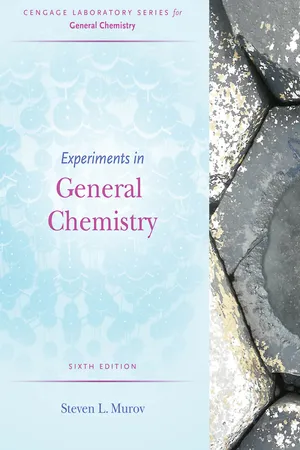
EXPERIMENTS IN GENERAL CHEMISTRY is the perfect textbook to prepared you for success in a chemistry class. This innovative book is not only full of exciting experiments but will help you understand the chemistry behind what is happening. With this guide in your pocket, acing any chemistry class will be a breeze!
- 468 pages
- English
- PDF
- Available on iOS & Android
eBook - PDF
Experiments in General Chemistry
About this book
Information

13
Name
Date
Lab
Section
Prelaboratory
Problems
-
Experiment
1
-
Early
Explorations
and
Terminology
The
solutions
to
the
starred
problems
are
in
Appendix
4
.
1.
What
color
is
water?
Problems
2
-
5
describe
some
observations
you
have
probably
made.
But
have
any
of
the
observations
stimulated
you
to
the
point
where
you
asked
a
question
about
them?
Try
to
come
up
with
a
question
now
and
suggest
an
explanation.
2.
Popcorn
pops
when
heated
sufficiently.
3.*
Vinegar
and
oil
do
not
mix.
4.
Your
laboratory
drawer
has
Erlenmeyer
flasks
and
beakers
that
hold
similar
volumes.
5.*
The
necks
of
volumetric
flasks
and
pipets
have
very
small
diameters.
Copyright
2014
Cengage
Learning.
All
Rights
Reserved.
May
not
be
copied,
scanned,
or
duplicated,
in
whole
or
in
part.
Due
to
electronic
rights,
some
third
party
content
may
be
suppressed
from
the
eBook
and/or
eChapter(s).
Editorial
review
has
deemed
that
any
suppressed
content
does
not
materially
affect
the
overall
learning
experience.
Cengage
Learning
reserves
the
right
to
remove
additional
content
at
any
time
if
subsequent
rights
restrictions
require
it.
Table of contents
- Cover
- IFC
- Title
- Statement
- Copyright
- Table of Contents
- Preface
- Textbook Correlation Table
- Chemistry Resources
- Experiments in General Chemistry Web Site:
- Safety First and Prudent Laboratory Practice
- Experiment 1: Early Explorations and Terminology
- Experiment 2: Separation of Mixtures
- Experiment 3: Measurements and Identification Techniques
- Experiment 4: Density, Accuracy, Precision and Graphing
- Experiment 5: Empirical Formulas
- Experiment 6: Classification of Chemical Reactions
- Experiment 7: Quantitative Precipitation
- Experiment 8: Electrical Conductivity and Electrolytes
- Experiment 9: Ionic Reactions
- Experiment 10: Activities of Metals
- Experiment 11: Quantitative Solution Chemistry
- Experiment 12: Thermochemistry
- Activity 13: Properties of Elements and Compounds: An Internet Study
- Experiment 14: Spectroscopy of Cobalt(II) Ion
- Activity 15: Lewis Structures and Molecular Models
- Experiment 16: Molecular Polarity and Chromatography
- Experiment 17: Gas Law Studies
- Experiment 18: Cooling Curves and Crystal Structures
- Experiment 19: Water Purification and Analysis
- Activity 20: Organic Models and Isomerism
- Experiment 21: Acids and Bases: Reactions and Standardization
- Experiment 22: Acids and Bases: Analysis
- Experiment 23: Acids and Bases: pH, pKa Measurements
- Experiment 24: Equilibrium - Solubility Product
- Experiment 25: Equilibrium - Determination of Keq
- Experiment 26: Complexes
- Experiment 27: Rates and Mechanisms of Reactions - Visual and/or Spectroscopic Monitoring
- Experiment 28: Synthesis of Copper(II) Glycinate
- Experiment 29: Standardization of Thiosulfate
- Experiment 30: Analysis of Bleach and Copper(II) Glycinate
- Experiment 31: Redox Reactions
- Experiment 32: Electrochemistry
- Experiment 33: Spectroscopic Analysis of Aspirin
- Experiment 34: Polymer Properties and Selection
- Activity 35: Additional Challenges and Experiments
- Activity 36: Graphing Quantitative Relationships
- Appendix 1: Properties of Substances
- Appendix 2: Common Ions by Charge
- Appendix 3: Solubilities of Ionic Compounds - Approximate # of Grams of Solute Per 100 Grams of Solution
- Appendix 4: Solutions to Starred Prelaboratory Problems
- IBC
Trusted by 375,005 students
Access to over 1.5 million titles for a fair monthly price.
Study more efficiently using our study tools.
Frequently asked questions
Yes, you can cancel anytime from the Subscription tab in your account settings on the Perlego website. Your subscription will stay active until the end of your current billing period. Learn how to cancel your subscription
No, books cannot be downloaded as external files, such as PDFs, for use outside of Perlego. However, you can download books within the Perlego app for offline reading on mobile or tablet. Learn how to download books offline
Perlego offers two plans: Essential and Complete
- Essential is ideal for learners and professionals who enjoy exploring a wide range of subjects. Access the Essential Library with 800,000+ trusted titles and best-sellers across business, personal growth, and the humanities. Includes unlimited reading time and Standard Read Aloud voice.
- Complete: Perfect for advanced learners and researchers needing full, unrestricted access. Unlock 1.5M+ books across hundreds of subjects, including academic and specialized titles. The Complete Plan also includes advanced features like Premium Read Aloud and Research Assistant.
We are an online textbook subscription service, where you can get access to an entire online library for less than the price of a single book per month. With over 1.5 million books across 990+ topics, we’ve got you covered! Learn about our mission
Look out for the read-aloud symbol on your next book to see if you can listen to it. The read-aloud tool reads text aloud for you, highlighting the text as it is being read. You can pause it, speed it up and slow it down. Learn more about Read Aloud
Yes! You can use the Perlego app on both iOS and Android devices to read anytime, anywhere — even offline. Perfect for commutes or when you’re on the go.
Please note we cannot support devices running on iOS 13 and Android 7 or earlier. Learn more about using the app
Please note we cannot support devices running on iOS 13 and Android 7 or earlier. Learn more about using the app
Yes, you can access Experiments in General Chemistry by Steven Murov in PDF and/or ePUB format, as well as other popular books in Physical Sciences & Chemistry. We have over 1.5 million books available in our catalogue for you to explore.