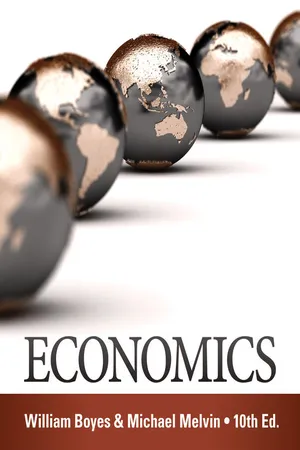
Gain a solid global understanding of basic economic principles and examine the latest thinking on important microeconomic and macroeconomic happenings with Boyes/Melvin's popular ECONOMICS, 10E. A reader-friendly writing style, carefully integrated learning features, and emphasis on global economics help you fully understand the connections between key economic principles and today's actual business practices. Timely updates and memorable examples ensure you are learning using the latest economic developments. Solid microeconomics materials emphasize the fundamentals and practical application of current events, while macroeconomics coverage highlights the financial crisis and its global implications. You also gain in-depth understanding of globalization -- one of today's most significant business issues –- and its impact on economic growth and poverty. Cutting-edge learning technology and a full range of supplements, including the world-leading Aplia homework system and MindTap, and an integrated eReader, help clarify key economic concepts and equip you with the economic background you need for success in business today.
eBook - PDF
Economics
About this book
Information
top:
Ó
Carsten
Reisinger/Shutterstock
CHAPTER
2
Scarcity
and
Opportunity
Costs
Preview
Why
are
some
countries
rich
and
others
poor?
The
primary
reason
is
that
some
countries
have
a
system
of
private
property
rights
and
economic
freedom
and
others
do
not.
But
private
property
rights
and
economic
freedom
do
not
mean
that
everyone
has
everything
they
want.
Everyone
wants
more
of
something
than
what
they
have,
even
the
wealthy.
This
brings
up
several
issues.
Who
decides
what
is
available?
Who
decides
who
gets
some
items
and
who
gets
left
out?
Is
it
possible
that
everyone
can
have
everything
they
want?
We
discuss
answers
to
these
questions
in
this
chapter.
FUNDAMENTAL
QUESTIONS
1.
What
are
opportunity
costs?
2.
What
is
a
production
possibilities
curve?
3.
What
are
the
gains
from
trade?
4.
How
do
we
determine
who
gets
what?
Ó
Tyler
Olson/Shutterstock.com
19
Copyright
2016
Cengage
Learning.
All
Rights
Reserved.
May
not
be
copied,
scanned,
or
duplicated,
in
whole
or
in
part.
Due
to
electronic
rights,
some
third
party
content
may
be
suppressed
from
the
eBook
and/or
eChapter(s).
Editorial
review
has
deemed
that
any
suppressed
content
does
not
materially
affect
the
overall
learning
experience.
Cengage
Learning
reserves
the
right
to
remove
additional
content
at
any
time
if
subsequent
rights
restrictions
require
it.
Table of contents
- Cover
- Title
- Statement
- Copyright
- Dedication
- Brief Contents
- Contents
- Suggested Outlines for One-Term Courses
- Preface
- Ch 1: The Wealth of Nations: Ownership and Ecnomic Freedom
- Ch 2: Scarity and Opportunity Costs
- Ch 3: The Market and Price System
- Ch 4: The Aggregate Economy
- Ch 5: National Income Accounting
- Ch 6: An Introduction to the Foreign Exchange Market and the Balance of Payments
- Ch 7: Unemployment and Inflation
- Ch 8: Macroeconomic Equilibrium: Aggregate Demand and Supply
- Ch 9: Aggregate Expenditures
- Ch 10: Income and Expenditures Equilibrium
- Ch 11: Fiscal Policy
- Ch 12: Money and Banking
- Ch 13: Monetary Policy
- Ch 14: Macroeconomic Policy: Tradeoffs, Expectations, Credibility, and Sources of Business Cycles
- Ch 15: Macroeconomic Viewpoints: New Keynesian, Monetarist, and New Classical
- Ch 16: Economic Growth
- Ch 17: Development Economics
- Ch 18: Globalization
- Ch 19: Using Economics to Understand the World Around You
- Ch 20: Elasticity: Demand and Supply
- Ch 21: Demand: Consumer Choice
- Ch 22: Supply: The Costs of Doing Business
- Ch 23: Profit Maximization
- Ch 24: Perfect Competition
- Ch 25: Monopoly
- Ch 26: Monopolistic Competition and Oligopoly
- Ch 27: Markets and Government
- Ch 28: Antitrust and Regulation
- Ch 29: Resource Markets
- Ch 30: The Labor Market
- Ch 31: Capital Markets
- Ch 32: The Land Market and Natural Resources
- Ch 33: Income, Income Distribution, and Poverty
- Ch 34: World Trade Equilibrium
- Ch 35: International Trade Restrictions
- Ch 36: Exchange Rates and Financial Links between Countries
- Glossary
- Index
Trusted by 375,005 students
Access to over 1.5 million titles for a fair monthly price.
Study more efficiently using our study tools.
Frequently asked questions
Yes, you can cancel anytime from the Subscription tab in your account settings on the Perlego website. Your subscription will stay active until the end of your current billing period. Learn how to cancel your subscription
No, books cannot be downloaded as external files, such as PDFs, for use outside of Perlego. However, you can download books within the Perlego app for offline reading on mobile or tablet. Learn how to download books offline
Perlego offers two plans: Essential and Complete
- Essential is ideal for learners and professionals who enjoy exploring a wide range of subjects. Access the Essential Library with 800,000+ trusted titles and best-sellers across business, personal growth, and the humanities. Includes unlimited reading time and Standard Read Aloud voice.
- Complete: Perfect for advanced learners and researchers needing full, unrestricted access. Unlock 1.5M+ books across hundreds of subjects, including academic and specialized titles. The Complete Plan also includes advanced features like Premium Read Aloud and Research Assistant.
We are an online textbook subscription service, where you can get access to an entire online library for less than the price of a single book per month. With over 1.5 million books across 990+ topics, we’ve got you covered! Learn about our mission
Look out for the read-aloud symbol on your next book to see if you can listen to it. The read-aloud tool reads text aloud for you, highlighting the text as it is being read. You can pause it, speed it up and slow it down. Learn more about Read Aloud
Yes! You can use the Perlego app on both iOS and Android devices to read anytime, anywhere — even offline. Perfect for commutes or when you’re on the go.
Please note we cannot support devices running on iOS 13 and Android 7 or earlier. Learn more about using the app
Please note we cannot support devices running on iOS 13 and Android 7 or earlier. Learn more about using the app
Yes, you can access Economics by William Boyes, Michael Melvin in PDF and/or ePUB format, as well as other popular books in Economics & Economic Theory. We have over 1.5 million books available in our catalogue for you to explore.