What drove U.S. Catholics in their arduous quest, full of twists and turns over more than a century, to win an American saint? The absence of American names in the canon of the saints had left many of the faithful feeling spiritually unmoored. But while canonization may be fundamentally about holiness, it is never only about holiness, reveals Kathleen Sprows Cummings in this panoramic, passionate chronicle of American sanctity. Catholics had another reason for petitioning the Vatican to acknowledge an American holy hero.
A home-grown saint would serve as a mediator between heaven and earth, yes, but also between Catholicism and American culture. Throughout much of U.S. history, the making of a saint was also about the ways in which the members of a minority religious group defined, defended, and celebrated their identities as Americans. Their fascinatingly diverse causes for canonization—from Kateri Tekakwitha and Elizabeth Ann Seton to many others that are failed, forgotten, or still under way—represented evolving national values as Catholics made themselves at home. Cummings’s vision of American sanctity shows just how much Catholics had at stake in cultivating devotion to men and women perched at the nexus of holiness and American history—until they finally felt little need to prove that they belonged.
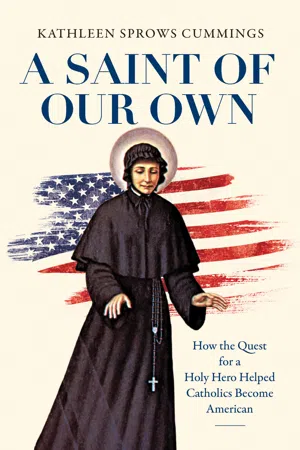
eBook - ePub
A Saint of Our Own
How the Quest for a Holy Hero Helped Catholics Become American
- 328 pages
- English
- ePUB (mobile friendly)
- Available on iOS & Android
eBook - ePub
A Saint of Our Own
How the Quest for a Holy Hero Helped Catholics Become American
About this book
Information
Topic
Theology & ReligionSubtopic
North American History1
NORTH AMERICAN SAINTS
“Where does America stand,” asked attorney Robert H. Clarke, in the “vast spiritual empire of the communion of saints?” The answer—that America was not represented at all among Catholic canonized saints—irritated Clarke. While U.S. Catholics could obviously share “the great saints of the universal church,” it was inconceivable to him that a nation long past its “nascent period of colonial life” had yet to produce a saint of its very own. What is a nation, Clarke wondered, “without patrons or shrines?” For American Catholics, he predicted, this would be one of the most important “questions of the hour.”1
Clarke’s questions were not uncommon in the 1880s and 1890s, as rapid changes at home and rising aspirations abroad prompted Americans to struggle to define their nation and assess where it stood in relation to the rest of the world. How, many wondered, did increases in urbanization, industrialization, and new sources of immigration affect what it meant to be American? How should the United States educate its children to prepare them for citizenship in a new century? How should the United States position itself in relation to global empires, and how should it assert itself on a world stage? These and other “questions of the hour” were very much on the minds of Archbishop James Gibbons and other leaders of the U.S. Catholic church when they gathered for the Third Plenary Council of Baltimore in 1884. Clarke’s musings on sanctity and American identity, in fact, had emerged in direct response to an initiative launched at the council, the largest gathering of American church leaders to date.
The Holy See had convoked the council to address a host of issues facing the church in the United States: increasing numbers of Catholic immigrants, conflict among ethnic groups, disputes between priests and bishops, Catholic workers’ gravitation toward labor unions, and Catholic children’s attendance at public schools.2 Underlying the Vatican’s concern regarding these specific issues was a broader skepticism on the part of its Congregation for the Propagation of the Faith about the very nature of Catholics’ participation in the unfolding American experiment. Could the church thrive, as Gibbons and others insisted, in a religiously pluralistic society, under a government that enshrined freedom of religion?
Like Clarke’s query about American saints, the Third Plenary Council itself represented an attempt by U.S. Catholics to claim for their nation the respect they believed it deserved from the universal church. Propaganda Fide, the Vatican body that directed the church’s affairs in its mission territories, had intended to use the Third Plenary Council to increase Roman supervision of the church in the United States. Accordingly, Pope Leo XIII had originally appointed an Italian bishop to preside over the council, but in response to objections from U.S. priests and bishops, he had relented and designated Gibbons as his presiding delegate. The Holy See’s confidence in Gibbons would only grow in the aftermath of the council. In 1886, he was elevated to the rank of cardinal and would serve as the de facto leader of the U.S. Catholic hierarchy until his death in 1921. The Vatican consulted him on all matters American, and the Holy See channeled all of its correspondence to the United States through him.3
It was thus Gibbons’s signature that appeared on a petition that council delegates addressed to Pope Leo XIII and sent on behalf of the entire U.S. hierarchy. This was the “first step ever taken by American bishops” to initiate a U.S. cause for canonization. The petition’s subject was the life and virtues of the woman it called “Katharine Tekakwitha,” a native convert to Catholicism who had been born in 1656 in what later became northern New York and died in a Mohawk village in New France twenty-four years later. The bishops praised Tekakwitha as “a splendid example of every virtue” who had left behind “a renown for sanctity which has been confirmed by wonderful events.”4
The petition summarized the central elements of a hagiography first established in the early eighteenth century. Two Jesuit missionaries had published biographies of Tekakwitha soon after her death, testifying to and increasing her reputation for holiness.5 They and subsequent hagiographers emphasized her conversion, refusal of marriage proposals, habits of fasting and self-flagellation, and public vow of virginity. The other well-known “wonderful events” cited in the petition included Tekakwitha’s deathbed transfiguration, in which smallpox scars had disappeared from her face, and miraculous healings that her devotees credited to her intercession.6 The council’s petition also named two other candidates for canonization: Isaac Jogues and René Goupil, two French Jesuit missionaries to New France who had been executed by indigenous people in the 1640s. Tekakwitha had been born very close to the site of Jogues and Goupil’s martyrdom, and hagiographers often attributed her conversion to the missionaries’ grisly sacrifice. Characterized as the “first fruit of their blood,” Tekakwitha represented a validation not simply of their deaths but of the Jesuit missions more generally.7
The novelty of the Baltimore petition rested in its purpose rather than its content. The petition was to Tekakwitha’s cause what Gibbons’s proposal to Elizabeth Ann Seton’s spiritual daughters had been for hers: the beginning of an attempt to elevate Tekakwitha from the unofficial sanctity long recognized by her devotees to a formal sanctity that would be acknowledged by the entire church. The U.S. bishops hoped the petition would eventually supply the U.S. church with a native patron. “Humbly beg[ging]” Pope Leo to initiate the causes for canonization of Goupil, Jogues, and Tekakwitha, the petition celebrated the spiritual benefits that would follow once the Holy See agreed to consider their cause, emphasizing that having models of holiness “drawn from their very midst” would “inspire the devotion of the faithful in this country” and “afford it native patrons.”8 Echoing this language, many of Tekakwitha’s devotees declared that the petition reflected the will of the people; the laity, not the hierarchy, had felt most acutely “the need of a special intercessor in Heaven” and “had risen up to call her blessed.”9
Most of the U.S. Catholics who beseeched the Vatican for a “native patron” were well aware that the church had already placed them under the spiritual protection of St. Rose of Lima, Peru, and the patronage of the Blessed Mother under the title Our Lady of the Immaculate Conception.10 At this point in their history, however, U.S. Catholics yearned for a saint whose feet had walked on the same soil and whose eyes had seen the same landscape. They wanted, in other words, a “special intercessor in Heaven” who could match the new moment in which they found themselves.
This new moment was readily apparent at the Third Plenary Council, where bishops approved a number of initiatives that would shape the U.S. church in the decades to come. One of the council’s best-known decrees related to Catholic education. Although Catholic schools had certainly existed before 1884, only at this council did U.S. bishops commit to building a parish school system that would rival its public counterpart in scale and quality.11 Similarly decisive was the council’s report on the pastoral care of Italian immigrants, which noted their rising numbers and the problems they presented for a U.S. church dominated by Irish American and German American priests and bishops.12
Debates within the council also foreshadowed an internal division within the U.S. hierarchy over how the church should respond to the social, cultural, and intellectual challenges of a rapidly changing world. While the battle lines between the dissenting camps were often blurred, two discernible mindsets emerged. On one side were bishops who, while recognizing the dangers that the modern world posed to the faith, believed that the Catholic Church could flourish in the American environment to an extent that would not be possible in European countries in which the democratic revolutions had caused the church to lose much of its power and relevance. These so-called liberal or Americanist bishops championed a rapid integration of Catholics into American culture, English-language worship, more decision-making power for U.S. bishops, and greater collaboration between Catholic and government-sponsored institutions. Those who came to be called “conservatives” adopted a less optimistic stance, focusing on the threats the modern world posed to the faith. They advocated a tightening of ecclesiastical discipline, careful maintenance of immigrants’ native language and worship styles, and more insular parishes and schools. Intertwined with these issues was a disagreement over how much control the Holy See should have over U.S. Catholic affairs, especially as the church’s organizational structure edged toward a reclassification from “mission territory” into a national church. In 1892, the Holy See’s creation of a new ecclesiastical office in the United States, an apostolic delegation, exacerbated tensions between liberals and conservatives as they competed for the support of the new papal representative to the U.S.—even as the appointment sent off warning bells among anti-Catholics who worried his arrival signaled papal encroachment onto American sovereignty.13
The “school question,” the “ethnic question,” the “Americanist question,” and the “Roman question” are subjects that have long engaged historians of U.S. Catholicism, and rightly so, as the debates over these collectively capture what it has meant to be both Catholic and American. Equally revelatory, this book argues, can be an exploration of the “saint question.” To understand which historical figures U.S. Catholics nominated as prospective patron saints—and their hopes for what these nominations would achieve—is to understand how they defined themselves as Catholics and as Americans at this aspirational moment in their history.
A Saint from Our Land, among Circumstances Familiar
News of the “first step ever” in initiating a U.S. cause for canonization delighted many U.S. Catholics. Attorney Robert H. Clarke, for example, welcomed the “bold” answer to the question “Where are our national saints and shrines?” Pleading their causes “in the court of Rome,” Clarke contended that the eventual canonization of Jogues, Goupil, and Tekakwitha would give North American Catholics the equivalent of Ireland’s Patrick or Bridget or of France’s Louis or Genevieve. “Yes, America has her saints,” he declared, “and now we ask that they, too, may receive the homage paid to the servants of God.”14
John Gilmary Shea, a prolific and prominent church historian, was equally elated, maintaining that the eventual beatification of Tekakwitha and the martyrs would satisfy U.S. Catholics’ deep longing for national patrons who had “lived and labored and sanctified themselves in our land, among circumstances familiar.”15 Though Shea had been urging church leaders to pursue the causes of Tekakwitha and the martyrs since the early 1850s, his request had acquired a much greater sense of immediacy by the 1880s. By then, like Gibbons and many other U.S. Catholics, Shea was growing increasingly dissatisfied that, although “personages noted for eminent sanctity have flourished in Canada and the United States from the time of the earliest settlement,” there had been “no active steps to secure the canonization of any of them.” Shea did not hold church leaders in either country responsible for this: “The condition of the [North American] Church of the last century,” he realized, “had taxed the resources of Catholics in both countries to the utmost,” and the exigencies of building a mission church had left American bishops with little energy or capital to devote to pursuing a cause.16 Instead, he blamed the lack of a North American saint on the length and rigor of the “modern” process of canonization. The more discriminating post-Reformation approach to saint-seeking left Catholics on the church’s periphery—far from its center of wealth and power—at a distinct disadvantage. “If it were as easy today to obtain the honor of the altars as it was a thousand years ago,” one priest lamented, “the calendars of all the dioceses of the United States would show many feasts of local saints, martyrs, confessors and virgins.”17 Recognizing the hurdle that a lack of financial resources constituted for pursuing a saint’s cause, Edward McSweeny, a U.S. Catholic priest, suggested that the Vatican appoint a special group of cardinals to glorify the “hidden saints” of countries “whose people are too poor to stand all the necessary expense.”18
Looking south only compounded U.S. Catholics’ frustration. Seventeen men and women from Central and South America had been successfully elevated to the ranks of sainthood since the institution of the modern process.19 “Without monarchs or wealthy communities to undertake the long and often expensive investigations demanded at Rome,” one American Catholic grumbled, it was no wonder that “no servant of God who lived or labored … in any part of our continent lying north of the Rio Grande” had ever even been proposed for canonization.20
This perception that the Rio Grande marked a great divide between acknowledged and unacknowledged exemplars of Catholic holiness fostered a spirit of cooperation between saint-seekers in Canada and the United States. This manifested itself most clearly in causes that obviously straddled the border between the two countries. Tekakwitha had been born in what became the United States and died in what was later Canada. Accordingly, members of the Canadian hierarchy also drafted a petition to the Holy See on Tekakwitha’s behalf at their own national meeting. The collaborative spirit between Canada and the United States was rooted not only in their shared position vis-à-vis the center of the church’s power but also in the conviction that effecting the canonization of a person from either the United States or Canada would be a “rare accomplishment” considering that neither country “belong[ed] to the Latin races.” In the eyes of many U.S. and Canadian Catholics, in other words, their joint quest for a national patron pitted a saint-deprived culture of North America against a saint-saturated one to the south.21 Though this argument admittedly underscores the distinctly European American cast to the quest for a U.S. saint—it is difficult to imagine, for example, that a Catholic living in San Francisco, San Antonio, or anywhere in the western and southwestern United States would have perceived saints to be absent from their landscape—the imbalance was nonetheless dramatic. When it came to saints who had walked on American soil, the Rio Grande did mark a sharp divide.
One canonized South American emerged as a particular flash point for U.S. saint-seekers’ discontent. In 1671, the church had canonized Rose of Lima, a Dominican mystic who had died in Peru in 1617. One of the first saints to pass through the modern canonization process, Rose was also the first successful cause to emerge from the “New” World. As such the Holy See proclaimed her “patron of all the Americas,” encouraging Catholics from “Cape Horn to Alaska” to embrace Rose as their particular advocate, to build churches and shrines in her honor, and to commemorate her feast day.22 Some late nineteenth-century U.S. Catholics did follow this advice and express fervent devotion to Rose. In one of the better-known examples, Rose Hawthorne Lathrop, daughter of author Nathaniel Hawthorne and literary figure in her own right, claimed a spiritual kinship with the Peruvian saint soon after her conversion to Catholicism in 1891 when she dedicated her newly founded community of Dominican sisters to Rose of Lima.23
The devotion of Lathrop and others notwithstanding, it had become increasingly evident by the late nineteenth century that many Catholics in the United States and Canada did not view Rose of Lima as an acceptable representative for their collective spiritual interests. One priest, convinced that most U.S. Catholics were not even aware of Rose’s patronage, urged church leader...
Table of contents
- Cover Page
- Title Page
- Copyright Page
- Dedication
- Contents
- Figures
- Introduction. American Saints Are Rare Birds
- 1. North American Saints
- 2. Nation Saints
- 3. Citizen Saint
- 4. Superpower Saints
- 5. Aggiornamento Saints
- 6. Papal Saints
- Epilogue. The Next American Saints
- Select Timeline of Events and Milestones in U.S. Causes for Canonization
- Acknowledgments
- Notes
- Bibliography
- Index
Trusted by 375,005 students
Access to over 1.5 million titles for a fair monthly price.
Study more efficiently using our study tools.
Frequently asked questions
Yes, you can cancel anytime from the Subscription tab in your account settings on the Perlego website. Your subscription will stay active until the end of your current billing period. Learn how to cancel your subscription
No, books cannot be downloaded as external files, such as PDFs, for use outside of Perlego. However, you can download books within the Perlego app for offline reading on mobile or tablet. Learn how to download books offline
Perlego offers two plans: Essential and Complete
- Essential is ideal for learners and professionals who enjoy exploring a wide range of subjects. Access the Essential Library with 800,000+ trusted titles and best-sellers across business, personal growth, and the humanities. Includes unlimited reading time and Standard Read Aloud voice.
- Complete: Perfect for advanced learners and researchers needing full, unrestricted access. Unlock 1.5M+ books across hundreds of subjects, including academic and specialized titles. The Complete Plan also includes advanced features like Premium Read Aloud and Research Assistant.
We are an online textbook subscription service, where you can get access to an entire online library for less than the price of a single book per month. With over 1.5 million books across 990+ topics, we’ve got you covered! Learn about our mission
Look out for the read-aloud symbol on your next book to see if you can listen to it. The read-aloud tool reads text aloud for you, highlighting the text as it is being read. You can pause it, speed it up and slow it down. Learn more about Read Aloud
Yes! You can use the Perlego app on both iOS and Android devices to read anytime, anywhere — even offline. Perfect for commutes or when you’re on the go.
Please note we cannot support devices running on iOS 13 and Android 7 or earlier. Learn more about using the app
Please note we cannot support devices running on iOS 13 and Android 7 or earlier. Learn more about using the app
Yes, you can access A Saint of Our Own by Kathleen Sprows Cummings in PDF and/or ePUB format, as well as other popular books in Theology & Religion & North American History. We have over 1.5 million books available in our catalogue for you to explore.