eBook - PDF
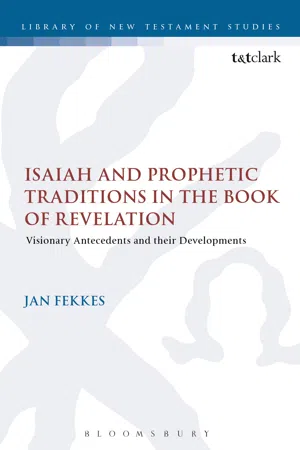
Isaiah and Prophetic Traditions in the Book of Revelation
Visionary Antecedents and their Development
- 338 pages
- English
- PDF
- Available on iOS & Android
eBook - PDF
Isaiah and Prophetic Traditions in the Book of Revelation
Visionary Antecedents and their Development
About this book
This work is concerned with the influence of biblical and prophetic traditions on the author of the book of Revelation, and in particular his use of the prophecies of Isaiah. First, John's own prophetic consciousness and expression is compared with previous Israelite-Jewish and early Christian prophetic conventions. This is followed by an evaluation of John's use of the OT in general, including a discussion of methodology for isolating allusions, the question of the validity of the terms quotation and allusion in Revelation, and the presence of thematic patterns in the author's choice of Scripture. All this is foundational to the main portion of the work (Ch. III), where a detailed analysis is undertaken to determine the validity of all proposed allusions to Isaiah in the book of Revelation. Of the 72 suggested allusions treated, 40 were judged as certain or virtually certain, 24 were considered as unlikely or doubtful, and 8 were appraised as probable or possible. Those allusions which were accepted received further evaluation to see how and why they were used by John, with special attention given to the tradition-history of the passage used, and the possible interpretative techniques employed. A variety of exegetical and literary devices were uncovered, including the use of catchwords, inclusio, repetition of texts, exploitation of Hebrew parallelism, and the collection of texts around a central theme. Furthermore, John's use of Isaiah is concentrated in basic areas, with clusters of Isaiah texts appearing in specific sections of Revelation. The principal Isaian themes with which he is interested are holy war and the Day of the Lord, oracles against the nations, and salvation prophecies relating to the community of faith and the restored and glorified Jerusalem. It was concluded that on the whole, John's use of Isaiah is not random, and he does not use the OT texts merely as a visionary resource for language, phrases, structural patterns etc. But he consciously carries on the prophecies of his biblical predecessors and invokes their authority. The remnants and results of John's interpretation of Isaiah presuppose exegetical activity and application prior to the vision experience and it is likely that at least some of his intended readers were familiar not only with his theological concerns, but also with his methodological approach.
Information
Table of contents
- Cover
- Editorial Board
- Title
- Copyright
- CONTENTS
- Acknowledgments
- Abbreviations
- Introduction
- Part I METHODOLOGICAL UNDERPINNINGS
- Part 2 JOHN AND THE PROPHET ISAIAH: ALLUSIONS AND APPLICATION
- Bibliography
- Index of References
- Index of Authors
Trusted by 375,005 students
Access to over 1.5 million titles for a fair monthly price.
Study more efficiently using our study tools.
Frequently asked questions
Yes, you can cancel anytime from the Subscription tab in your account settings on the Perlego website. Your subscription will stay active until the end of your current billing period. Learn how to cancel your subscription
No, books cannot be downloaded as external files, such as PDFs, for use outside of Perlego. However, you can download books within the Perlego app for offline reading on mobile or tablet. Learn how to download books offline
Perlego offers two plans: Essential and Complete
- Essential is ideal for learners and professionals who enjoy exploring a wide range of subjects. Access the Essential Library with 800,000+ trusted titles and best-sellers across business, personal growth, and the humanities. Includes unlimited reading time and Standard Read Aloud voice.
- Complete: Perfect for advanced learners and researchers needing full, unrestricted access. Unlock 1.5M+ books across hundreds of subjects, including academic and specialized titles. The Complete Plan also includes advanced features like Premium Read Aloud and Research Assistant.
We are an online textbook subscription service, where you can get access to an entire online library for less than the price of a single book per month. With over 1.5 million books across 990+ topics, we’ve got you covered! Learn about our mission
Look out for the read-aloud symbol on your next book to see if you can listen to it. The read-aloud tool reads text aloud for you, highlighting the text as it is being read. You can pause it, speed it up and slow it down. Learn more about Read Aloud
Yes! You can use the Perlego app on both iOS and Android devices to read anytime, anywhere — even offline. Perfect for commutes or when you’re on the go.
Please note we cannot support devices running on iOS 13 and Android 7 or earlier. Learn more about using the app
Please note we cannot support devices running on iOS 13 and Android 7 or earlier. Learn more about using the app
Yes, you can access Isaiah and Prophetic Traditions in the Book of Revelation by Jan Fekkes III in PDF and/or ePUB format, as well as other popular books in Theology & Religion & Biblical Studies. We have over 1.5 million books available in our catalogue for you to explore.