Scholarly interest in intertextuality remains as keen as ever. Armed with new questions, interpreters seek to improve their understanding of the function of older scripture in later scripture. The essays assembled in the present collection address these questions. These essays treat pre-Christian texts, as well as Christian texts, that make use of older sacred tradition. They analyze the respective uses of scripture in diverse Jewish and Christian traditions. Some of these studies are concerned with discreet bodies of writings, such as the Dead Sea Scrolls, while others are concerned with versions of scriptures, such as the Hebrew or Old Greek, and text critical issues. Other studies are concerned with how scripture is interpreted as part of apocalyptic and eschatology.
Early Christian Literature and Intertextuality includes essays that explore the use of Old Testament scripture in the Gospels and Acts. Other studies examine the Apostle Paul's interpretation of scripture in his letters, while other studies look at non-Pauline writings and their utilization of scripture. Some of the studies in this collection show how older scripture clarifies important points of teaching or resolves social conflict, law, conversion, anthropology, paradise, and Messianism are among the themes treated in these studies, themes rooted in important ways in older sacred tradition. The collection concludes with studies on two important Christian interpreters, Syriac-speaking Aphrahat in the east and Latin-speaking Augustine in the west.
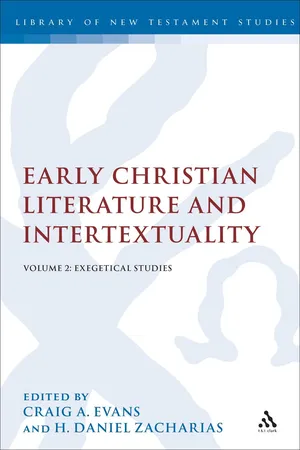
eBook - PDF
Early Christian Literature and Intertextuality
Volume 2: Exegetical Studies
- 264 pages
- English
- PDF
- Available on iOS & Android
eBook - PDF
Early Christian Literature and Intertextuality
Volume 2: Exegetical Studies
About this book
Information
Table of contents
- CONTENTS
- LIST OF ABBREVIATIONS
- LIST OF CONTRIBUTORS
- INTRODUCTION
- 1. A NEW VIEW ON THE RELATION BETWEEN SEPTUAGINT AND MASORETIC TEXT IN THE STORY OF DAVID AND GOLIATH
- 2. A CASE OF PSYCHOLOGICAL DUALISM: PHILO OF ALEXANDRIA AND THE INSTRUCTION ON THE TWO SPIRITS
- 3. JESUS’ JEWISH HERMENEUTICAL METHOD IN THE NAZARETH SYNAGOGUE
- 4. THE MAGNIFICAT AMONG THE BIBLICAL NARRATIVE-SET PSALMS
- 5. AN ECHO OF MERCY: A REREADING OF THE PARABLE OF THE GOOD SAMARITAN
- 6. PSALM 2 AND THE SON OF GOD IN THE FOURTH GOSPEL
- 7. JOEL 2.28-32A IN ACTS 2.17-21: THE DISCOURSE AND TEXT-CRITICAL IMPLICATIONS OF VARIATION FROM THE LXX
- 8. GENESIS 1–3 AND CONCEPTIONS OF HUMANKIND IN 4QINSTRUCTION, PHILO AND PAUL
- 9. WHY CAN’T ‘THE ONE WHO DOES THESE THINGS LIVE BY THEM’? THE USE OF LEVITICUS 18.5 IN GALATIANS 3.12
- 10. SURROGATE, SLAVE AND DEVIANT? THE FIGURE OF HAGAR IN JEWISH TRADITION AND PAUL (GALATIANS 4.21-31)
- 11. SUBVERTING SARAH IN THE NEW TESTAMENT: GALATIANS 4 AND 1 PETER 3
- 12. ‘I WILL GIVE AUTHORITY OVER THE NATIONS’: PSALM 2.8-9 IN REVELATION 2.26-27
- 13. EXEGESIS OF ISAIAH 11.2 IN APHRAHAT THE PERSIAN SAGE
- BIBLIOGRAPHY
- INDEX OF REFERENCES
- INDEX OF AUTHORS
Trusted by 375,005 students
Access to over 1.5 million titles for a fair monthly price.
Study more efficiently using our study tools.
Frequently asked questions
Yes, you can cancel anytime from the Subscription tab in your account settings on the Perlego website. Your subscription will stay active until the end of your current billing period. Learn how to cancel your subscription
No, books cannot be downloaded as external files, such as PDFs, for use outside of Perlego. However, you can download books within the Perlego app for offline reading on mobile or tablet. Learn how to download books offline
Perlego offers two plans: Essential and Complete
- Essential is ideal for learners and professionals who enjoy exploring a wide range of subjects. Access the Essential Library with 800,000+ trusted titles and best-sellers across business, personal growth, and the humanities. Includes unlimited reading time and Standard Read Aloud voice.
- Complete: Perfect for advanced learners and researchers needing full, unrestricted access. Unlock 1.5M+ books across hundreds of subjects, including academic and specialized titles. The Complete Plan also includes advanced features like Premium Read Aloud and Research Assistant.
We are an online textbook subscription service, where you can get access to an entire online library for less than the price of a single book per month. With over 1.5 million books across 990+ topics, we’ve got you covered! Learn about our mission
Look out for the read-aloud symbol on your next book to see if you can listen to it. The read-aloud tool reads text aloud for you, highlighting the text as it is being read. You can pause it, speed it up and slow it down. Learn more about Read Aloud
Yes! You can use the Perlego app on both iOS and Android devices to read anytime, anywhere — even offline. Perfect for commutes or when you’re on the go.
Please note we cannot support devices running on iOS 13 and Android 7 or earlier. Learn more about using the app
Please note we cannot support devices running on iOS 13 and Android 7 or earlier. Learn more about using the app
Yes, you can access Early Christian Literature and Intertextuality by Craig A. Evans, H. Daniel Zacharias, Craig A. Evans,H. Daniel Zacharias in PDF and/or ePUB format, as well as other popular books in Theology & Religion & Biblical Studies. We have over 1.5 million books available in our catalogue for you to explore.