- 273 pages
- English
- PDF
- Available on iOS & Android
eBook - PDF
About this book
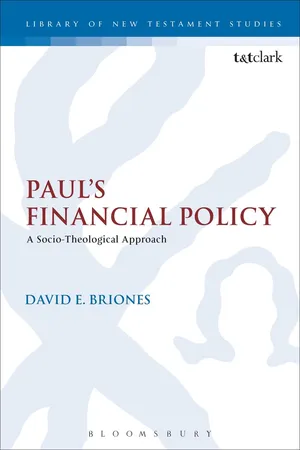
This book attempts to prove the consistent nature of Paul's financial policy by drawing from his social environment and theological convictions to tease out a three-way relational pattern with God as the source of all possessions. This three-way relational framework not only dictates Paul's decision to accept or reject finances from his churches but also directly challenges long-standing claims made about Paul's financial policy. After outlining the various approaches that scholars have taken to make sense of Paul's seemingly inconsistent financial policy, this book provides a close exegetical analysis of relevant passages in Philippians, 1 Corinthians, and 2 Corinthians in order to unearth a three-way relational pattern found in Philippians but that is absent from the Corinthian Correspondence. In Paul's positive gift-exchange relationship with the Philippians, God is acknowledged as the source of all possessions, whereas the Corinthians are criticized for striving after two-way exchanges that result in honor, power, and prestige.After this is demonstrated, a socio-theological reason for Paul's refusal of Corinthian gifts is propounded. Paul refused Corinthian support, not because they desired to patronise him as a dependent client, but because they sought to be under Paul as their superior, an act that neglected God as the superior source of all gifts in the divine economy. Paul therefore refuses their support to avoid two-way relationships of gift so prevalent in ancient society and to underscore the source of the gift of the gospel, the one from whom and through whom and to whom are all things - God.
Information
Table of contents
- CONTENTS
- Acknowledgments
- Abbreviations
- Chapter 1. APPROACHES TO PAUL’S FINANCIAL POLICY
- 1. Introduction
- 2. Reappraising Various Approaches
- 3. Offering a Combined Alternative – A Socio-Theological Approach
- 4. The Trajectory of this Study
- Chapter 2. CONTEXTUALISING PAUL
- 1. Introduction
- 2. Paul’s Socio-Economic Climate
- 3. Paul’s Ideological Climate: Patterns of Reciprocity in Seneca’s De Beneficiis
- 4. Conclusion
- Chapter 3. PAUL’S POSITIVE GIFT-GIVING RELATIONSHIP WITH THE PHILIPPIANS
- 1. Introduction
- 2. The History of Paul’s Relationship with the Philippians
- 3. The Nature of Paul’s Relationship with the Philippians
- 4. Exegetical Investigation of Philippians 1.7 and 1.12-30
- 5. Exegetical Investigation of Philippians 1.3-6, 2.25-30, and 4.10-20
- 6. Conclusion: Paul’s koinonia with the Philippians
- Chapter 4. PAUL’S NEGATIVE RELATIONSHIP WITH THE CORINTHIANS (PART I)
- 1. Introduction
- 2. The Social Ethos of Corinth
- 3. The Cultural Conformity of the Corinthians Post-Conversion
- 4. Paul’s Response to the Corinthians’ Culturally Conditioned Lifestyle
- 5. The Socio-Theological Strategy behind Paul’s Financial Policy
- 6. Conclusion
- Chapter 5. PAUL’S NEGATIVE RELATIONSHIP WITH THE CORINTHIANS (PART II)
- 1. Introduction
- 2. Reconstruction of Events between 1 and 2 Corinthians
- 3. The Corinthians’ Culturally Conditioned Lifestyle Maintained
- 4. The Gift-Giving Relationship (or Lack Thereof) between Paul and the Corinthians
- 5. Conclusion
- Chapter 6. CONCLUSION
- 1. Paul’s Financial Policy in Socio-Theological Perspective
- 2. The Achieved Goals of the Socio-Theological Approach to Paul’s Financial Policy
- 3. Implications for Further Study
- Bibliography
- Index of References
- Index of Authors
Trusted by 375,005 students
Access to over 1.5 million titles for a fair monthly price.
Study more efficiently using our study tools.
Frequently asked questions
Yes, you can cancel anytime from the Subscription tab in your account settings on the Perlego website. Your subscription will stay active until the end of your current billing period. Learn how to cancel your subscription
No, books cannot be downloaded as external files, such as PDFs, for use outside of Perlego. However, you can download books within the Perlego app for offline reading on mobile or tablet. Learn how to download books offline
Perlego offers two plans: Essential and Complete
- Essential is ideal for learners and professionals who enjoy exploring a wide range of subjects. Access the Essential Library with 800,000+ trusted titles and best-sellers across business, personal growth, and the humanities. Includes unlimited reading time and Standard Read Aloud voice.
- Complete: Perfect for advanced learners and researchers needing full, unrestricted access. Unlock 1.5M+ books across hundreds of subjects, including academic and specialized titles. The Complete Plan also includes advanced features like Premium Read Aloud and Research Assistant.
We are an online textbook subscription service, where you can get access to an entire online library for less than the price of a single book per month. With over 1.5 million books across 990+ topics, we’ve got you covered! Learn about our mission
Look out for the read-aloud symbol on your next book to see if you can listen to it. The read-aloud tool reads text aloud for you, highlighting the text as it is being read. You can pause it, speed it up and slow it down. Learn more about Read Aloud
Yes! You can use the Perlego app on both iOS and Android devices to read anytime, anywhere — even offline. Perfect for commutes or when you’re on the go.
Please note we cannot support devices running on iOS 13 and Android 7 or earlier. Learn more about using the app
Please note we cannot support devices running on iOS 13 and Android 7 or earlier. Learn more about using the app
Yes, you can access Paul's Financial Policy by David E. Briones in PDF and/or ePUB format, as well as other popular books in Theology & Religion & Biblical Biography. We have over 1.5 million books available in our catalogue for you to explore.