Focusing specifically on the issue of genre methodology in Acts, Bale' work will have clear ramifications for the study of biblical texts in general. The first part of the work surveys the state of genre theory in Acts scholarship and demonstrates its inadequacy for both classifying and interpreting Acts. Bale constructs a new genre model rooted in contemporary genre theory, tackling the problematic issue in Biblical scholarship of the relationship between history and fiction in literature. From this theoretical analysis Bale presents a new, pragmatic model for genre which is non-exclusive and heavily intertextual.
In part two Bale utilises the model in three original readings which draw heavily upon parallels from ancient literature. The first reading shows how a specific device at the beginning of Acts dictates interpretation. The second looks at the problem of Paul's status as apostle in Acts from a narrative rather than a propositional perspective. The final reading explores several passages in Acts which may instructively be read as incorporating themes and techniques from ancient comedy and related genres.
- 260 pages
- English
- PDF
- Available on iOS & Android
eBook - PDF
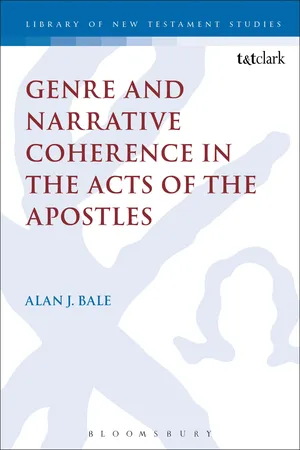
Genre and Narrative Coherence in the Acts of the Apostles
About this book
Information
Table of contents
- CONTENTS
- Acknowlegments
- Abbreviations
- Preface
- INTRODUCTION
- I. Orientation
- II. Outline of the Study
- III. Historicity, Fiction and the Genre of Acts
- IV. The Problem of Classification
- V. The Rational of Classifying
- Part I -- METHODOLOGY
- Chapter 1 -- PRELIMINARIES
- I. My Location in the Debate
- II. Unity with Luke’s Gospel
- III. Preface
- IV. ‘We’ Passages
- V. Dating
- VI. Sources
- VII. Textual Problems
- VIII. Terminology
- Chapter 2 -- A SURVEY OF GENRE PROPOSALS
- I. Introduction
- II. A Look at Some Proposals
- III. Pick a Box, Any Box: The Options So Far
- Chapter 3 -- THE THEORY OF GENRE
- I. Introduction
- II. Genre, Classification, Hybridity
- III. Genre, Conventions, Expectations
- IV. Generic Hybridisation in Interpretation
- V. Conclusion: Genre and Narrative Coherence
- Chapter 4 -- HISTORY AND FICTION
- I. Introduction
- II. Fiction and Cognition
- III. The Conventions of Reading
- IV. Conclusion to Part I: The Creation of a Cognitive Environment for Acts
- Part II -- THE STUDIES
- INTRODUCTION TO PART II: CONFIGURING THE NARRATIVE OF ACTS
- I. Introduction
- II. Intertext and Convention: From Beginning to End
- III. Acts 1.1-11: Dropped into a Dream
- Chapter 5 -- THE AMBIGUOUS ORACLE IN ACTS 1.6
- I. The Oracle and the Plot
- II. Paul’s Role
- III. Support from Oracular Literature
- IV. Conclusion
- Chapter 6 -- THE CONFIGURATION OF PAUL’S APOSTOLIC STATUS
- I. Introduction
- II. Paul as Apostle in Scholarship
- III. Paul’s Parallels
- IV. The Compound Argument: The Example of Socrates
- V. Apostolic Status
- VI. Refraction of Intentionality and Configurative Value
- VII. Luke’s Narrative Argument: A Summary
- VIII. Parallels in Ancient Literature
- IX. Conclusion
- Chapter 7 -- COMEDY AND CHARACTERISATION IN ACTS
- I. Introduction: The Bible and Comedy
- II. Humorous Episodes in Acts
- III. The Problem of the Miletus Speech: Acts 20.17-38
- IV. An Analysis of the Speech
- V. Some Parallels
- VI. Conclusion
- Chapter 8 -- SUMMARY AND CONCLUSIONS
- I. Summary
- II. Conclusions
- III. Potential Avenues of Future Research
- Bibliography
- Index of References
- Index of Authors
Trusted by 375,005 students
Access to over 1.5 million titles for a fair monthly price.
Study more efficiently using our study tools.
Frequently asked questions
Yes, you can cancel anytime from the Subscription tab in your account settings on the Perlego website. Your subscription will stay active until the end of your current billing period. Learn how to cancel your subscription
No, books cannot be downloaded as external files, such as PDFs, for use outside of Perlego. However, you can download books within the Perlego app for offline reading on mobile or tablet. Learn how to download books offline
Perlego offers two plans: Essential and Complete
- Essential is ideal for learners and professionals who enjoy exploring a wide range of subjects. Access the Essential Library with 800,000+ trusted titles and best-sellers across business, personal growth, and the humanities. Includes unlimited reading time and Standard Read Aloud voice.
- Complete: Perfect for advanced learners and researchers needing full, unrestricted access. Unlock 1.5M+ books across hundreds of subjects, including academic and specialized titles. The Complete Plan also includes advanced features like Premium Read Aloud and Research Assistant.
We are an online textbook subscription service, where you can get access to an entire online library for less than the price of a single book per month. With over 1.5 million books across 990+ topics, we’ve got you covered! Learn about our mission
Look out for the read-aloud symbol on your next book to see if you can listen to it. The read-aloud tool reads text aloud for you, highlighting the text as it is being read. You can pause it, speed it up and slow it down. Learn more about Read Aloud
Yes! You can use the Perlego app on both iOS and Android devices to read anytime, anywhere — even offline. Perfect for commutes or when you’re on the go.
Please note we cannot support devices running on iOS 13 and Android 7 or earlier. Learn more about using the app
Please note we cannot support devices running on iOS 13 and Android 7 or earlier. Learn more about using the app
Yes, you can access Genre and Narrative Coherence in the Acts of the Apostles by Alan Bale in PDF and/or ePUB format, as well as other popular books in Theology & Religion & Biblical Criticism & Interpretation. We have over 1.5 million books available in our catalogue for you to explore.