In this book Jaco Gericke is concerned with different ways of approaching the question of what, according to the Hebrew Bible, a god was assumed to be. As a supplement to the tradition of predominantly linguistic, historical, literary, comparative, social-scientific and related ways of looking at the research problem, Gericke offers a variety of experimental philosophical perspectives that aim to take a step back from the scholarly discussion as it has unfolded hitherto in order to provide a new type of worry when looking at the riddle of what the biblical texts assumed made a god divine.
Consisting of a brief history of philosophical interpretations of the concepts of whatness and essence from Socrates to Derrida, the relevant ideas are adapted and reapplied to look at some interesting metaphysical oddities arising from generic uses of elohim/el/eloah as common noun in the Hebrew Bible. As such the study seeks to be a prolegomenon to all future research in that, instead of answering the question regarding a supposed nature of divinity, it aims to complicate it beyond expectation. In this way a case is made for a more nuanced and indeterminate manner of constructing the problem of what it meant to call something a god.
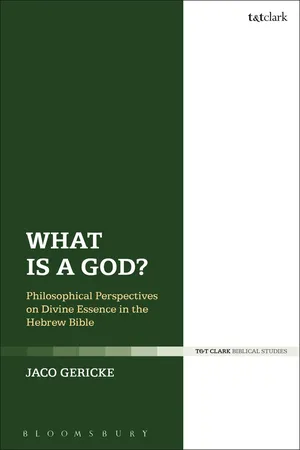
eBook - PDF
What is a God?
Philosophical Perspectives on Divine Essence in the Hebrew Bible
- 190 pages
- English
- PDF
- Available on iOS & Android
eBook - PDF
About this book
Information
Table of contents
- Cover
- Title
- Copyright
- Dedication
- Contents
- Foreword
- Acknowledgements
- Abbreviations
- 1. Introduction: What Is an םיהלא
- 2. Whatness and a Socratic Definition of םיהלא - ness via Common Properties
- 3. Whatness and a Platonist Perspective on םיהלא - ness as Form/ Universal
- 4. Whatness and Aristotelian Essentialism about an םיהלא as Secondary Substance
- 5. Whatness and a Porphyrian Tree of םיהלא as Species/ Genus
- 6. Whatness and a Boethian Distinction between Essence/ Existence in an םיהלא
- 7. Whatness and an Avicennian View on the Quiddity of an םיהלא
- 8. Whatness and Abelardian Nominalism about the Status of an םיהלא
- 9. Whatness and a Thomistic Perspective on the Complexity of an םיהלא
- 10. Whatness and a Scotian Interpretation of an םיהלא’s Haecceity
- 11. Whatness and a Cartesian Notion of an םיהלא’s Principal Attribute
- 12. Whatness and Lockean Anti- essentialism about םיהלא as Sortal
- 13. Whatness and Leibnizian Superessentialism about Necessity in an םיהלא
- 14. Whatness and a Kantian Concept of an םיהלא as Thing- in- Itself
- 15. Whatness and a Hegelian View of the Essence of an םיהלא in Appearances
- 16. Whatness and a Nietzschean Interpretation of an םיהלא as Will to Power
- 17. Whatness and Wittgensteinian Family Resemblances among the םיהלא
- 18. Whatness and a Husserlian Reduction of an םיהלא’s Essence as Intentional Object
- 19. Whatness and a Heideggerian View of What Is Ownmost in an םיהלא’s Identity over Time
- 20. Whatness and a Sartrean Idea of Existence Preceding Essence in an םיהלא
- 21. Whatness and a Quinean Denial of Necessary and Sufficient Conditions for Being an םיהלא
- 22. Whatness and the Popperian Essentialist Fallacy in Defining an םיהלא
- 23. Whatness and Kripkean Modal Neo- Essentialism about םיהלא as Rigid Designator
- 24. Whatness and Derridean Differential Ontology for an םיהלא beyond Anti- essentialism
- 25. Summary and Conclusions
- Bibliography
- Index of Biblical References
- Index of Philosophical Sources
- Index of Subjects
- Index of Authors
Trusted by 375,005 students
Access to over 1.5 million titles for a fair monthly price.
Study more efficiently using our study tools.
Frequently asked questions
Yes, you can cancel anytime from the Subscription tab in your account settings on the Perlego website. Your subscription will stay active until the end of your current billing period. Learn how to cancel your subscription
No, books cannot be downloaded as external files, such as PDFs, for use outside of Perlego. However, you can download books within the Perlego app for offline reading on mobile or tablet. Learn how to download books offline
Perlego offers two plans: Essential and Complete
- Essential is ideal for learners and professionals who enjoy exploring a wide range of subjects. Access the Essential Library with 800,000+ trusted titles and best-sellers across business, personal growth, and the humanities. Includes unlimited reading time and Standard Read Aloud voice.
- Complete: Perfect for advanced learners and researchers needing full, unrestricted access. Unlock 1.5M+ books across hundreds of subjects, including academic and specialized titles. The Complete Plan also includes advanced features like Premium Read Aloud and Research Assistant.
We are an online textbook subscription service, where you can get access to an entire online library for less than the price of a single book per month. With over 1.5 million books across 990+ topics, we’ve got you covered! Learn about our mission
Look out for the read-aloud symbol on your next book to see if you can listen to it. The read-aloud tool reads text aloud for you, highlighting the text as it is being read. You can pause it, speed it up and slow it down. Learn more about Read Aloud
Yes! You can use the Perlego app on both iOS and Android devices to read anytime, anywhere — even offline. Perfect for commutes or when you’re on the go.
Please note we cannot support devices running on iOS 13 and Android 7 or earlier. Learn more about using the app
Please note we cannot support devices running on iOS 13 and Android 7 or earlier. Learn more about using the app
Yes, you can access What is a God? by Jaco Gericke in PDF and/or ePUB format, as well as other popular books in Theology & Religion & Biblical Criticism & Interpretation. We have over 1.5 million books available in our catalogue for you to explore.