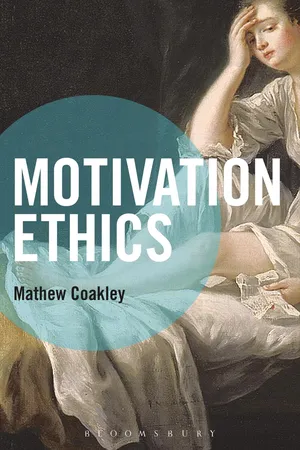
This is a book about a particular moral theory – motivation ethics – and why we should accept it. But it is also a book about moral theorizing, about how we might compare different structures of moral theory.
In principle we might morally evaluate a range of objects: we might, for example, evaluate what people do – is some action right, wrong, permitted, forbidden, a duty or beyond what is required? Or we might evaluate agents: what is it to be morally heroic, or morally depraved, or highly moral? And, we could evaluate institutions: which ones are just, or morally better, or legitimate?
Most theories focus on one (or two) of these and offer arguments against rivals. What this book does is to step back and ask a different question: of the theories that evaluate one object, are they compatible with an acceptable account of the evaluation of the other objects?
So, for instance, if a moral theory tells us which actions are right and wrong, well can it then be compatible with a theory of what it is to be a morally good or bad or heroic or depraved agent (or deny the need for this)? It seems that this would be an easy task, but the book sets out how this is very difficult for some of our most prominent theories, why this is so, and why a theory based on motivations might be the right answer.
eBook - PDF
Motivation Ethics
About this book
Information
Table of contents
- FC
- Half title
- Also Available from Bloomsbury
- Title
- Copyright
- Contents
- Acknowledgements
- Introduction and overview
- 1 Consequentialism and the moral agent question
- 2 Motivation ethics
- 3 Deontology and the moral agent question
- 4 Moral demandingness and two concepts of evaluation
- 5 The problem of special relationships
- 6 Global duties and the state
- 7 Political legitimacy and the good
- 8 Interpersonal comparisons of the good
- 9 Conclusions
- Epilogue: On the scope of reason
- Notes
- Bibliography
- Index
Trusted by 375,005 students
Access to over 1.5 million titles for a fair monthly price.
Study more efficiently using our study tools.
Frequently asked questions
Yes, you can cancel anytime from the Subscription tab in your account settings on the Perlego website. Your subscription will stay active until the end of your current billing period. Learn how to cancel your subscription
No, books cannot be downloaded as external files, such as PDFs, for use outside of Perlego. However, you can download books within the Perlego app for offline reading on mobile or tablet. Learn how to download books offline
Perlego offers two plans: Essential and Complete
- Essential is ideal for learners and professionals who enjoy exploring a wide range of subjects. Access the Essential Library with 800,000+ trusted titles and best-sellers across business, personal growth, and the humanities. Includes unlimited reading time and Standard Read Aloud voice.
- Complete: Perfect for advanced learners and researchers needing full, unrestricted access. Unlock 1.5M+ books across hundreds of subjects, including academic and specialized titles. The Complete Plan also includes advanced features like Premium Read Aloud and Research Assistant.
We are an online textbook subscription service, where you can get access to an entire online library for less than the price of a single book per month. With over 1.5 million books across 990+ topics, we’ve got you covered! Learn about our mission
Look out for the read-aloud symbol on your next book to see if you can listen to it. The read-aloud tool reads text aloud for you, highlighting the text as it is being read. You can pause it, speed it up and slow it down. Learn more about Read Aloud
Yes! You can use the Perlego app on both iOS and Android devices to read anytime, anywhere — even offline. Perfect for commutes or when you’re on the go.
Please note we cannot support devices running on iOS 13 and Android 7 or earlier. Learn more about using the app
Please note we cannot support devices running on iOS 13 and Android 7 or earlier. Learn more about using the app
Yes, you can access Motivation Ethics by Mathew Coakley in PDF and/or ePUB format, as well as other popular books in Philosophy & Ethics & Moral Philosophy. We have over 1.5 million books available in our catalogue for you to explore.