When Galileo dropped cannon-balls from the top of the Leaning Tower of Pisa, he did more than overturn centuries of scientific orthodoxy. At a stroke, he established a new conception of the scientific method based upon careful experimentation and rigorous observation - and also laid the groundwork for an ongoing conflict between the critical open-mindedness of science and the recalcitrant dogmatism of religion that would continue to the modern day.
The problem is that Galileo never performed his most celebrated experiment in Pisa. In fact, he rarely conducted any experiments at all. The Church publicly celebrated his work, and Galileo enjoyed patronage from the great and the powerful; his ecclesiastical difficulties only began when disgruntled colleagues launched a campaign to discredit their academic rival. But what does this tell us about modern science if its own foundation myth turns out to be nothing more than political propaganda?
Getting Science Wrong discusses some of the most popular misconceptions about science, and their continuing role in the public imagination. Drawing upon the history and philosophy of science it challenges wide-spread assumptions and misunderstandings, from creationism and climate change to the use of statistics and computer modelling. The result is an engaging introduction to contentious issues in the philosophy of science and a new way of looking at the role of science in society.
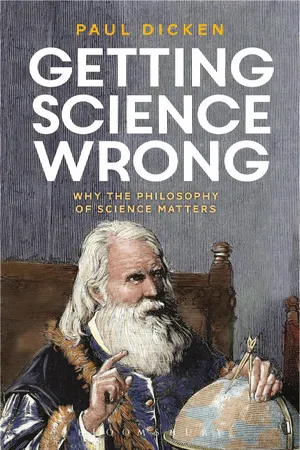
- 219 pages
- English
- PDF
- Available on iOS & Android
eBook - PDF
About this book
Information
Table of contents
- FC
- Half title
- Also Available from Bloomsbury
- Title
- Copyright
- Contents
- List of figures
- Introduction
- 1 Learning from our mistakes
- 2 A matter of trial and error
- 3 Images of science
- 4 88.6 percent of all statistics are made up
- 5 Living in different worlds
- 6 The bankruptcy of science
- 7 Deus ex machina
- Epilogue
- Dramatis personae
- Notes
- Bibliography
- Index
Trusted by 375,005 students
Access to over 1.5 million titles for a fair monthly price.
Study more efficiently using our study tools.
Frequently asked questions
Yes, you can cancel anytime from the Subscription tab in your account settings on the Perlego website. Your subscription will stay active until the end of your current billing period. Learn how to cancel your subscription
No, books cannot be downloaded as external files, such as PDFs, for use outside of Perlego. However, you can download books within the Perlego app for offline reading on mobile or tablet. Learn how to download books offline
Perlego offers two plans: Essential and Complete
- Essential is ideal for learners and professionals who enjoy exploring a wide range of subjects. Access the Essential Library with 800,000+ trusted titles and best-sellers across business, personal growth, and the humanities. Includes unlimited reading time and Standard Read Aloud voice.
- Complete: Perfect for advanced learners and researchers needing full, unrestricted access. Unlock 1.5M+ books across hundreds of subjects, including academic and specialized titles. The Complete Plan also includes advanced features like Premium Read Aloud and Research Assistant.
We are an online textbook subscription service, where you can get access to an entire online library for less than the price of a single book per month. With over 1.5 million books across 990+ topics, we’ve got you covered! Learn about our mission
Look out for the read-aloud symbol on your next book to see if you can listen to it. The read-aloud tool reads text aloud for you, highlighting the text as it is being read. You can pause it, speed it up and slow it down. Learn more about Read Aloud
Yes! You can use the Perlego app on both iOS and Android devices to read anytime, anywhere — even offline. Perfect for commutes or when you’re on the go.
Please note we cannot support devices running on iOS 13 and Android 7 or earlier. Learn more about using the app
Please note we cannot support devices running on iOS 13 and Android 7 or earlier. Learn more about using the app
Yes, you can access Getting Science Wrong by Paul Dicken in PDF and/or ePUB format, as well as other popular books in Philosophy & Philosophy History & Theory. We have over 1.5 million books available in our catalogue for you to explore.