The significance of the Zoroastrian religion in the development of the history of thought is often only mentioned in passing, or is completely overlooked. Zoroastrianism has developed over a span of at least three thousand years, with roots in a common Indo-Iranian culture and mythology, then becoming part of imperial Iranian ideology within an Ancient Near Eastern setting, and emerging in variant forms in western and central Asia in late antiquity. The religion continues as a living faith for an estimated 130 - 150,000 adherents in the world.
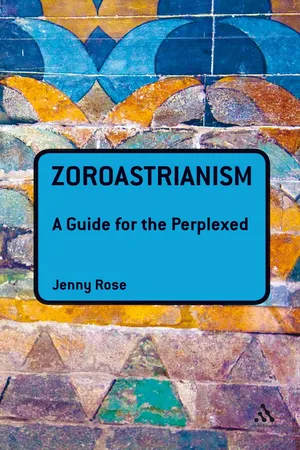
Most Zoroastrians if asked, 'In a nutshell, what do Zoroastrians believe?' would begin their answer with the moral maxim: 'Good Thoughts, Good Words, Good Deeds.' Zoroastrianism: A Guide for the Perplexed takes this foundational trifold ethic as the framework for its three main chapters. The book presents a comprehensive study of the religion through its focus on the questions that perplexed seekers might ask of a Zoroastrian concerning ideology and ethics; current discussions of 'text' and 'author'; and the putting-into-practice of the religion.
- 225 pages
- English
- PDF
- Available on iOS & Android
eBook - PDF
Zoroastrianism: A Guide for the Perplexed
About this book
Information
Table of contents
- Cover
- Half-title
- Title
- Copyright
- Dedication
- CONTENTS
- ACKNOWLEDGMENTS
- ABBREVIATIONS
- THE QUESTIONS
- INTRODUCTION
- CHAPTER 1 THOUGHTS, OR WHAT ZOROASTRIANS BELIEVE
- CHAPTER 2 WORDS, OR WHAT ZOROASTRIANS SAY AND WHO HAS THE VOICE
- CHAPTER 3 DEEDS, OR HOW ZOROASTRIANS PUT RELIGION INTO ACTION
- EPILOGUE: ENDLESS LIGHTS AND LIMITLESS TIME
- GLOSSARY OF TERMS AND NAMES
- A HISTORICAL TIMELINE
- NOTES
- BIBLIOGRAPHY
- INDEX
Trusted by 375,005 students
Access to over 1.5 million titles for a fair monthly price.
Study more efficiently using our study tools.
Frequently asked questions
Yes, you can cancel anytime from the Subscription tab in your account settings on the Perlego website. Your subscription will stay active until the end of your current billing period. Learn how to cancel your subscription
No, books cannot be downloaded as external files, such as PDFs, for use outside of Perlego. However, you can download books within the Perlego app for offline reading on mobile or tablet. Learn how to download books offline
Perlego offers two plans: Essential and Complete
- Essential is ideal for learners and professionals who enjoy exploring a wide range of subjects. Access the Essential Library with 800,000+ trusted titles and best-sellers across business, personal growth, and the humanities. Includes unlimited reading time and Standard Read Aloud voice.
- Complete: Perfect for advanced learners and researchers needing full, unrestricted access. Unlock 1.5M+ books across hundreds of subjects, including academic and specialized titles. The Complete Plan also includes advanced features like Premium Read Aloud and Research Assistant.
We are an online textbook subscription service, where you can get access to an entire online library for less than the price of a single book per month. With over 1.5 million books across 990+ topics, we’ve got you covered! Learn about our mission
Look out for the read-aloud symbol on your next book to see if you can listen to it. The read-aloud tool reads text aloud for you, highlighting the text as it is being read. You can pause it, speed it up and slow it down. Learn more about Read Aloud
Yes! You can use the Perlego app on both iOS and Android devices to read anytime, anywhere — even offline. Perfect for commutes or when you’re on the go.
Please note we cannot support devices running on iOS 13 and Android 7 or earlier. Learn more about using the app
Please note we cannot support devices running on iOS 13 and Android 7 or earlier. Learn more about using the app
Yes, you can access Zoroastrianism: A Guide for the Perplexed by Jenny Rose in PDF and/or ePUB format, as well as other popular books in Theology & Religion & History of Religion. We have over 1.5 million books available in our catalogue for you to explore.