In this exciting new work, Miriam Bankovsky shows how the pursuit of justice requires two orientations. The first is a practical commitment to the possibility of justice, which is the clear starting point for the broadly constructive theories of Rawls, Habermas and Honneth. Indeed, if justice were not possible, it would be difficult to see why it is worthwhile for human beings to live on this earth. However, a second orientation qualifies the first. It can be expressed as a deconstructive attentiveness to the impossibility of determining justice's content. This impossibility results from the tension between the appeal for individual consideration and the appeal for impartiality, demands that Derrida believes our historical concept of justice includes.
Framed by these two orientations, this ambitious book explores the promise and shortcomings of the constructive theories. Attentive to concrete experiences of injustice that these thinkers tend to overlook, Bankovsky provocatively challenges Rawls' account of civil disobedience, Habermas' defence of rational consensus, and Honneth's ideal of mutual recognition, providing new insights into deconstruction's relevance for contemporary theories of justice.
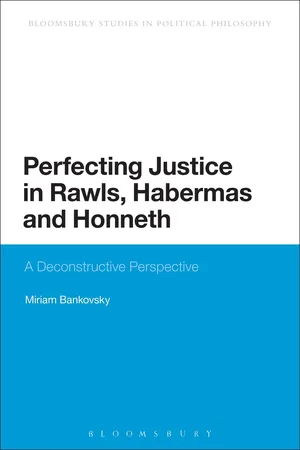
eBook - PDF
Perfecting Justice in Rawls, Habermas and Honneth
A Deconstructive Perspective
- 257 pages
- English
- PDF
- Available on iOS & Android
eBook - PDF
About this book
Information
Table of contents
- Title Page
- Copyright Page
- Contents
- Acknowledgements
- Chapter 1 Perfecting Justice: An Art of the Im/Possible
- Part One Justice as Fairness: A Project to Pursue
- Chapter 2 Rawls and the Possibility of ‘Ideal Theory’
- Chapter 3 Rawls and the ‘Undecidability’ of the Original Position Procedure
- Part Two Rational Consensus: Open to Contestation in Principle
- Chapter 4 Habermas and the Possibility of Popular Sovereignty
- Chapter 5 Habermas and the Perfectibility of Deliberative Outcomes
- Part Three Perfecting Recognition Relations
- Chapter 6 Honneth and the Possibility of Mutual Recognition
- Chapter 7 Honneth and Moral Progress in the Quality of Recognition Relations
- Chapter 8 Im/Possibility and the Cultivation of Deconstructive Civic Attitudes
- Notes
- Reference
- Index
Trusted by 375,005 students
Access to over 1.5 million titles for a fair monthly price.
Study more efficiently using our study tools.
Frequently asked questions
Yes, you can cancel anytime from the Subscription tab in your account settings on the Perlego website. Your subscription will stay active until the end of your current billing period. Learn how to cancel your subscription
No, books cannot be downloaded as external files, such as PDFs, for use outside of Perlego. However, you can download books within the Perlego app for offline reading on mobile or tablet. Learn how to download books offline
We are an online textbook subscription service, where you can get access to an entire online library for less than the price of a single book per month. With over 1.5 million books across 990+ topics, we’ve got you covered! Learn about our mission
Look out for the read-aloud symbol on your next book to see if you can listen to it. The read-aloud tool reads text aloud for you, highlighting the text as it is being read. You can pause it, speed it up and slow it down. Learn more about Read Aloud
Yes! You can use the Perlego app on both iOS and Android devices to read anytime, anywhere — even offline. Perfect for commutes or when you’re on the go.
Please note we cannot support devices running on iOS 13 and Android 7 or earlier. Learn more about using the app
Please note we cannot support devices running on iOS 13 and Android 7 or earlier. Learn more about using the app
Yes, you can access Perfecting Justice in Rawls, Habermas and Honneth by Miriam Bankovsky in PDF and/or ePUB format, as well as other popular books in Philosophy & Deconstruction in Philosophy. We have over 1.5 million books available in our catalogue for you to explore.