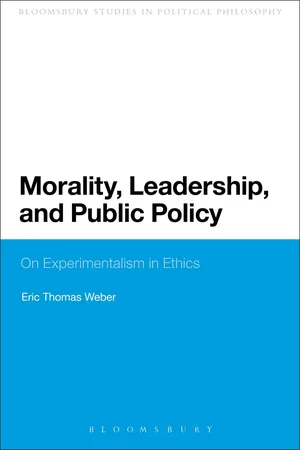
In Morality, Leadership, and Public Policy, Eric Weber argues for an experimentalist approach to moral theory in addressing practical problems in public policy. The experimentalist approach begins moral inquiry by examining public problems and then makes use of the tools of philosophy and intelligent inquiry to alleviate them.
Part I surveys the uses of practical philosophy and answers criticisms - including religious challenges - of the approach, presenting a number of areas in which philosophers' intellectual efforts can prove valuable for resolving public conflicts.
Part II presents a new approach to experimentalism in moral theory, based on the insights of John Dewey's pragmatism. Focusing on the elements of good public inquiry and the experimentalist attitude, Weber discusses ways of thinking about the effective construction and reconstruction of particular problems, including practical problems of public policy prioritization.
Finally, in Part III the book examines real-world examples in which the experimentalist approach to ethics proves useful, including instances of "bandwidth theft" and the controversies surrounding activist judges in the US Supreme Court.
- 209 pages
- English
- PDF
- Available on iOS & Android
eBook - PDF
About this book
Information
Table of contents
- Cover
- Half-title
- Title
- Copyright
- Contents
- Acknowledgments
- Chapter 1 Introduction
- Part One Philosophy and Religion in Public Policy
- Chapter 2 On Applying Ethics: Who’s Afraid of Plato’s Cave?
- Chapter 3 Religion, Public Reason, and Humanism: Paul Kurtz on Fallibilism and Ethics
- Part Two Experimentalism, Problem Construction, and Priorities
- Chapter 4 What Experimentalism Means in Ethics
- Chapter 5 Construction, Art, and Politics: On Creative Leadership
- Chapter 6 Philosophy and Public Policy Prioritization
- Part Three New Technologies and Experiments in Judging
- Chapter 7 “Stop him! He stole my internet connection!”: On the Historical Origins of Moral Concepts
- Chapter 8 Activist or Active Judges
- Chapter 9 Conclusion
- Notes
- Bibliography
- Index
Trusted by 375,005 students
Access to over 1.5 million titles for a fair monthly price.
Study more efficiently using our study tools.
Frequently asked questions
Yes, you can cancel anytime from the Subscription tab in your account settings on the Perlego website. Your subscription will stay active until the end of your current billing period. Learn how to cancel your subscription
No, books cannot be downloaded as external files, such as PDFs, for use outside of Perlego. However, you can download books within the Perlego app for offline reading on mobile or tablet. Learn how to download books offline
Perlego offers two plans: Essential and Complete
- Essential is ideal for learners and professionals who enjoy exploring a wide range of subjects. Access the Essential Library with 800,000+ trusted titles and best-sellers across business, personal growth, and the humanities. Includes unlimited reading time and Standard Read Aloud voice.
- Complete: Perfect for advanced learners and researchers needing full, unrestricted access. Unlock 1.5M+ books across hundreds of subjects, including academic and specialized titles. The Complete Plan also includes advanced features like Premium Read Aloud and Research Assistant.
We are an online textbook subscription service, where you can get access to an entire online library for less than the price of a single book per month. With over 1.5 million books across 990+ topics, we’ve got you covered! Learn about our mission
Look out for the read-aloud symbol on your next book to see if you can listen to it. The read-aloud tool reads text aloud for you, highlighting the text as it is being read. You can pause it, speed it up and slow it down. Learn more about Read Aloud
Yes! You can use the Perlego app on both iOS and Android devices to read anytime, anywhere — even offline. Perfect for commutes or when you’re on the go.
Please note we cannot support devices running on iOS 13 and Android 7 or earlier. Learn more about using the app
Please note we cannot support devices running on iOS 13 and Android 7 or earlier. Learn more about using the app
Yes, you can access Morality, Leadership, and Public Policy by Eric Thomas Weber in PDF and/or ePUB format, as well as other popular books in Philosophie & Ethik & Moralphilosophie. We have over 1.5 million books available in our catalogue for you to explore.