Classical Political Economy addresses the question of what determines the social division of labour, the division of society into independent firms and industries and develops the theoretical implications of primitive accumulation. It also offers a significantly different interpretation of classical political economy, demonstrating that this school of thought supported the process of primitive accumulation.
Classical political economy presents an imposing facade. For more than two centuries, the accepted doctrine dictates that a market generates forces that provide the most efficient method for organising production. This laissez faire approach is an ideology that gives capital absolute freedom of action, and yet called for intervention to coerce people to do things that they would not otherwise do. Classical political economy therefore encouraged policies that would hinder people's ability to produce for their own needs.
Michael Perelman, however, in this innovative take on the subject, seeks to challenge the ideologies that would allow things to continue in this line unchecked.
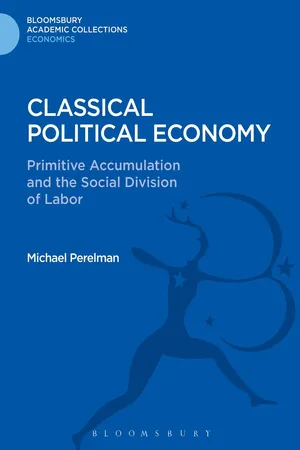
eBook - PDF
Classical Political Economy
Primitive Accumulation and the Social Division of Labor
- 285 pages
- English
- PDF
- Available on iOS & Android
eBook - PDF
About this book
Information
Table of contents
- Cover
- Contents
- Preface
- Introduction: Dark Designs
- 1 Primitive Accumulation
- 2 A Great Beginning
- 3 Sir James Steuart's Secret History of Primitive Accumulation
- 4 The Classics as Cossacks: Classical Political Economy Versus the Working Class
- 5 The Revisionist History of Professor Adam Smith
- 6 Benjamin Franklin and the Smithian Ideology of Slavery and Wage Labor
- 7 The Counterattack
- 8 Notes on Lenin and the Forging of Revolutionary Smithianism
- References
- Index
Trusted by 375,005 students
Access to over 1.5 million titles for a fair monthly price.
Study more efficiently using our study tools.
Frequently asked questions
Yes, you can cancel anytime from the Subscription tab in your account settings on the Perlego website. Your subscription will stay active until the end of your current billing period. Learn how to cancel your subscription
No, books cannot be downloaded as external files, such as PDFs, for use outside of Perlego. However, you can download books within the Perlego app for offline reading on mobile or tablet. Learn how to download books offline
Perlego offers two plans: Essential and Complete
- Essential is ideal for learners and professionals who enjoy exploring a wide range of subjects. Access the Essential Library with 800,000+ trusted titles and best-sellers across business, personal growth, and the humanities. Includes unlimited reading time and Standard Read Aloud voice.
- Complete: Perfect for advanced learners and researchers needing full, unrestricted access. Unlock 1.5M+ books across hundreds of subjects, including academic and specialized titles. The Complete Plan also includes advanced features like Premium Read Aloud and Research Assistant.
We are an online textbook subscription service, where you can get access to an entire online library for less than the price of a single book per month. With over 1.5 million books across 990+ topics, we’ve got you covered! Learn about our mission
Look out for the read-aloud symbol on your next book to see if you can listen to it. The read-aloud tool reads text aloud for you, highlighting the text as it is being read. You can pause it, speed it up and slow it down. Learn more about Read Aloud
Yes! You can use the Perlego app on both iOS and Android devices to read anytime, anywhere — even offline. Perfect for commutes or when you’re on the go.
Please note we cannot support devices running on iOS 13 and Android 7 or earlier. Learn more about using the app
Please note we cannot support devices running on iOS 13 and Android 7 or earlier. Learn more about using the app
Yes, you can access Classical Political Economy by Michael Perelman in PDF and/or ePUB format, as well as other popular books in Business & Business General. We have over 1.5 million books available in our catalogue for you to explore.