How, as historians, should we 'read' a film? Histories on Screen answers this and other questions in a crucial volume for any history student keen to master source use.
The book begins with a theoretical 'Thinking about Film' section that explores the ways in which films can be analyzed and interrogated as either primary sources, secondary sources or indeed as both. The much larger 'Using Film' segment of the book then offers engaging case studies which put this theory into practice. Topics including gender, class, race, war, propaganda, national identity and memory all receive good coverage in what is an eclectic multi-contributor volume. Documentaries, films and television from Britain and the United States are examined and there is a jargon-free emphasis on the skills and methods needed to analyze films in historical study featuring prominently throughout the text.
Histories on Screen is a vital resource for all history students as it enables them to understand film as a source and empowers them with the analytical tools needed to use that knowledge in their own work.
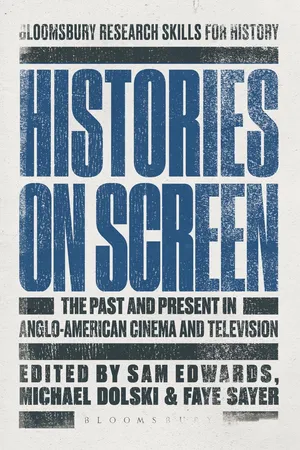
eBook - PDF
Histories on Screen
The Past and Present in Anglo-American Cinema and Television
- 353 pages
- English
- PDF
- Available on iOS & Android
eBook - PDF
Histories on Screen
The Past and Present in Anglo-American Cinema and Television
About this book
Information
Table of contents
- FC
- Half title
- Bloomsbury Research Skills for History
- Title
- Copyright
- Contents
- List of figures
- Notes on contributors
- Acknowledgements
- Introduction Sam Edwards and Amy Walling
- PART ONE Thinking about film and television
- 1 The moving image as primary source: Author, text and context Michael R. Dolski
- 2 The moving image as a secondary source: Truth, authenticity and narrative Faye Sayer
- 3 The moving image as memory: Past and present on screen Sam Edwards
- PART TWO Using film and television: Case studies
- 4 ‘The way we are’: Class and Britishness on film Marcus Morris
- 5 Were fires started? Exploring gender in British cinema of the Second World War Corinna M. Peniston-Bird
- 6 Screening multicultural Britain: Blair, Britishness and Bend It Like Beckham Sarah Ilott
- 7 Mammy, Mandingo, Django and Solomon: A century of American slavery in cinema from Uncle Tom’s Cabin to 12 Years a Slave Lydia Plath
- 8 The Empire at the movies: India in newsreels, c. 1911 to 1947 Tilman Frasch
- 9 ‘Truth’ and ‘interiority’: Screening and interpreting the early modern era Jonathan Spangler
- 10 Hollywood musicals make history Nicholas Gebhardt
- 11 ‘Moving’ images: Educational uses of D-Day imagery Michael R. Dolski
- PART THREE Making memory and identity: The politics and purpose of film and TV: Case studies
- 12 Superhero films and American national identity Michael Goodrum
- 13 ‘We will remember them’: Television and British memory of the First World War, 1964–2014 Sam Edwards
- 14 Presenting the past: New directions in television history Nicola Bishop
- Filmography
- Bibliography
- Index
Trusted by 375,005 students
Access to over 1.5 million titles for a fair monthly price.
Study more efficiently using our study tools.
Frequently asked questions
Yes, you can cancel anytime from the Subscription tab in your account settings on the Perlego website. Your subscription will stay active until the end of your current billing period. Learn how to cancel your subscription
No, books cannot be downloaded as external files, such as PDFs, for use outside of Perlego. However, you can download books within the Perlego app for offline reading on mobile or tablet. Learn how to download books offline
We are an online textbook subscription service, where you can get access to an entire online library for less than the price of a single book per month. With over 1.5 million books across 990+ topics, we’ve got you covered! Learn about our mission
Look out for the read-aloud symbol on your next book to see if you can listen to it. The read-aloud tool reads text aloud for you, highlighting the text as it is being read. You can pause it, speed it up and slow it down. Learn more about Read Aloud
Yes! You can use the Perlego app on both iOS and Android devices to read anytime, anywhere — even offline. Perfect for commutes or when you’re on the go.
Please note we cannot support devices running on iOS 13 and Android 7 or earlier. Learn more about using the app
Please note we cannot support devices running on iOS 13 and Android 7 or earlier. Learn more about using the app
Yes, you can access Histories on Screen by Sam Edwards, Faye Sayer, Michael Dolski, Sam Edwards,Faye Sayer,Michael Dolski in PDF and/or ePUB format, as well as other popular books in Histoire & Histoire de la Grande-Bretagne. We have over 1.5 million books available in our catalogue for you to explore.