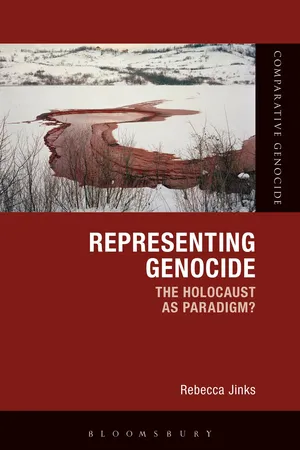
This book explores the diverse ways in which Holocaust representations have influenced and structured how other genocides are understood and represented in the West. Rebecca Jinks focuses in particular on the canonical 20th century cases of genocide: Armenia, Cambodia, Bosnia, and Rwanda. Using literature, film, photography, and memorialisation, she demonstrates that we can only understand the Holocaust's status as a 'benchmark' for other genocides if we look at the deeper, structural resonances which subtly shape many representations of genocide.
Representing Genocide pursues five thematic areas in turn: how genocides are recognised as such by western publics; the representation of the origins and perpetrators of genocide; how western witnesses represent genocide; representations of the aftermath of genocide; and western responses to genocide. Throughout, the book distinguishes between 'mainstream' and other, more nuanced and engaged, representations of genocide. It shows how these mainstream representations – the majority – largely replicate the representational framework of the Holocaust, including the way in which mainstream Holocaust representations resist recognising the rationality, instrumentality and normality of genocide, preferring instead to present it as an aberrant, exceptional event in human society. By contrast, the more engaged representations – often, but not always, originating from those who experienced genocide – tend to revolve around precisely genocide's ordinariness, and the structures and situations common to human society which contribute to and become involved in the violence.
- 281 pages
- English
- PDF
- Available on iOS & Android
eBook - PDF
About this book
Information
Table of contents
- Cover
- Contents
- List of Illustrations
- Acknowledgements
- Introduction
- 1 Recognizing genocide: the ‘genocidal imaginary’
- 2 Explaining genocide: representations of the origins and perpetrators of genocide
- 3 Witnessing genocide: western protagonists in the theatre of genocide
- 4 Resolving genocide: representations of the aftermath
- 5 Responding to genocide: attitudes and platitudes
- Conclusion
- Bibliography
- Index
Trusted by 375,005 students
Access to over 1.5 million titles for a fair monthly price.
Study more efficiently using our study tools.
Frequently asked questions
Yes, you can cancel anytime from the Subscription tab in your account settings on the Perlego website. Your subscription will stay active until the end of your current billing period. Learn how to cancel your subscription
No, books cannot be downloaded as external files, such as PDFs, for use outside of Perlego. However, you can download books within the Perlego app for offline reading on mobile or tablet. Learn how to download books offline
Perlego offers two plans: Essential and Complete
- Essential is ideal for learners and professionals who enjoy exploring a wide range of subjects. Access the Essential Library with 800,000+ trusted titles and best-sellers across business, personal growth, and the humanities. Includes unlimited reading time and Standard Read Aloud voice.
- Complete: Perfect for advanced learners and researchers needing full, unrestricted access. Unlock 1.5M+ books across hundreds of subjects, including academic and specialized titles. The Complete Plan also includes advanced features like Premium Read Aloud and Research Assistant.
We are an online textbook subscription service, where you can get access to an entire online library for less than the price of a single book per month. With over 1.5 million books across 990+ topics, we’ve got you covered! Learn about our mission
Look out for the read-aloud symbol on your next book to see if you can listen to it. The read-aloud tool reads text aloud for you, highlighting the text as it is being read. You can pause it, speed it up and slow it down. Learn more about Read Aloud
Yes! You can use the Perlego app on both iOS and Android devices to read anytime, anywhere — even offline. Perfect for commutes or when you’re on the go.
Please note we cannot support devices running on iOS 13 and Android 7 or earlier. Learn more about using the app
Please note we cannot support devices running on iOS 13 and Android 7 or earlier. Learn more about using the app
Yes, you can access Representing Genocide by Rebecca Jinks in PDF and/or ePUB format, as well as other popular books in Geschichte & Geschichte des 20. Jahrhunderts. We have over 1.5 million books available in our catalogue for you to explore.