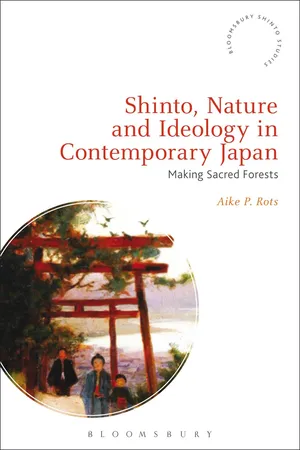
Shinto, Nature and Ideology in Contemporary Japan is the first systematic study of Shinto's environmental turn. The book traces the development in recent decades of the idea of Shinto as an 'ancient nature religion,' and a resource for overcoming environmental problems. The volume shows how these ideas gradually achieved popularity among scientists, priests, Shinto-related new religious movements and, eventually, the conservative shrine establishment.
Aike P. Rots argues that central to this development is the notion of chinju no mori: the sacred groves surrounding many Shinto shrines. Although initially used to refer to remaining areas of primary or secondary forest, today the term has come to be extended to any sort of shrine land, signifying not only historical and ecological continuity but also abstract values such as community spirit, patriotism and traditional culture.
The book shows how Shinto's environmental turn has also provided legitimacy internationally: influenced by the global discourse on religion and ecology, in recent years the Shinto establishment has actively engaged with international organizations devoted to the conservation of sacred sites. Shinto sacred forests thus carry significance locally as well as nationally and internationally, and figure prominently in attempts to reposition Shinto in the centre of public space.
- 273 pages
- English
- PDF
- Available on iOS & Android
eBook - PDF
About this book
Information

Introduction
23
on
different
levels:
locally,
it
serves
to
mobilize
community
members
around
the
shared
ecological
and
cultural
capital
of
a
particular
shrine
forest;
nationally,
it
is
employed
to
substantiate
claims
concerning
Shinto’s
public
character;
and
internationally,
it
provides
Shinto
with
new
legitimacy,
is
used
to
dissociate
it
from
its
imperial
past
and
even
draws
new
worshippers.
Indeed,
as
this
chapter
shows,
the
environmental
turn
has
contributed
to
the
popularization
of
Shinto
internationally:
for
instance,
Jinja
Honchō
has
donated
a
mikoshi
(portable
shrine)
to
the
Brooklyn
Botanic
Garden
in
New
York
and
supported
the
construction
of
a
shrine
in
San
Marino.
Other
Shinto
shrines
have
been
established
in
the
Netherlands
and
the
United
States,
and
there
are
also
online
communities
of
non-Japanese
Shinto
practitioners,
who
embrace
the
notion
of
Shinto
as
nature
spirituality.

Table of contents
- Cover
- Title
- Copyright
- Contents
- List of Figures
- Preface
- Note on Style
- Japanese Historical Periods
- Chapter 1 Introduction
- Chapter 2 Defining Shinto
- Chapter 3 Love of Nature
- Chapter 4 The Shinto Environmentalist Paradigm
- Chapter 5 Chinju no mori
- Chapter 6 Landscapes of the Past
- Chapter 7 Forests for the Future
- Chapter 8 Acorns for Tohoku
- Chapter 9 Going Green, Going Global
- Conclusion
- Notes
- References
- Index
Trusted by 375,005 students
Access to over 1.5 million titles for a fair monthly price.
Study more efficiently using our study tools.
Frequently asked questions
Yes, you can cancel anytime from the Subscription tab in your account settings on the Perlego website. Your subscription will stay active until the end of your current billing period. Learn how to cancel your subscription
No, books cannot be downloaded as external files, such as PDFs, for use outside of Perlego. However, you can download books within the Perlego app for offline reading on mobile or tablet. Learn how to download books offline
Perlego offers two plans: Essential and Complete
- Essential is ideal for learners and professionals who enjoy exploring a wide range of subjects. Access the Essential Library with 800,000+ trusted titles and best-sellers across business, personal growth, and the humanities. Includes unlimited reading time and Standard Read Aloud voice.
- Complete: Perfect for advanced learners and researchers needing full, unrestricted access. Unlock 1.5M+ books across hundreds of subjects, including academic and specialized titles. The Complete Plan also includes advanced features like Premium Read Aloud and Research Assistant.
We are an online textbook subscription service, where you can get access to an entire online library for less than the price of a single book per month. With over 1.5 million books across 990+ topics, we’ve got you covered! Learn about our mission
Look out for the read-aloud symbol on your next book to see if you can listen to it. The read-aloud tool reads text aloud for you, highlighting the text as it is being read. You can pause it, speed it up and slow it down. Learn more about Read Aloud
Yes! You can use the Perlego app on both iOS and Android devices to read anytime, anywhere — even offline. Perfect for commutes or when you’re on the go.
Please note we cannot support devices running on iOS 13 and Android 7 or earlier. Learn more about using the app
Please note we cannot support devices running on iOS 13 and Android 7 or earlier. Learn more about using the app
Yes, you can access Shinto, Nature and Ideology in Contemporary Japan by Aike P. Rots in PDF and/or ePUB format, as well as other popular books in Theology & Religion & Asian Religions. We have over 1.5 million books available in our catalogue for you to explore.