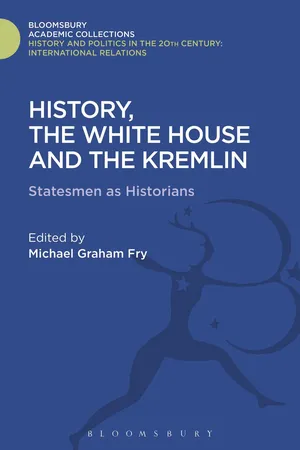
Historical knowledge in its various forms – learned, observed and experienced – is one of the principal intellectual resources available to politicians and the officials who serve them. These policy communities habitually, though sometimes naively, inexpertly and misleadingly, use history in the crafting of policy. In this book the question of whether politicians use history wisely and judiciously is posed about those who inhabit the Kremlin as well as the White House.
The question has several dimensions which are examined here in a series of original essays. Is historically based reasoning rational? How influential is historical knowledge in deliberations over policy? And does historically based reasoning lead to sound decisions about future policy? The authors range over a wide area of economic and political issues – Palestine, Soviet policy, British and United States hegemonies and comparable predicaments, United States acceptance of its international responsibilities, Soviet expansionism, the Cuban Missile Crisis, US policy towards Latin America and the historical content of President Bush Sr.'s response to Iraq's invasion of Kuwait.
- 290 pages
- English
- PDF
- Available on iOS & Android
eBook - PDF
About this book
Information
Table of contents
- Cover
- Half-title
- Title
- Copyright
- Contents
- List of contributors
- Preface
- Acknowledgements
- 1 Introduction
- 2 United States policy and the Palestine problem: historical dimensions and the creation of an 'alternative narrative'
- 3 The boundaries of rational calculation in Soviet policy towards Japan
- 4 The Cuban Missile Crisis twenty-five years later: the learning continues
- 5 The Soviet General Staff: an institution's response to change
- 6 British and American hegemony compared: lessons for the current era of decline
- 7 Being a borrower: the re-emergence of the United States as a debtor nation
- 8 The United States and inter-war money and finance: lessons for Japan's future from America's past
- 9 The politics of empire: a theory with an application to the Soviet case
- 10 The power of historical analogies: Soviet interventions in Eastern Europe and US interventions in Central America
- 11 Learning and reasoning by analogy
- 12 Conclusion
- Index
Trusted by 375,005 students
Access to over 1.5 million titles for a fair monthly price.
Study more efficiently using our study tools.
Frequently asked questions
Yes, you can cancel anytime from the Subscription tab in your account settings on the Perlego website. Your subscription will stay active until the end of your current billing period. Learn how to cancel your subscription
No, books cannot be downloaded as external files, such as PDFs, for use outside of Perlego. However, you can download books within the Perlego app for offline reading on mobile or tablet. Learn how to download books offline
Perlego offers two plans: Essential and Complete
- Essential is ideal for learners and professionals who enjoy exploring a wide range of subjects. Access the Essential Library with 800,000+ trusted titles and best-sellers across business, personal growth, and the humanities. Includes unlimited reading time and Standard Read Aloud voice.
- Complete: Perfect for advanced learners and researchers needing full, unrestricted access. Unlock 1.5M+ books across hundreds of subjects, including academic and specialized titles. The Complete Plan also includes advanced features like Premium Read Aloud and Research Assistant.
We are an online textbook subscription service, where you can get access to an entire online library for less than the price of a single book per month. With over 1.5 million books across 990+ topics, we’ve got you covered! Learn about our mission
Look out for the read-aloud symbol on your next book to see if you can listen to it. The read-aloud tool reads text aloud for you, highlighting the text as it is being read. You can pause it, speed it up and slow it down. Learn more about Read Aloud
Yes! You can use the Perlego app on both iOS and Android devices to read anytime, anywhere — even offline. Perfect for commutes or when you’re on the go.
Please note we cannot support devices running on iOS 13 and Android 7 or earlier. Learn more about using the app
Please note we cannot support devices running on iOS 13 and Android 7 or earlier. Learn more about using the app
Yes, you can access History, the White House and the Kremlin by Michael Graham Fry in PDF and/or ePUB format, as well as other popular books in Politics & International Relations & Politics. We have over 1.5 million books available in our catalogue for you to explore.