eBook - PDF
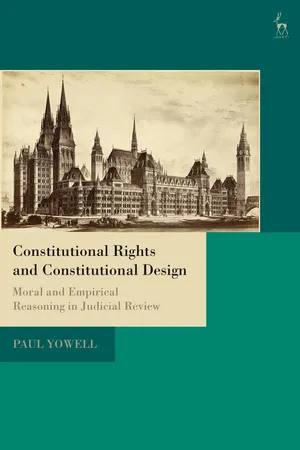
Constitutional Rights and Constitutional Design
Moral and Empirical Reasoning in Judicial Review
- 187 pages
- English
- PDF
- Available on iOS & Android
eBook - PDF
Constitutional Rights and Constitutional Design
Moral and Empirical Reasoning in Judicial Review
About this book
The decisions courts make in constitutional rights cases pervade our political life and touch on our most basic interests and values. The spread of judicial review of legislation around the world means that courts are increasingly called on to settle matters of moral and political controversy, including assisted suicide, data privacy, anti-terrorism measures, marriage, and abortion. But doubts regarding the institutional capacities of courts for deciding such questions are growing. Judges now regularly review social science research to assess whether a law will effectively achieve its aim, and at what cost to other interests. They cite studies and statistical information from psychology, sociology, medicine, and other disciplines in which they are rarely trained. This empirical reasoning proceeds alongside open-ended moral reasoning, with judges employing terms such as equality, liberty, and autonomy, then determining what these require in concrete circumstances. This book shows that courts were not designed for this kind of moral and empirical reasoning. It argues that in comparison to legislatures, the institutional capacities of courts are deficient. Legislatures are better equipped than courts for deliberating and decision-making in regard to the kinds of factual and moral issues that arise in constitutional rights cases. The book concludes by considering the implications of comparative institutional capacity for constitutional design. Is a system of judicial review of legislation something that constitutional framers should choose to adopt? If so, in what form? For countries with systems of judicial review, practical proposals are made to remedy deficiencies in the institutional capacities of courts.
Information
Table of contents
- Preface
- Contents
- 1. Introduction
- 2. The Adjudication of Constitutional Rights
- 3. Are Rights Trumps?
- 4. Judicial Capacity and Empirical Research
- 5. Comparative Analysis of Institutional Capacities
- 6. The Problem of Entrenchment
- 7. Judicial Review and Constitutional Design
- Index
Trusted by 375,005 students
Access to over 1.5 million titles for a fair monthly price.
Study more efficiently using our study tools.
Frequently asked questions
Yes, you can cancel anytime from the Subscription tab in your account settings on the Perlego website. Your subscription will stay active until the end of your current billing period. Learn how to cancel your subscription
No, books cannot be downloaded as external files, such as PDFs, for use outside of Perlego. However, you can download books within the Perlego app for offline reading on mobile or tablet. Learn how to download books offline
Perlego offers two plans: Essential and Complete
- Essential is ideal for learners and professionals who enjoy exploring a wide range of subjects. Access the Essential Library with 800,000+ trusted titles and best-sellers across business, personal growth, and the humanities. Includes unlimited reading time and Standard Read Aloud voice.
- Complete: Perfect for advanced learners and researchers needing full, unrestricted access. Unlock 1.5M+ books across hundreds of subjects, including academic and specialized titles. The Complete Plan also includes advanced features like Premium Read Aloud and Research Assistant.
We are an online textbook subscription service, where you can get access to an entire online library for less than the price of a single book per month. With over 1.5 million books across 990+ topics, we’ve got you covered! Learn about our mission
Look out for the read-aloud symbol on your next book to see if you can listen to it. The read-aloud tool reads text aloud for you, highlighting the text as it is being read. You can pause it, speed it up and slow it down. Learn more about Read Aloud
Yes! You can use the Perlego app on both iOS and Android devices to read anytime, anywhere — even offline. Perfect for commutes or when you’re on the go.
Please note we cannot support devices running on iOS 13 and Android 7 or earlier. Learn more about using the app
Please note we cannot support devices running on iOS 13 and Android 7 or earlier. Learn more about using the app
Yes, you can access Constitutional Rights and Constitutional Design by Paul Yowell in PDF and/or ePUB format, as well as other popular books in Diritto & Diritto comparato. We have over 1.5 million books available in our catalogue for you to explore.