In recent years the European Union has developed a comprehensive strategy to conclude free trade agreements which includes not only prominent trade partners such as Canada, the United States and Japan but also numerous developing countries.
This book looks at the existing WTO law and at the new EU free trade agreements with the Caribbean and sub-Saharan Africa through the lens of the human right to adequate food. It shows how the clauses on the import and export of food included in recent free trade agreements limit the capacity of these countries to implement food security policies and to respect their human rights obligations. This outcome appears to be at odds with international human rights law and dismissive of existing human rights references in EU-founding treaties as well as in treaties between the EU and developing states.
Yet, the book argues against the conception in human rights literature that there is an inflexible agenda encoded in world trade law which is fundamentally conflictual with non-economic interests. The book puts forward the idea that the European Union is perfectly placed to develop a narrative of globalisation considering other areas of public international law when negotiating trade agreements and argues that the EU does have the competences and influence to uphold a role of international leadership in designing a sustainable global trading system. Will the EU be ambitious enough?
A timely contribution to the growing academic literature on the relation between world trade law and international human rights law, this book imagines a central role for the EU in reconciling these two areas of international law.
eBook - PDF
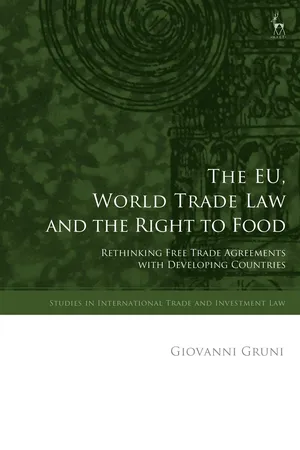
The EU, World Trade Law and the Right to Food
Rethinking Free Trade Agreements with Developing Countries
- 219 pages
- English
- PDF
- Available on iOS & Android
eBook - PDF
The EU, World Trade Law and the Right to Food
Rethinking Free Trade Agreements with Developing Countries
About this book
Information
Table of contents
- Acknowledgements
- Contents
- Table of Abbreviations
- 1. Introduction
- 2. The Right to Food in International Law
- 3. Realising the Right to Food in the Global Food Market
- 4. The EU External Trade Policy and the EU External Food Security Policy
- 5. The Right to Food in the WTO
- 6. The EU-CARIFORUM Economic Partnership Agreement
- 7. The Economic Partnership Agreements between the EU and Sub-Saharan Africa
- 8. Conclusions
- Bibliography
- Index
Trusted by 375,005 students
Access to over 1.5 million titles for a fair monthly price.
Study more efficiently using our study tools.
Frequently asked questions
Yes, you can cancel anytime from the Subscription tab in your account settings on the Perlego website. Your subscription will stay active until the end of your current billing period. Learn how to cancel your subscription
No, books cannot be downloaded as external files, such as PDFs, for use outside of Perlego. However, you can download books within the Perlego app for offline reading on mobile or tablet. Learn how to download books offline
Perlego offers two plans: Essential and Complete
- Essential is ideal for learners and professionals who enjoy exploring a wide range of subjects. Access the Essential Library with 800,000+ trusted titles and best-sellers across business, personal growth, and the humanities. Includes unlimited reading time and Standard Read Aloud voice.
- Complete: Perfect for advanced learners and researchers needing full, unrestricted access. Unlock 1.5M+ books across hundreds of subjects, including academic and specialized titles. The Complete Plan also includes advanced features like Premium Read Aloud and Research Assistant.
We are an online textbook subscription service, where you can get access to an entire online library for less than the price of a single book per month. With over 1.5 million books across 990+ topics, we’ve got you covered! Learn about our mission
Look out for the read-aloud symbol on your next book to see if you can listen to it. The read-aloud tool reads text aloud for you, highlighting the text as it is being read. You can pause it, speed it up and slow it down. Learn more about Read Aloud
Yes! You can use the Perlego app on both iOS and Android devices to read anytime, anywhere — even offline. Perfect for commutes or when you’re on the go.
Please note we cannot support devices running on iOS 13 and Android 7 or earlier. Learn more about using the app
Please note we cannot support devices running on iOS 13 and Android 7 or earlier. Learn more about using the app
Yes, you can access The EU, World Trade Law and the Right to Food by Giovanni Gruni in PDF and/or ePUB format, as well as other popular books in Law & International Law. We have over 1.5 million books available in our catalogue for you to explore.