The Cambridge Yearbook of European Legal Studies provides a forum for the scrutiny of significant issues in EU Law, the law of the European Convention on Human Rights, and Comparative Law with a 'European' dimension, and particularly those issues which have come to the fore during the year preceding publication. The contributions appearing in the collection are commissioned by the Centre for European Legal Studies (CELS) Cambridge, a research centre in the Law Faculty of the University of Cambridge specialising in European legal issues.
The papers presented are at the cutting edge of the fields which they address, and reflect the views of recognised experts drawn from the University world, legal practice, and the institutions of both the EU and its Member States. Inclusion of the comparative dimension brings a fresh perspective to the study of European law, and highlights the effects of globalisation of the law more generally, and the resulting cross fertilisation of norms and ideas that has occurred among previously sovereign and separate legal orders.
The Cambridge Yearbook of European Legal Studies is an invaluable resource for those wishing to keep pace with legal developments in the fast moving world of European integration.
INDIVIDUAL CHAPTERS
Please click on the link below to purchase individual chapters from Volume 14 through Ingenta Connect:
www.ingentaconnect.com
SUBSCRIPTION TO SERIES
To place an annual online subscription or a print standing order through Hart Publishing please click on the link below. Please note that any customers who have a standing order for the printed volumes will now be entitled to free online access.
www.hartjournals.co.uk/cyels/subs
Editorial Advisory Board: Albertina Albors-Llorens, John Bell, Alan Dashwood, Simon Deakin, David Feldman, Richard Fentiman, Angus Johnston, John Spencer
Founding Editors: Alan Dashwood and Angela Ward
eBook - PDF
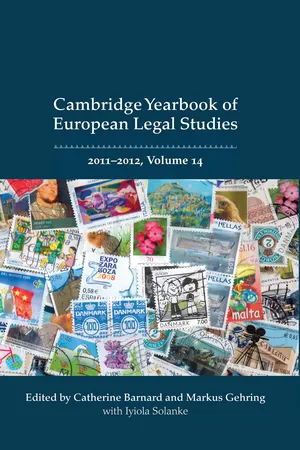
Cambridge Yearbook of European Legal Studies, Vol 14 2011-2012
- 832 pages
- English
- PDF
- Available on iOS & Android
eBook - PDF
Cambridge Yearbook of European Legal Studies, Vol 14 2011-2012
About this book
Information
Table of contents
- Cover
- Prelims
- Preface
- Contents
- List of Contributors
- Table of Cases
- Table of Legislation
- 1. The Purpose of the EU Procurement Directives: Ends, Means and the Implications for National Regulatory Space for Commercial and Horizontal Procurement Policies
- 2. How Regulatory Networks Shaped Institutional Reform under the EU Telecoms Framework
- 3. Perfectionism in European Law
- 4. From Fiscal Compact to Fiscal Union? New Rules for the Eurozone
- 5. A 'Minefield of Misreckonings': Europe's Constitutional Pluralism
- 6. The Court of Justice as a Labour Court
- 7. Protection Against Acts Harmful to Human Health and the Environment Adopted by the EU Institutions
- 8. Paths for Constitutional Thinking 'Beyond the State'?
- 9. The Euro Area Crisis and Constitutional Limits to Fiscal Integration
- 10. The Fight against Terrorism, Fundamental Rights and the EU Courts: The Unsolved Conundrum
- 11. Behavioural Economics and the Autonomous Consumer
- 12. The European Union as a Source of Inspiration
- 13. European Fundamental Rights and the Member States: From 'Selective' to 'Total' Incorporation?
- 14. Who's Afraid of the Big, Bad European Public Prosecutor?
- 15. Allowing the Right Margin: The European Court of Human Rights and The National Margin of Appreciation Doctrine: Waiver or Subsidiarity of European Review?
- 16. 'Posting' and 'Posted Workers': The Need for Clear Definitions of Two Key Concepts of the Posting of Workers Directive
- 17. An Illusion of Protection and an Assumption of Responsibility: The Possibility of Swedish State Liability after Laval
- 18. Up in the Air: Aviation, the EU Emissions Trading Scheme and the Question of Jurisdiction
- The Advocate General. Securing Trust and Democracy in the EU Judicial Order
- 19. Securing Trust in the Court of Justice of the EU: The Influence of the Advocates General
- 20. A Fourth in the Court: Why Are There Advocates General in the Court of Justice?
- 21. The Advocate General: Bringing Clarity to CJEU Decisions? A Case-Study of Mangold and Kucukdecevi
- 22. The Advocate General: A Key Actor of the Court of Justice of the European Union
- 23. Social Legitimacy and the Court of Justice of the EU: Some Reflections on the Role of the Advocate General
- 24. Advocates General and Grand Chamber Cases: Assistant with the Touch of Substitution
- 25. The Notion of Consensus as a Route to Democratic Adjudication?
- 26. The Advocate General: Assisting the CJEU of Article 13 TEU to Secure Trust and Democracy
- 27. Advocate Generals' Opinions or Separate Opinions? Judicial Engagement in the CJEU
- Index
Trusted by 375,005 students
Access to over 1.5 million titles for a fair monthly price.
Study more efficiently using our study tools.
Frequently asked questions
Yes, you can cancel anytime from the Subscription tab in your account settings on the Perlego website. Your subscription will stay active until the end of your current billing period. Learn how to cancel your subscription
No, books cannot be downloaded as external files, such as PDFs, for use outside of Perlego. However, you can download books within the Perlego app for offline reading on mobile or tablet. Learn how to download books offline
Perlego offers two plans: Essential and Complete
- Essential is ideal for learners and professionals who enjoy exploring a wide range of subjects. Access the Essential Library with 800,000+ trusted titles and best-sellers across business, personal growth, and the humanities. Includes unlimited reading time and Standard Read Aloud voice.
- Complete: Perfect for advanced learners and researchers needing full, unrestricted access. Unlock 1.5M+ books across hundreds of subjects, including academic and specialized titles. The Complete Plan also includes advanced features like Premium Read Aloud and Research Assistant.
We are an online textbook subscription service, where you can get access to an entire online library for less than the price of a single book per month. With over 1.5 million books across 990+ topics, we’ve got you covered! Learn about our mission
Look out for the read-aloud symbol on your next book to see if you can listen to it. The read-aloud tool reads text aloud for you, highlighting the text as it is being read. You can pause it, speed it up and slow it down. Learn more about Read Aloud
Yes! You can use the Perlego app on both iOS and Android devices to read anytime, anywhere — even offline. Perfect for commutes or when you’re on the go.
Please note we cannot support devices running on iOS 13 and Android 7 or earlier. Learn more about using the app
Please note we cannot support devices running on iOS 13 and Android 7 or earlier. Learn more about using the app
Yes, you can access Cambridge Yearbook of European Legal Studies, Vol 14 2011-2012 by Catherine Barnard, Markus Gehring, Catherine Barnard,Markus Gehring in PDF and/or ePUB format, as well as other popular books in Droit & Droit international. We have over 1.5 million books available in our catalogue for you to explore.