The purpose of this book is to find a unified approach to the doctrine of mens rea in the sphere of international criminal law, based on an in-depth comparative analysis of different legal systems and the jurisprudence of international criminal tribunals since Nuremberg. Part I examines the concept of mens rea in common and continental legal systems, as well as its counterpart in Islamic Shari'a law. Part II looks at the jurisprudence of the post-Second World War trials, the work of the International Law Commission and the concept of genocidal intent in light of the travaux préparatoires of the 1948 Genocide Convention. Further chapters are devoted to a discussion of the boundaries of mens rea in the jurisprudence of the International Criminal Tribunals for the former Yugoslavia and Rwanda. The final chapter examines the definition of the mental element as provided for in Article 30 of the Statute of the International Criminal Court in light of the recent decisions delivered by the International Criminal Court.
The study also examines the general principles that underlie the various approaches to the mental elements of crimes as well as the subjective element required in perpetration and participation in crimes and the interrelation between mistake of law and mistake of fact with the subjective element.
With a Foreword by Professor William Schabas and an Epilogue by Professor Roger Clark
From the Foreword by William Schabas
Mohamed Elewa Badar has taken this complex landscape of mens rea at the international level and prepared a thorough, well-structured monograph. This book is destined to become an indispensable tool for lawyers and judges at the international tribunals.
From the Epilogue by Professor Roger Clark
This is the most comprehensive effort I have encountered pulling together across legal systems the 'general part' themes, especially about the 'mental element', found in confusing array in the common law, the civil law and Islamic law. In this endeavour, Dr Badar's researches have much to offer us.
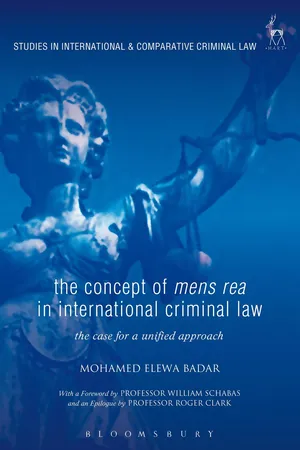
eBook - PDF
The Concept of Mens Rea in International Criminal Law
The Case for a Unified Approach
- 540 pages
- English
- PDF
- Available on iOS & Android
eBook - PDF
The Concept of Mens Rea in International Criminal Law
The Case for a Unified Approach
About this book
Information
Table of contents
- Cover
- Prelims
- Foreword
- Preface
- Contents
- Table of Cases
- 1. Introduction
- 2. From Vengeance to Mens Rea to Mentes Reae
- 3. Mens Rea in the Common Law of England and Wales, Australia and Canada
- 4. Mens Rea in the American Law Institute's Model Penal Code
- 5. Mens Rea in German and French Criminal Law
- 7. Mens Rea in Islamic Criminal Law
- 8. Mens Rea in post-World War II Trials, the Travaux Preparatoire of the Genocide Convention and the Work of the International Law Commission
- 9. Mens Rea of Crimes in the Jurisprudence of the Former Yugoslavia and Rwanda
- 10. The Mens Rea of Perpetration and Participation in the Jurisprudence of the ICTY and ICTR
- 11. Mens Rea in the Jurisprudence of the International Criminal Court
- 12. General Conclusions and Recommendations
- Epilogue
- Bibliography
- Reports and Consultation Papers (England and Other Common Law Systems)
- Index
Trusted by 375,005 students
Access to over 1.5 million titles for a fair monthly price.
Study more efficiently using our study tools.
Frequently asked questions
Yes, you can cancel anytime from the Subscription tab in your account settings on the Perlego website. Your subscription will stay active until the end of your current billing period. Learn how to cancel your subscription
No, books cannot be downloaded as external files, such as PDFs, for use outside of Perlego. However, you can download books within the Perlego app for offline reading on mobile or tablet. Learn how to download books offline
Perlego offers two plans: Essential and Complete
- Essential is ideal for learners and professionals who enjoy exploring a wide range of subjects. Access the Essential Library with 800,000+ trusted titles and best-sellers across business, personal growth, and the humanities. Includes unlimited reading time and Standard Read Aloud voice.
- Complete: Perfect for advanced learners and researchers needing full, unrestricted access. Unlock 1.5M+ books across hundreds of subjects, including academic and specialized titles. The Complete Plan also includes advanced features like Premium Read Aloud and Research Assistant.
We are an online textbook subscription service, where you can get access to an entire online library for less than the price of a single book per month. With over 1.5 million books across 990+ topics, we’ve got you covered! Learn about our mission
Look out for the read-aloud symbol on your next book to see if you can listen to it. The read-aloud tool reads text aloud for you, highlighting the text as it is being read. You can pause it, speed it up and slow it down. Learn more about Read Aloud
Yes! You can use the Perlego app on both iOS and Android devices to read anytime, anywhere — even offline. Perfect for commutes or when you’re on the go.
Please note we cannot support devices running on iOS 13 and Android 7 or earlier. Learn more about using the app
Please note we cannot support devices running on iOS 13 and Android 7 or earlier. Learn more about using the app
Yes, you can access The Concept of Mens Rea in International Criminal Law by Mohamed Elewa Badar in PDF and/or ePUB format, as well as other popular books in Law & Criminal Law. We have over 1.5 million books available in our catalogue for you to explore.